Below, you will discover our COMPLETE listing of Eastern Florida cruising news/postings from fellow cruisers, arranged in chronological order, based on publication date. IF YOU WOULD LIKE TO NARROW YOUR SELECTION of EF cruising news to those messages which pertain to a specific geographic sub-region, locate the RED, vertically stacked menu, on the right side of this, and all Cruisers’ Net pages. Click on “Eastern Florida.” A drop down menu will appear, with a blue background, Now, click on “EF Regional Cruising News.” A sub-drop-down menu will now appear, listing 12 Eastern Florida geographic sub-regions. Select your waters of interest, and after clicking on your choice, a list of messages will appear, confined to the sub-region you have picked!
*** THIS DIV IS AUTOMATICALLY HIDDEN WHEN DISPLAYED – INFO FOR DEBUGGING PURPOSES *** ***MANUALLY DO: FIX TITLE, EXPIRE DATE, CATEGORIES, ENABLE SOCIAL POST *** 0: llnr: 47700 District: 07 lat/lon: 25.943891,-80.128643 Desc: Dumfoundling Bay Daybeacon 50
SAFETY/INTRACOASTAL WATERWAY (FLORIDA) – SEVENTH DISTRICT WEST PALM BEACH TO MIAMI (CHART 11467) HILLSBORO INLET – BISCAYNE CREEK/ATON/SEC MIA BNM 0109-25
1. DUMFOUNDLING BAY DAYBEACON 50 (LLNR 47700) IS REPORTED DESTROYED. 2. ALL MARINERS ARE REQUESTED TO TRANSIT AREA WITH CAUTION. CANCEL AT//312100Z JUL 25//
BT
This email was sent to curtis.hoff@CruisersNet.net using GovDelivery Communications Cloud on behalf of: U.S. Coast Guard · U.S. Department of Homeland Security · Washington, DC 20528 · 800-439-1420
Anchorage limitations continue to be considered/expanded in various important Florida cruising areas. St. Lucie County is considering establishing two areas and conducting a public hearing on July 22 at 9am.
The Board of County Commissioners of St. Lucie County, Florida, announces a public meeting to which all persons are invited.
DATE AND TIME: July 22, 2025, at 9 a.m. or as soon thereafter as possible to receive all testimony and evidence to consider and act upon the adoption of proposed Ordinance 2025-012.
PLACE: County Commissioner Chambers of Roger Poitras Administration Annex located at 2300 Virginia Ave., Fort Pierce, FL 34982 (3rd Floor).
GENERAL SUBJECT MATTER TO BE CONSIDERED: The Board of County Commissioners of St. Lucie County, FL is conducting a public hearing to introduce an ordinance to establish two (2) Anchoring Limitation Areas in St. Lucie County and amendments to Chapter 50-Waterways of the St. Lucie Code.
Pursuant to the provisions of the Americans with Disabilities Act, any person requiring special accommodations to participate in this meeting is asked to advise the County at least 48 hours before the meeting by contacting: St. Lucie County Human Resources Department:
This email was sent to Curtis.Hoff@CruisersNet.net using GovDelivery Communications Cloud on behalf of: Florida Fish & Wildlife Conservation Commission · 620 S. Meridian Street · Tallahassee, FL 32399-1600 · (850) 488-4676
*** THIS DIV IS AUTOMATICALLY HIDDEN WHEN DISPLAYED – INFO FOR DEBUGGING PURPOSES *** ***MANUALLY DO: FIX TITLE, EXPIRE DATE, CATEGORIES, ENABLE SOCIAL POST *** 0: llnr: 38220 District: 07 lat/lon: 30.481851,-81.457694 Desc: Gunnison Cut Daybeacon 59
SAFETY/FERNANDINA BEACH – ST. JOHNS RIVER – GUNNISON CUT/ATON/SEC JAX BNM 0108-25
1. GUNNISON CUT DAYBEACON 59 (LLNR 38220) IS REPORTED DESTROYED. 2. ALL MARINERS ARE ADVISED TO TRANSIT THE AREA WITH CAUTION. CANCEL AT//221613Z JUL 25//
BT
This email was sent to curtis.hoff@CruisersNet.net using GovDelivery Communications Cloud on behalf of: U.S. Coast Guard · U.S. Department of Homeland Security · Washington, DC 20528 · 800-439-1420
*** THIS DIV IS AUTOMATICALLY HIDDEN WHEN DISPLAYED – INFO FOR DEBUGGING PURPOSES *** ***MANUALLY DO: FIX TITLE, EXPIRE DATE, CATEGORIES, ENABLE SOCIAL POST *** 0: llnr: 37986 District: 07 lat/lon: 30.662933,-81.484889 Desc: Fernandina Beach Daybeacon 1A
1. FERNANDINA BEACH DAYBEACON 1A (LLNR 37986) IS REPORTED DESTROYED. 2. ALL MARINERS ARE ADVISED TO TRANSIT THE AREA WITH CAUTION. CANCEL AT//181956Z JUL 25//
BT
This email was sent to curtis.hoff@CruisersNet.net using GovDelivery Communications Cloud on behalf of: U.S. Coast Guard · U.S. Department of Homeland Security · Washington, DC 20528 · 800-439-1420
*** THIS DIV IS AUTOMATICALLY HIDDEN WHEN DISPLAYED – INFO FOR DEBUGGING PURPOSES *** ***MANUALLY DO: FIX TITLE, EXPIRE DATE, CATEGORIES, ENABLE SOCIAL POST ***
SAFETY/MATANZAS RIVER/ATON/SEC JAX BNM 0105-25
1. MATANZAS RIVER WRECK BUOY HAS BEEN TEMPORARILY ESTABLISHED IN POSN: 29-53-41.220N, 081-18-24.780W. 2. THIS AID IS ESTABLISHED ON THE MATANZAS RIVER TO MARK A SUNKEN SAILBOAT. 3. ALL MARINERS ARE ADVISED TO TRANSIT THE AREA WITH CAUTION. CANCEL AT//181408Z JUL 25//
BT
This email was sent to curtis.hoff@CruisersNet.net using GovDelivery Communications Cloud on behalf of: U.S. Coast Guard · U.S. Department of Homeland Security · Washington, DC 20528 · 800-439-1420
I found this article to be fascinating since I have entered many of these inlets while cruising up and down the East Coast. It is interesting to read about the rich history of many of them.
Cruisers Net publishes Loose Cannon articles with Captain Swanson’s permission in hopes that mariners with salt water in their veins will subscribe. $7 a month or $56 for the year, and you may cancel at any time.
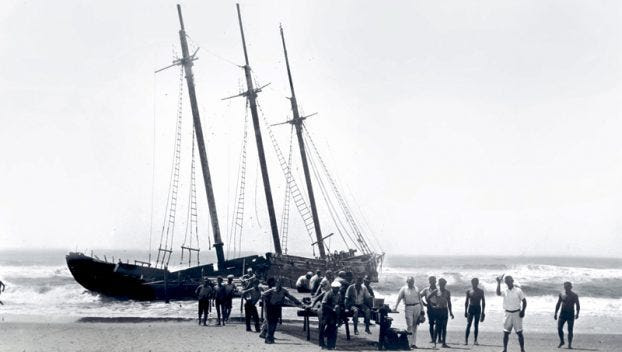
Ocracoke Island villagers salvage lumber from the shattered hull of the schooner Nomis in the summer of 1935. Nomis was carrying 338,000 feet of lumber from Georgetown, South Carolina, to New York City.
Okay, its Fourth of July weekend, so the theme of this Loose Cannon installment is light and playful: Trivia related to various inlets along the Atlantic Coast from Virginia to the Florida border. I was digging for something in my archives, and I found historical summaries written over a decade ago but never published.
Not all inlets are mentioned, and Charleston is omitted altogether because of its historic significance defies pithy summarization. And please do not assume that just because an inlet is included it is recommended for navigation.
Enjoy.
Virginia
Rudee
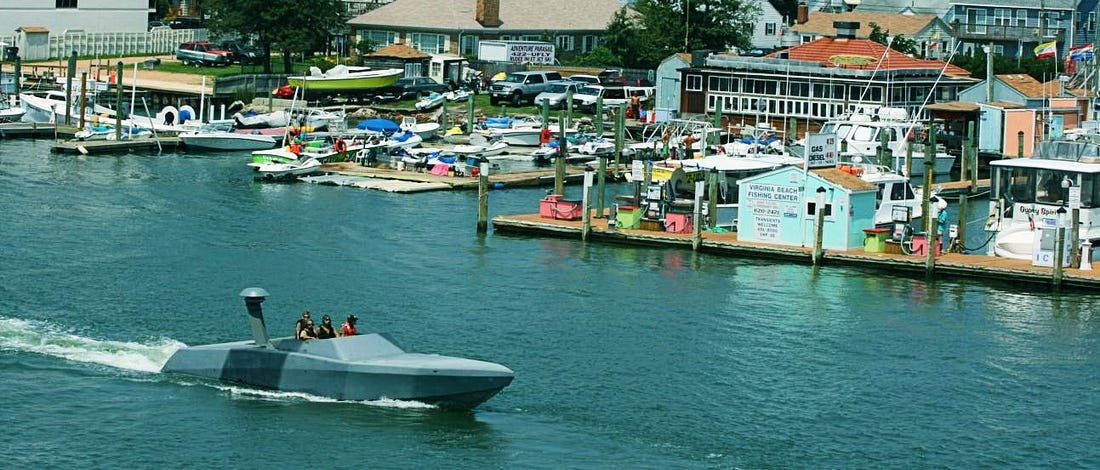
What is now Rudee Inlet began as a manmade drainage culvert. In 1968, the state created the current inlet, part of a $1 million plan to attract boaters. Now regular dredging is part of a cycle of a system to replenishment sand on the beaches of Virginia Beach. You can often see East Coast Navy SEAL teams launching boats for training exercises here.
Navy SEAL stealth boat goes for a spin at Rudee Inlet, Virginia Beach.
North Carolina
Oregon
In 1873 Congress approved and appropriated funds for the building of 29 lifesaving stations, one of which was the Bodie Island Station, located on the south side of Oregon Inlet. In 1883, the station on the north side of Oregon Inlet (also known as Tommy’s Hummock) was officially named the Bodie Island Station and the “old” Bodie Island Station (south of the inlet) was renamed as the Oregon Inlet Station. These are the antecedents to the current Coast Guard Station on Bodie.
Hatteras
The first Hatteras Inlet was formed south of the current inlet, but closed around 1764. The modern Hatteras Inlet was formed on September 7, 1846 by a violent gale. This was the same storm that opened present-day Oregon Inlet to the north. This became a profitable inlet, because it gave the Inner Banks, a quicker and easier way to travel to and from the Gulf Stream. It was easier to come into this inlet from the north.
Because of the increase of commerce, Hatteras Village Post Office was established in 1858. The initial invasion of the North Carolina coast, on Hatteras Island, during the Civil War called Battle of Hatteras Inlet Batteries came from Hatteras Inlet. The two Confederate forts guarding the inlet quickly fell. The Graveyard of the Atlantic Museum is also located here. Need we say more?
Ocracoke
The residents of this area have stoutly resisted modernization and change and a visit here is very much a trip back to the way it used to be. Ocracoke is part of the area known as the Graveyard of the Atlantic, due to the many shipwrecks over the centuries—more than 600, according to some sources.
Home to whalers and Spanish privateers in the 18th century, Cape Lookout Bight is the location of the distinctively diamond patterned Cape Lookout Lighthouse. The wreck of the schooner Chrissie Wright occurred here on Lookout Shoals, where the entire crew but the cook perished in view of shore, rescuers unable to reach them until the next day due to the large breakers.
Beaufort
Pirate Edward Teach, popularly known as Blackbeard, lost his ship Queen Ann’s Revenge in 1718 after running aground at Beaufort Inlet. There is a fascinating multimedia display at the Beaufort Maritime Museum on his story, and the continuing excavation of his vessel. Blackbeard was later killed by naval forces off Ocracoke, but his head came home through Beaufort inlet, hanging on the bowsprit of the ship which captured him.
Mason
In March 2002, Mason inlet was cut through at a location about 3,500 feet northeast of what was then Mason Inlet. A week after the successful opening of the new inlet, the old Mason Inlet was closed. This engineering work, sponsored by local interests, was in response to the southward migration of Mason Inlet over the years to the point were it was threatening to undermine the Shell Island Resort and community to the south.
Masonboro
In November 1862, Union warships forced blockade running British schooner F.W. Pindar aground at the inlet, and sent a boat crew to destroy the vessel. The boat swamped and the crew was captured after successfully firing the schooner. In the same month, the Union Navy ran the British bark Sophia aground and destroyed her near the inlet as well.
Carolina Beach
Shoaling closed the original inlet in the early 1900s. It was blasted open again with explosives in 1952. In 2007, $1.2 million in federal funds were allocated for dredging Carolina Beach Inlet.
Cape Fear River
Cape Fear’s moniker comes from the fearsome Frying Pan Shoals offshore. This area marks the southern border of the Graveyard of the Atlantic. Bald Head Lighthouse, long known as “Old Baldy,” was North Carolina’s first lighthouse, dating back to 1796. Legendary 19th century singlehander Joshua Slocum came ashore in this region while returning from South America in a small vessel he built and wrote about in his book “Voyage of the Liberdade.”
Lockwood’s Folly
Lockwoods Folly Inlet was the scene of several Civil War confrontations. In an area noted as the Cape Fear Civil War Shipwreck District (shown here from a U.S. Army Corps survey chart), which crosses the inlet itself, are found the wrecks of Lisa Marie, Elizabeth, Iron Age and Bendigo. The name ‘Lockwood’s Folly’ came about when a certain Mr. Lockwood built himself a boat, which happened to have draft too great to transit the inlet. Some things haven’t changed.
Shallotte
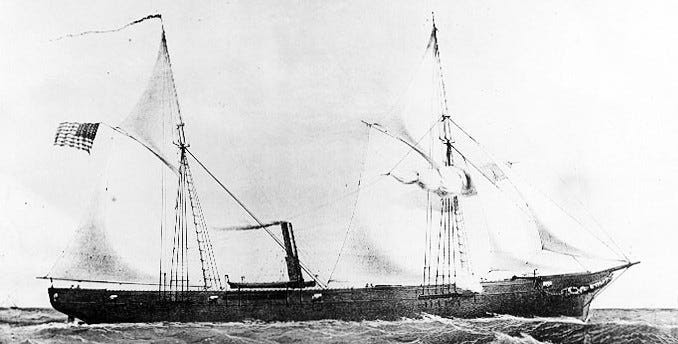
The entire coastal area was a hotspot of activity during the Civil War. The Union gunship Penobscot, at 158 feet and 10-foot 6-inch draft, destroyed her first Confederate vessel, the schooner Sereta, which went aground and was abandoned off Shallotte Inlet in June 1862. In November, the Penobscot forced the British ship Pathfinder aground at Shallotte Inlet, then destroyed her. Penobscot was known as the “90-day gunship” for the length of time it took to build her.
A “90-day-gunship,” sister ship to the USS Penobscot.
South Carolina
Little River Inlet
Because of the marshes surrounding Little River, the area received little land traffic until roads were built in the 1920s. Along with the safety afforded by the harbor, it thus became somewhat of a haven for pirates and smugglers. Following the arrival of some ‘northerners’ after the War of 1812, the town was known as “Yankee Town,” certainly not a name fondly accepted by those born there.
Murrells Inlet
Close by Murrells Inlet lies Drunken Jack Island—and Drunken Jack. Legend has it that a pirate was accidentally marooned with nothing but a supply of rum. When the ship finally returned, all they found were empty bottles of rum, and the bones of poor Jack. The island is also another of those reputed to contain Blackbeard’s treasure.
Winyah Bay
The first Europeans to settle the banks of Winyah Bay were actually the Spanish, but after failing as farmers, they built a ship from the towering cypress and oak trees lining the swamps, and sailed off to the Spice Islands of the Caribbean, where there was a ready market for their slaves.
Stono River
Union naval forces controlled the Stono River during the Civil War, but got their comeuppance when a Confedate artillery unit set up on the banks by cover of darkness, bombarded a Union warship and forced her officers to row ashore to surrender.
North Edisto River
The North Edisto River inlet was often used as a back door for Union vessels to attack Charleston, as any vessel proceeding through the Charleston inlet was a sitting duck, unable to return fire with while inbound with Fort Moultrie forward of the alignment of her guns.
St. Helena Sound
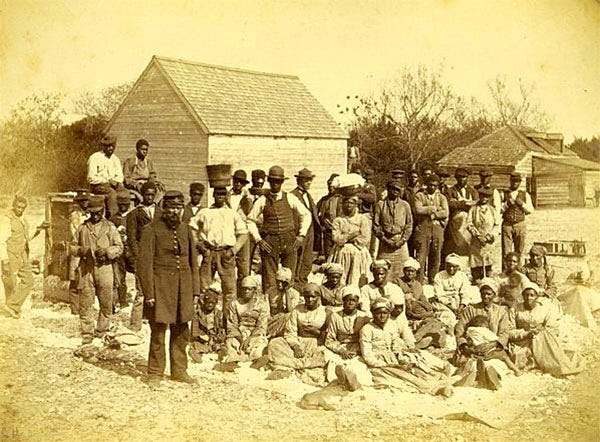
St. Helena Island is considered the center of African American Gullah culture and is also the site of several forts which have been extensively excavated. During the Civil War, Fort Walker fell early, leading to the capture of Port Royal. The slaves were freed and measures, including land grants, were undertaken to assist them. Black history is such a powerful force in this area that those supporting the Gullah culture have been able to prevent the building of condos and gated communities on St. Helena Island.
Portrait of a Gullah community after the Civil War.
New River Entrance
Camp Lejeune is located nearby and one will often see Marines on exercises. Kids will be thrilled as they roar by in their inflatable vessels, complete with weaponry, or operating tanks on the east side of the ICW or artillery towed behind trucks. Skippers knowing that this gear constitutes targets for shooting exercises may be a little less sanguine about them.
Port Royal Sound
Most mariners are aware that the Parris Island Marine Corps base is here. What most won’t know is that Cat Island, at the anchorage at Mile 544, was at one time a nudist colony. Hilton Head Island was at one time a prominent outpost of the Gullah community. (The nudist colony closed prior to World War II in case you were wondering!)
Calibogue Sound
This entire area was fought over by the Spanish, French and British for years, and the coast was a favorite hunting ground for pirates, including Blackbeard. The area is noted for its Gullah heritage. Today, most of the coast is a major resort region, with golf on Hilton Head Island. being one of the biggest draws. The red-striped replica lighthouse at Harbortown Yacht Basin is one of the most photographed sights on the Waterway.
Georgia
Savannah River
This entire area was fought over by the Spanish, French and British for years, and the coast was a favorite hunting ground for pirates, including Blackbeard. The area is noted for its Gullah heritage. Colonial Savannah, an early “planned city” (by Gen. James Oglethorpe), is regarded as one of the most beautiful in the United States.
Wassaw Sound
Thunderbolt was supposedly named after a lighting bolt struck there, creating a spring and giving native Americans a reason to settle there.
Ossaba Sound
Archeological evidence indicates Ossabaw Island has been inhabited for 4,000 years. During the last century it was a hunting retreat and then, a privately held scholarly and artistic retreat. When the owners could no longer subsidize the cost, they sold the island to the state of Georgia, thus preserving its natural beauty for the enjoyment of future generations.
St. Catherines Sound
A Spanish fort dating from 1566 was built on St. Catherines Island, which General Sherman awarded to freed slaves after the Civil war along with Ossabaw and Sapelo islands. This state of affairs lasted for two years, after which the island was returned to its former owner, and the new residents relocated to the Georgia mainland. An 1893 hurricane covered the entire island in water. Only one person survived.
Sapelo Sound
Sapelo Island’s ownership makes for a fascinating story. Fleeing revolution at home, a syndicate of French nobles purchased it in 1790, followed by a Danish sea captain, then a planter who was the only one who ever managed to make a profit from the island’s soil. In the 20th century, an excutive of the Hudson Motorcar Company, took possession, but the Crash of ’29 forced him to sell to R.J. Reynolds of tobacco fame. In 1969, Reynold’s widow donated part of it to the state of Georgia for a wildlife refuge. Now the entire island has protected status under government ownership.
An old Coast Guard photo of the Sapelo Island lighthouse.
Doboy Sound
Cruisers using this inlet may well notice mounds of large rocks not native to the area, particularly on Commodore Island. These are ballast stones from tallships which used these waters in past centuries, tossed overboard to lighten them so they could navigate the shallower waters upstream with their cargoes.
St. Simons Sound
Originally built in 1808, St. Simons lighthouse was torn down by Confederate forces in 1862 and replaced in 1872. In 1953, the oil lamps were replaced by a Fresnel lens and the 106 foot structure can be climbed. The view is worth the effort.
St. Andrews Sound
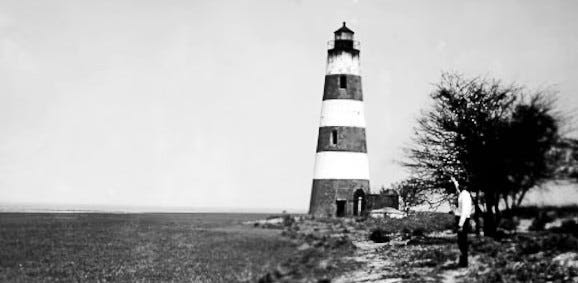
The lighthouse on Little Cumberland Island operated from 1838 until its deactivation in 1915. The keeper’s house was destroyed by fire in 1968.
St. Mary’s Inlet
Fernandina Beach on the Florida side was founded by Union soldiers, who returned there after having occupied Amelia Island during the war; they were drawn to the area’s climate and natural beauty. That may explain why the city’s downtown resembles a 19th Century New England town.
LOOSE CANNON is a reader-supported publication. To receive new posts and support the work, consider becoming a free or paid subscriber.
Anchorage limitations continue to be considered/expanded in various important Florida cruising areas. St. Lucie County is considering establishing two areas and conducting a public hearing on July 22 at 9am.
The Board of County Commissioners of St. Lucie County, Florida, announces a public meeting to which all persons are invited.
DATE AND TIME: July 22, 2025, at 9 a.m. or as soon thereafter as possible to receive all testimony and evidence to consider and act upon the adoption of proposed Ordinance 2025-012.
PLACE: County Commissioner Chambers of Roger Poitras Administration Annex located at 2300 Virginia Ave., Fort Pierce, FL 34982 (3rd Floor).
GENERAL SUBJECT MATTER TO BE CONSIDERED: The Board of County Commissioners of St. Lucie County, FL is conducting a public hearing to introduce an ordinance to establish two (2) Anchoring Limitation Areas in St. Lucie County and amendments to Chapter 50-Waterways of the St. Lucie Code.
Pursuant to the provisions of the Americans with Disabilities Act, any person requiring special accommodations to participate in this meeting is asked to advise the County at least 48 hours before the meeting by contacting: St. Lucie County Human Resources Department:
This email was sent to Curtis.Hoff@CruisersNet.net using GovDelivery Communications Cloud on behalf of: Florida Fish & Wildlife Conservation Commission · 620 S. Meridian Street · Tallahassee, FL 32399-1600 · (850) 488-4676
Notice is given that the U.S. Army Corps of Engineers (USACE) is advising commercial and recreational vessels to check lake and canal levels daily when making navigation decisions. USACE is conducting RECOVERY operations, which involve the lowering of Lake Okeechobee to allow for growth of submerged aquatic vegetation (SAV) and for the overall health of the lake. This is causing lake levels to be lower than typical. Additionally, the Corps may hold the upper pool of the C-43 canal, between the Julian Keen Jr. Lock and Dam (S-77) and Ortona Lock and Dam (S-78) below its optimal level.
Cruisers Net publishes Loose Cannon articles with Captain Swanson’s permission in hopes mariners with salt water in their veins will subscribe.. $7 a month or $56 for the year and you may cancel at anytime.
There was a subsequent correction published to this post:
New Anchoring Law Does Not Automatically Limit You to 30 Days.
Thanks to keen-eyed reader Sean Welsh, we’ve corrected a factual error in today’s Florida anchoring law story. The story was corrected to reflect that anchoring is not limited to 30 days automatically in Florida’s biggest four counties. The law gives the counties power to enact limits affecting anyone who has been anchored in the jurisdiction for 30 days. Depending on the will of local authorities it could very well be that you must leave after the 30-day limit, however.
Among other things, HB 481 designates the sections of Biscayne Bay lying between Palm Island and Star Island, between Palm Island and Hibiscus Island, between Palm Island and Watson Island, between Sunset Island I and State Road 112, and between the Sunset Islands as anchoring limitation areas.
“Time to move along, old-timer. Your 30 days are up.”
The state of Florida has officially taken sides. Cruisers are out of favor and need stricter regulations. Center-console people have become the cool kids and deserving of “freedom.”
On Tuesday, Governor Ron DeSantis signed into law House Bill 481 which expands an anchoring ban to even more of the waters at Miami Beach waters and limits anchoring to 30 days in a six-month period in Florida’s four most populous counties. This law was directed at liveaboard sailors in particular because their vessels are deemed most likely to eventually become derelict.
The law also increases from 100 feet to 300 feet the distance from the marked boundary of a public mooring field where boats cannot anchor.
Boating coalitions argued that local authorities could use existing Florida laws to prevent vessels from becoming derelict instead of passing new restrictions on anchoring. Proponents—including bill sponsor Miami Republican Rep. Vicki Lopez—shrewdly framed the issue in terms of safety and environmental protection.
“Current legislation leaves gaps that threaten the well-being of boaters and the health of our marine ecosystem,” Lopez said. By boaters, Lopez may be referring to the folks that own center-consoles, which they keep on a dock in front of their waterfront homes. These elite property owners have been the driving force behind a perpetual bid against anchoring in Florida.
On Monday, the governor signed the “Boater Freedom Act,” which forbids Florida police from pulling over and boarding recreational vessels without probable cause that a violation has occurred. Sure, this change applies to sailboats and trawlers, too, but in practice the vast majority of boaters being pulled over for safety checks were operating…you know it…center-consoles. That’s because there are so many more of them.
Florida center-console people often recreate in celebratory herds during events such as Boater Skip Day, sandbar rallies and boat parades for Donald Trump. On these occasions, it is also all-hands-on-deck for the water cops. Alas, they will now have to witness real-time idiocy before they can motor over close enough to catch a whiff of alcohol.
Meanwhile, in Miami-Dade, Broward (Ft. Lauderdale), Hillsborough (Tampa) and Palm Beach counties, the message will be, “Time to move along, old-timer. Your 30 days are up.”
A recent Boater Skip Day at Bayard Point on Florida’s St. Johns River.
LOOSE CANNON covers hard news, technical issues and nautical history. Every so often he tries to be funny. Subscribe for free to support the work. If you’ve been reading for a while—and you like it—consider upgrading to paid.
We know how stressful it can be to travel with extra luggage—especially during peak season when flights are full and cargo space is tight. That’s why we’re excited to offer a simple solution: Guaranteed Cargo Blocks.
Travel smart with these benefits:
Guaranteed Space: Unlike regular excess baggage, which is only accepted if there’s room, a Guaranteed Cargo Block reserves weight capacity just for you.
Your Baggage, Prioritized: Choose from 25lb, 50lb, or 100lb blocks and reserve in advance. With a Guaranteed Cargo Block, your excess items will fly on your scheduled flight—even if other cargo gets bumped.
Peace of Mind : Skip the stress and uncertainty on your day of travel. With a Guaranteed Cargo Block, your excess baggage is confirmed before check-in.
Cost Savings: Book early and lock in the lowest rates for guaranteed space for your extra luggage.
Especially during our busy season, securing a Guaranteed Cargo Block ensures your belongings travel when you do.
“We use Makers Air fairly regularly and have never been disappointed. Customer service is the best! Very professional, great follow through! They make it easy and fun!”
-San Andros
“I truly appreciate your service! I am comforted knowing that my cargo will arrive as scheduled. Keep up the good work serving the Bahamas!
-Staniel Cay
“The service is great! Employees are always working hard to keep customers satisfied! I will continue to use Makers Air for all my shipping needs and recommend to others!”
1. INDIAN RIVER (SOUTH SECTION) LIGHT 14 (LLNR 43275) HAS BEEN REPORTED MISSING DAYBOARD. 2. ALL MARINERS ARE ADVISED TO TRANSIT THE AREA WITH CAUTION. CANCEL AT//080039Z MAY 25//
Trawlerfest is making its debut in Ft. Lauderdale this March 4-8, 2025, at Bahia Mar Marina. This is the perfect opportunity to learn from industry experts, discover new & used boats, and network with fellow boating enthusiasts in a beautiful new location.
Take advantage of our early bird special and save 10% on a 5-Day VIP Pass! With exclusive access to seminars, expert-led sessions, and a hands-on experience with boats, Trawlerfest is the event you won’t want to miss.
Trawlerfest is making its debut in Ft. Lauderdale this March 4-8, 2025, at Bahia Mar Marina. This is the perfect opportunity to learn from industry experts, discover new & used boats, and network with fellow boating enthusiasts in a beautiful new location.
Take advantage of our early bird special and save 10% on a 5-Day VIP Pass! With exclusive access to seminars, expert-led sessions, and a hands-on experience with boats, Trawlerfest is the event you won’t want to miss.
1. TOLOMATO RIVER DAYBEACON 8 (LLNR 38640 [30°5.6239N / 081°21.9047W, 30.093732 / -81.365079]) IS REPORTED DESTROYED. 2. ALL MARINERS BE ADVISED TO TRANSIT THE AREA WITH CAUTION.







 Like
Like Comment
 Restack









 Guaranteed Space: Unlike regular excess baggage, which is only accepted if there’s room, a Guaranteed Cargo Block reserves weight capacity just for you.
 Your Baggage, Prioritized: Choose from 25lb, 50lb, or 100lb blocks and reserve in advance. With a Guaranteed Cargo Block, your excess items will fly on your scheduled flight—even if other cargo gets bumped.
 Peace of Mind : Skip the stress and uncertainty on your day of travel. With a Guaranteed Cargo Block, your excess baggage is confirmed before check-in.
 Cost Savings: Book early and lock in the lowest rates for guaranteed space for your extra luggage.







Be the first to comment!