


That Time Vonnegut Did ‘the Ditch’ in a Kennedy Boat – Loose Cannon
Cruisers Net publishes Loose Cannon articles with Captain Swanson’s permission in hopes that mariners with
When all else fails, try journalism. That Time Vonnegut Did ‘the Ditch’ in a Kennedy BoatFamed Author Crewed on an Annual ‘Marlin’ Delivery to Palm Beach
Even before I read someone else saying it, I long ago came to believe that author Kurt Vonnegut Jr. was the late 20th century reincarnation of Mark Twain. Vonnegut’s 1969 novel Slaughterhouse Five was his masterpiece, his Twainyist work, his Huckleberry Finn equivalent. Slaughterhouse Five, by the way, has been banned in school libraries in the Florida county where I reside—a shining example of why no one is ever coming to Florida for the opera or the education.¹ Three years before Slaughterhouse Five began its 10,000-million-copy (and counting) sales run in 1969, Joe Kennedy’s skipper invited Vonnegut to crew for him on a delivery. Captain Frank Wirtanen was taking the Kennedy family boat from Hyannisport, Massachusetts, to the family’s winter colony at Palm Beach. Back then they didn’t called it the Intracoastal Waterway, instead it was the “Inland Waterway.” Vonnegut chronicled his adventure in a 3,000-word essay entitled “Brief Encounters on the Inland Waterway,” which was first published in Venture magazine in 1966 and later included in his 1974 collection, Wampeters, Foma & Granfalloons. Loose Cannon obtained a paperback copy of Wampeters online. ²
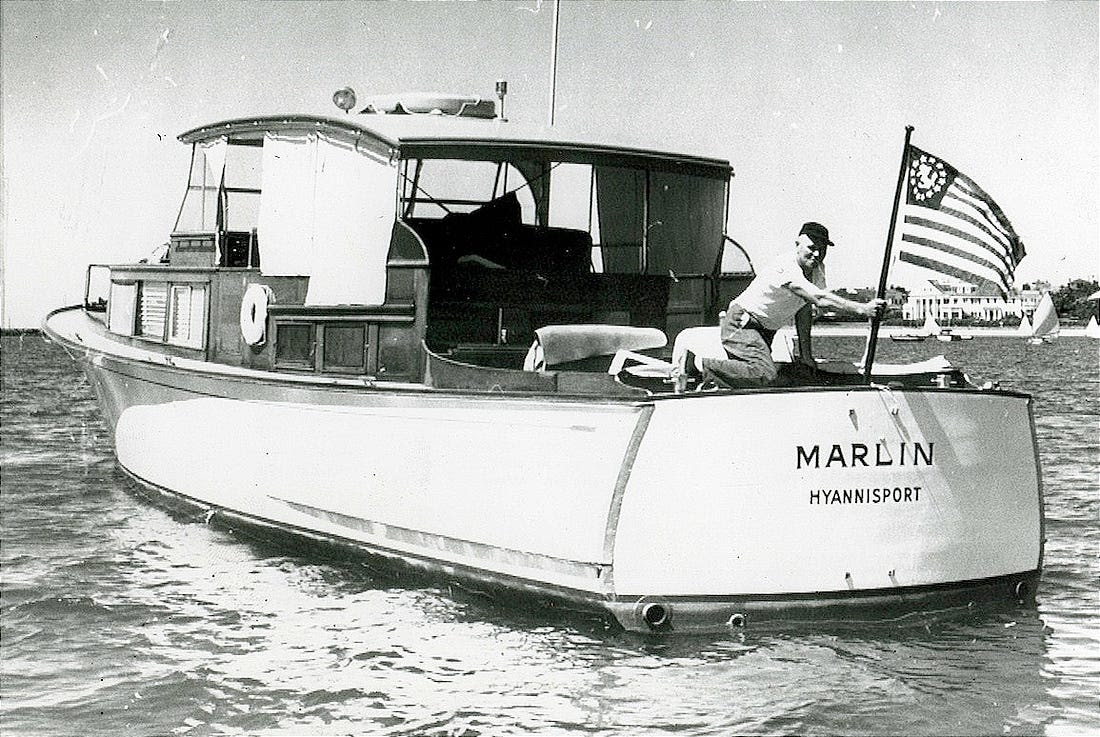
(Alas, there were no illustrations or photos of Vonnegut’s voyage to be found, unlike Loose Cannon’s recently republished “The Forgotten Voyage: Ansel Adams on the ICW.”) The name of the yacht is Marlin, and she was acquired by the Kennedys in 1952. According to Soundings magazine, she had recently been the property of the Yellow Cab Company of Massachusetts, which “put her at the disposal of the state’s governor. Prior to that, she had been commandeered by the Navy for coastal patrols during World War II. JFK was on board with his advisers in August 1961 when he was informed that the the East Germans had begun to build the Berlin Wall. Five years and one assassination later, here is how Vonnegut described her:
In the mid-1960s, the Golden Era of Middle-Class Boat Ownership had yet to take hold as the boating industry retooled to convert from custom-wood to fiberglass manufacturing. The ICW snowbird migration was nothing like it is today. Vonnegut described it thus:
That was the context of Vonnegut’s ride-along. Here’s how he described his deal with the captain:
Just like today, the captains and crews working for wealthy yacht owners constituted a their own subculture. Not millionaires themselves, yacht crew nonetheless lived and worked adjacent to their a lifestyle of luxury. Yet, because of the the many Kennedy children that it entertained, Vonnegut joked that the 35-year-old motoryacht looked like a “set from a Clifford Odets play about the Great Depression.” In the Chesapeake and Delaware Canal, they joined a migration of dozens of millionaires’ yachts heading south, ownerless. The captains and crews would regularly gather at restaurants and pubs, like Shaefer’s seafood restaurant, to swap stories. One of the captains was a rarity back then—a woman. She was single-handedly piloting a boat bigger than Marlin from New York to Key West. Vonnegut noted that she was a staunch Barry Goldwater supporter. You know, the conservative senator that Lyndon Johnson beat for the presidency. And speaking of women, Vonnegut recalled this exchange:
The author opined on Marlin’s fuel consumption, which he had meticulously tracked for the entire two-week trip. He reported that the twin V-8s had burned a total of 1,522 gallons, a rate Wirtanen described as “splendid.” What was actually splendid was the price—36 cents a gallon, for a grand total of about 550 bucks.
Because of images such as the above, Marlin was recognized and drew onlookers along the way, although Vonnegut mentions one obtuse Army Corps of Engineers officer who had never heard of Joe Kennedy of Hyannisport. The reception became more mixed as Marlin went deeper into the South.
The most touching moment came when Marlin pulled into a marina in Jacksonville, the nearest metropolis to where I sit typing. (Jacksonville calls itself the “Bold New City of the South,” a sentiment shared by absolutely no one.) As this next snippet suggests, symbols really do matter:
Here’s how Vonnegut ends his essay, an exchange at Palm Beach with one the yacht captains he had come to know, a Swede named Gunther:
LOOSE CANNON covers hard news, technical issues and nautical history. Every so often he tries to be funny. Subscribe for free to support the work. If you’ve been reading for a while—and you like it—consider upgrading to paid. |








Be the first to comment!