| February 9, 2026 | City of Gulfport, FL – Gateway to the Gulf Newsletter |
| |
| E-Newsletter: Monday, February 2, 2026 Missed last week’s update? Click here to read it now. |
| Upcoming Events See what’s happening this month. |
| Senior Center E-news Click here to see what’s happening next. |
| Library Calendar of Events Upcoming activities at the Gulfport Library. |
| Recreation Center Click here to see all classes and activities. |
| Gulfport Community Update Click here to read more. |
| Gulfport Arts & Heritage Click here to see upcoming events. |
| Gulfport City Hall and facilities will be closed on Monday, February 16 in observance of Presidents’ Day. The Sanitation schedule will not be affected. |
|
|
| A Message from Mayor Love |
|
|
Good Afternoon Gulfport, I’d like to share a few important updates and upcoming dates for your calendar. Please mark Tuesday, March 3rd at 6:00 PM in Council Chambers for a first look at the architect’s preliminary concepts for the Senior Center expansion, which is being envisioned in three phases. During this same meeting, our engineering team will also present revised and more detailed proposals outlining the recommended order for addressing our stormwater infrastructure needs. I also encourage residents to attend the workshop on Thursday, February 26th at 6:00 PM in Council Chambers, where the City will provide information regarding the 287(g) mandate. Public comment will be heard during this session. If you haven’t already, please take time to watch the presentation I gave at the last Council Meeting covering parking, speed limits, and potential one-way street considerations downtown. We will continue that discussion at a workshop on March 26th at 6:00 PM in Council Chambers, where your feedback and suggested improvements to the plan will be welcomed. This is an opportunity to help get the conversation started early in the process. I’ve heard from many of you regarding the recent fish kill in our ponds. Kyle with the Department of Environmental Protection (DEP) has advised that the fish affected are tilapia and that the cause is related to the recent cold temperatures. Tilapia are not native to Florida and are particularly sensitive to cold weather events. As always, I welcome your emails and input on any of these topics at klove@mygulfport.us. -Mayor Love |
|
|
| City Manager’s Gulfport Community Update |
|
|
| Gulfport Community Update: February 1 – 7, 2026 |
Gulfport City Hall and facilities will be closed on Monday, February 16 in observance of Presidents Day. The sanitation schedule will not be affected. The northbound lane of 58th Street South is closed between 22nd & 17th Avenues for infrastructure improvements. Side street intersections are closed to northbound drivers. Drivers are encouraged to use 49th Street as an alternate route. Motorists should anticipate delays and exercise caution. The project is anticipated to be completed by late June. For information call Public Works at 893-1089. The Southwest Florida Water Management District (SWFMD) Phase II watering restrictions will begin Sunday, February 8. Lawn watering will be limited to once a week between the hours of 6 p.m. & 8 a.m. Addresses ending in 0 & 1 can water on Mondays; 2 & 3 on Tuesdays; 4 & 5 on Wednesdays; 6 & 7 on Thursdays, and; 8 & 9 and locations without a discernable address can water on Fridays. For information, call 813-856-5679 or email Water.Restrictions@WaterMatters.org. |
|
|
| Upcoming Official Meetings |
|
|
| City of Gulfport: Meetings Calendar February 2026 - February 3, 2026: City Council Meeting – 6:00pm
- February 5, 2026: City Council Workshop – 6:00pm
- February 11, 2026: Board of Adjustment – 6:00pm (AGENDA)
- February 17, 2026: Council Meeting – 6:00 pm
- February 19, 2026: Special Magistrate (If necessary) – 9:30am
- February 26, 2026: City Council Workshop – 6:00pm
|
|
|
All meetings are open to the public and are held in the City Hall, City Council Chambers, 2401 53rd Street South, In Person, unless otherwise noted. Meetings may occasionally be added, cancelled or rescheduled after this list is published. Please check the city’s website https://mygulfport.us for updated information. |
|
|
| This Weeks Events & Meetings |
|
|
| Registration Closes Today: Gulfport Art in the Yard Community Art SaleMonday, February 9 at 3 p.m. Gulfport Residents Only Local artists are invited to participate in the City of Gulfport’s bi-annual Art in the Yard Community Art Sale, taking place Saturday, March 21, from 10 a.m. to 4 p.m. (rain date: Sunday, March 22). This beloved event transforms Gulfport into an open-air gallery, featuring original artwork displayed and sold from artists’ own front yards. Don’t miss your chance to be part of one of Gulfport’s most colorful and creative community events. |
|
|
| AARP Tax PreparationMon. & Fri., February 9 – April 13 | 10 a.m. – 3 p.m. Gulfport Public Library, 5501 28th Ave. S. Tax preparation for federal income tax returns for eligible individuals by trained volunteers. The service is free. Call 727-755-3112 to make an appointment. Leave a message & a volunteer will call you back to schedule your appointment. There will be no walk-in tax preparation. |
|
|
| | Study Club Monday, February 9th | 5:30 p.m. Gulfport Public Library, 5501 28th Ave. S. Join us for Study Club. Quiet space for teens to focus on homework and studies for ages 12-18. For additional information call 727-893-1074. |
|
|
| | Gulfport Tuesday Fresh Market Tuesday, February 10th | 9 a.m. – 3 p.m. Downtown Waterfront District, Beach Blvd. S. The Gulfport Tuesday Fresh Market is a year-round open-air market held in Gulfport’s Waterfront District on Beach Blvd. below 28th Ave. S., 9 a.m. – 3 p.m., October – May & 9 a.m. – 2 p.m., June – September. It also offers a variety of independent shops, boutiques, galleries, its own beach and a large cluster of restaurants, all within easy walking distance. The Fresh Market offers visitors the opportunity for a relaxing day trip in a small town full of “Old Florida” charms. |
|
|
| | What’s on Your Mind? With Councilmember Marlene Shaw – Every Second Tuesday Tuesday, February 10th | 11 a.m. – 1 p.m. SumitrA Espresso Lounge, 2838 Beach Blvd. S. Join Councilmember Marlene Shaw for casual conversation and community connection at SumitrA Espresso Lounge, 2838 Beach Blvd. S., every second Tuesday from 11:00 AM to 1:00 PM. Whether you have questions, concerns, or ideas to share, she’s here to listen and talk about the issues that matter to you. Councilmember Shaw also holds City Hall office hours every Monday from 2:00 to 3:00 PM at 2401 53rd Street South. Appointments are available upon request. Contact mshaw@mygulfport.us or (727) 826-7311 for more info. |
|
|
| Florida’s Living Shores: How Native Plants Protect Coastal Habitats Wednesday, February 11th | 1 p.m. Gulfport Public Library, 5501 28th Ave. S. Come and learn about the role that Florida native plants play in protecting coastal ecosystems! In a presentation lead by Pinellas Master Gardeners Priscilla Kidder and Deb Rothenberger, we will look at some key species and their impacts, as well as discuss how plants can be integrated into environmentally-friendly living shorelines. We will also discuss opportunities for getting involved in local coastal habitat restoration projects. This presentation aims to empower residents to transform their own coastal landscapes into sustainable, thriving habitats using Florida’s best native salt tolerant plants. We will have plants and seeds to give away to participants! This program is funded by a grant from the Florida Land Title Association Charitable Action Foundation. |
|
|
| Story Circle NightThursday, February 12th | 5:45 p.m. Gulfport Public Library, 5501 28th Ave. S. Storytelling Circle for adult storytellers. Participants may be professional or novice storytellers. We encourage you to prepare a traditional folktale, ancient myth, fairy tale, tall tale, family lore, local history, parable, or a life lesson learned (5-mins. or less, please). Storytelling is an art form and practice open to all. All are welcomed to try. Sponsored by Enroy Foundation, Inc., a Gulfport 501(c)3 organization for visual & performing arts and Circle of Friends of the Gulfport Public Library. Contact: Maureen Kilroy, email mk_away@yahoo.com. |
|
|
| | USCG Auxiliary Recreational Boating Course Saturday, February 14th | 9 a.m. – 5 p.m. 49th Street Neighborhood Center, 1617 49th St. S. The US Coast Guard Auxiliary Flotilla 7-16 in Gulfport will hold a Recreational Boating Course on the second Saturday of every month in Gulfport. The 8 hour course includes subjects as Boat Nomenclature, Before you get underway, Navigating the Waterway, updated Legal Requires, Boating equipment and emergencies are a few of the subjects, and qualifies for the Florida Boating ID Card as well. Cost is $40 per person. Contact Marty Richardson to reserve a seat at 630-674-5352 or merichardsonjr@att.net. |
|
|
| Gulfport Fine Arts FestivalSat. & Sun., February 14 – 15 | 10 a.m. – 5 p.m. Clymer Park, Gulfport Blvd. S. and Beach Blvd. S. to 26th Ave. S. The Gulfport Fine Arts Festival returns to Clymer Park, celebrating a decade of artistic excellence. This two-day juried event features more than 50 artists working in painting, sculpture, jewelry, photography, mixed media, and more. Enjoy meeting the artists, browsing and purchasing original works, and soaking in a festive atmosphere in one of Gulfport’s most scenic outdoor locations. Join art lovers, collectors, and the community Saturday and Sunday from 10 a.m. – 5 p.m. Admission and parking are free, making it a perfect weekend outing to celebrate creativity, culture, and Gulfport’s vibrant community. |
|
|
| Betty Fox Live in ConcertSunday, February 15th | 6 – 9 p.m. Catherine Hickman Theater, 5501 27th Ave. S. Get ready for an unforgettable night of soul, blues, and roots as the Betty Fox Band takes the stage at the Catherine Hickman Theater. Renowned for her powerful vocals and dynamic stage presence, Betty Fox blends gospel, blues, and soul into a high-energy performance featuring original songs and reimagined classics. General seating tickets are $25 and available now. Don’t miss this chance to experience a show that’s as moving as it is memorable. |
|
|
| Upcoming Events & Meetings |
|
|
| | Ask a City Councilor at the Third Tuesday Fresh Market Tuesday, February 17th | 11 a.m. – 1 p.m. SumitrA Espresso Lounge, 2838 Beach Blvd. S. Gulfport City Council will be hosting an opportunity, every third Tuesday of the month, for residents to get to know their Councilmember, ask questions, and provide comment. For more information, please call City of Gulfport Vice Mayor, Ward 1 Representative, April Thanos at (727) 826-7138. |
|
|
| | Gulfport Neighborhood Watch Meetings Wednesday, February 18th | 6 p.m. Every third Wednesday of each month City Hall (Council Chambers), 2401 53rd St. S. For more information, please contact Mr. Jim Wright Neighborhood Watch Coordinator at 727-893-1022 or jwright@mygulfport.us. |
|
|
| COF Annual MeetingThursday, February 19th | 6:30 p.m. Gulfport Public Library, 5501 28th Ave. S. Join us for our Circle of Friends Annual Meeting featuring music performed by the Celtic duo, Emily Ann & Kelly Thompson. Enjoy jigs and fiddle tunes with us as we celebrate the accomplishments of the Circle of Friends and how they continue to support the Gulfport Public Library. Light refreshments start at 6:30pm and the annual meeting report is at 6:45pm. The Celtic duo performance begins at 7:00pm. |
|
|
| Free Community Tree GiveawaySaturday, February 21st | 9 – 11 a.m. Clymer Park (Greenway), 23rd Ave. S. & Beach Blvd. S. The City of Gulfport invites residents to the Free Community Tree Giveaway at Clymer Park, part of our ongoing Plant a Tree initiative. Gulfport residents with a driver’s license or water bill for proof can receive free trees to enhance their property and support the city’s environmental sustainability efforts. Exploring the Future of Gulfport Beach will also be on-site, sharing information about nature-based coastal resiliency solutions, collecting community surveys on beach concerns and ideas, and offering a fun coastal resilience quiz along with giveaways like native plant seeds and Gulfport Beach–branded sunglasses. For more information, please contact the Parks & Facilities Superintendent at 727-893-1092. |
|
|
| | Third Saturday Gulfport Night Market Saturday, February 21st | 5 – 9 p.m. Beach Blvd. S. (Waterfront District) The Gulfport Night Market operates year-round from 5pm to 9pm on the first Friday and third Saturday of each month. The Gulfport Merchants Chamber is proud to partner with the Tampa Bay Markets team to work directly with new and returning vendors and to manage the Gulfport Night Market events. Tampa Bay Markets is a local events management company that operates 13 successful local markets and special events within the greater Tampa Bay Area, celebrating its 15th anniversary year of operation. |
|
|
| All-Star Comedy Night at the Maria CenterSaturday, February 21st | 6 – 8 p.m. | Doors open at 4:45 Maria Center, 1500 58th St. S. Four nationally recognized comedians return to the Maria Center stage for a night filled with big laughs, sharp wit, and unforgettable performances. Fresh off his standout role on the hit series Loudermilk, comedy veteran Jackie Flynn headlines this special event, bringing big-city stand-up to an intimate theater setting. He’ll be joined by three audience favorites who had the crowd roaring last year: Kevin Flynn, Kerry McNally, and DC Benny. This one-night-only comedy showcase is perfect for date night, group outings, or anyone who enjoys sharp, grown-up comedy. VIP tickets are $45 and include one free drink, hors d’oeuvres, preferred seating, and access to a meet-and-greet after party. General admission is $30, and early bird buyers can enjoy $5 off through February 8. |
|
|
| COF Presents: The Roots of Black Music in AmericaThursday, February 26th | 1 p.m. Gulfport Public Library, 5501 28th Ave. S. Take a 100-year musical journey with producer, songwriter, and troubadour Karlus Trapp. Through songs, stories, and history, you’ll experience ragtime, jazz, Motown, and more. Educational, entertaining, and toe-tapping, this program will leave you smiling, humming, and seeing America’s music in a whole new light. Sponsored by the Circle of Friends of the Gulfport Library. |
|
|
| Toppermost Beatles TributeFriday, February 27th | 7 p.m. Catherine Hickman Theater, 5501 27th Ave. S. Get ready for an amazing musical experience as Maremil Music presents a spectacular tribute to the legendary sound of The Beatles. Toppermost, a highly acclaimed, Michigan-based tribute band, brings the magic of the “Fab Four” to life with authentic instruments, period-accurate costumes, and spot-on vocal harmonies. Known for their energetic, theatrical performances and a repertoire of more than 100 beloved songs, they deliver a nostalgic journey through both the early touring years and the groundbreaking studio era. VIP seating is available for $40, with general admission starting at $25. For ticketing and information, call Maremil Music Productions at 360-878-3474. |
|
|
| Gulfport’s Get RescuedSaturday, February 28th | 10 a.m. – 5 p.m. Downtown Waterfront District, Beach Blvd. S. Gulfport’s Get Rescued Festival returns for its 22nd year with a fun-filled, pet-friendly day! Enjoy up to 50 animal rescue groups, pet vendors, training demos, the Florida Weiner Dog Derby, raffles, and more. All leashed people and well-behaved pets are welcome. Admission is free, with plenty of complimentary parking. Proceeds benefit participating animal rescue groups. For more info, email getrescuedinc@gmail.com or text 727-417-5494. |
|
|
| | For the Love of Gulfport Sunday, March 1st | 11 a.m. – 4 p.m. Trolley Market Square, Tangerine Ave. S. Join WonderWorks and Gulfport Pride Florida for the First Annual For the Love of Gulfport Community Day on Sunday, Mar 1 at 11:00 a.m. at Trolley Market Square (Tangerine Ave S. & 49th St. S.). This family-friendly event will feature food, entertainment, local vendors, kids’ activities, and more. |
|
|
| | Music in the Park: The New Horizons Jazz & Concert Bands of Gulfport Sunday, March 1st | 3 p.m. Clymer Park (Pavilion), Gulfport Blvd. S. and Beach Blvd. S. to 26th Ave. S. Join the New Horizons Jazz and Concert Bands for an afternoon of live music at the pavilion at Clymer Park. This free community concert features jazz and concert band favorites performed by talented local musicians. Bring a chair, bring a friend, and enjoy Gulfport’s vibrant arts scene. |
|
|
| Fusion 49th General MeetingMonday, March 2nd | 6 p.m. 49th Street Neighborhood Center, 1617 49th St. S. Join us for the next Fusion 49th General Meeting and get involved in shaping our district. Opportunities are available to serve on the Organization, Design, Economic Vitality, and Promotions Committees. To learn about qualifications or to sign up, contact Nancy Dunham (Fancy Nancy – Professional Services) at 727-710-6676. |
|
|
| | What’s on Your Mind? With Councilmember Marlene Shaw – Every First Wednesday Wednesday, March 4th | 2 – 3 p.m. Wonder Works, 5314 Gulfport Blvd. S. Join Councilmember Marlene Shaw for casual conversation and community connection at Wonder Works, 5314 Gulfport Blvd. S., every first Wednesday from 2:00 PM to 3:00 PM. Whether you have questions, concerns, or ideas to share, she’s here to listen and talk about the issues that matter to you. Councilmember Shaw also holds City Hall office hours every Monday from 2:00 to 3:00 PM at 2401 53rd Street South. Appointments are available upon request. Contact mshaw@mygulfport.us or (727) 826-7311 for more info. |
|
|
| | First Friday Gulfport Night Market Friday, March 6th | 5 – 9 p.m. Beach Blvd. S. (Waterfront District) Formally known as Art Walk on the first Friday and IndieFaire on the third Saturday, these recurring monthly events will launch for 2025 branded as the Gulfport Night Market. The night market concept unites the energy of the former events, offering an evening marketplace experience with vibrant local offerings from local makers, artisans, and small business vendors to engage the community and visitors as they shop, stroll, and sip in beautiful downtown Gulfport. |
|
|
| | Pink Flamingo Home & Garden Tour Saturday, March 7th | 11 a.m. – 5 p.m. Gulfport, FL (Ward 4 The Pink Flamingo Home Tour invites residents and visitors to explore a dozen distinctive homes and gardens in Gulfport’s Ward 4. This popular, self-guided event attracts more than 500 guests each year and highlights the charm, creativity, and eclectic character of the neighborhood, with each stop offering its own unique visual story. Guests are encouraged to enjoy the tour at their own pace while supporting local cafés, shops, and small businesses, and to purchase tickets early, as the Pink Flamingo Home Tour frequently sells out. |
|
|
| | Gulfport Community Players present “Quartet” March 12 – 22, 2026 Thur. – Fri. – Sat. at 8 p.m., Sat. & Sun. at 2 p.m. Catherine Hickman Theater, 5501 27th Ave. S. Quartet by Ronald Harwood is a warm, witty, and deeply moving play set in a retirement home for former musicians. Four once-celebrated opera singers reunite with plans to perform a concert honoring Verdi’s birthday, but the arrival of Jean, a glamorous former diva and Reginald’s ex-wife, disrupts the group’s harmony and brings old rivalries and unresolved emotions back to the surface. Exploring themes of aging, forgiveness, love, and lasting friendship, Quartet builds to a poignant and bittersweet finale that celebrates both memories of the past and the bonds that endure. |
|
|
| | Gulfport Permit Free City-Wide Yard Sale Saturday, March 14th | Dawn – Dusk City of Gulfport, FL The City of Gulfport’s permit-free Citywide Yard Sale takes place on Saturday, March 14, with a rain date of Sunday, March 15. Brochures listing all participating addresses, printed and generously sponsored by Olympus Printing, will be available at all City facilities starting Thursday, March 12, and in the Gulfport Public Library lobby (5501 28th Ave. S.) on the day of the event; the Library opens at 10 a.m. on Saturdays. Participants are also listed on Google Maps for easy navigation. Don’t miss your chance to have your address featured on the brochure and Google Maps for added visibility. Registration ends on Friday, March 6 at 3 p.m. For more information call, 727-893-1118. |
|
|
| | Gulfport Marina Nautical Flea Market Saturday, March 14th | 7 a.m. – 1 p.m. Gulfport Municipal Marina,4630 29th Ave. S. The Gulfport Nautical Flea Market invites boaters, anglers, and bargain hunters to browse a wide selection of marine-related items, collectibles, and unique nautical finds. From fishing gear and boating accessories to one-of-a-kind treasures, this community favorite offers something for everyone. Vendor spaces are limited and available for $10 per 10′ x 10′ space, with participants asked to bring their own tables and chairs. For additional details, interested vendors and attendees are encouraged to contact the Marina Office. |
|
|
| | 2026 Great American Cleanup – Clam Bayou Saturday, March 14th | 9 – 11 a.m. Clam Bayou Nature Park, Miriam St. S. Gulfport Grassroots, in partnership with Keep Pinellas Beautiful & the City of Gulfport will host the 2026 Great American Cleanup at Clam Bayou Nature Park 9 a.m. – 11 a.m., Saturday, March 14. Volunteers should wear closed-toed shoes, sun protection and weather appropriate clothing. Cleanup supplies will be provided. |
|
|
| Gulfport History Museum Online Collection View the Museum’s online collection here. |
| Latest Beach Water Quality Sampling Data See the latest report here. |
| Gulfport Charter & Code of Ordinances Online access is provided at the following link. |
| Bill Payment Options View and pay Utility & Marina Billing accounts online here. |
| Employee Directory Click here to view the Gulfport Employee Directory. |
| In Case You Missed It: “Take 2 on Tuesdays” Last week’s Take 2 on Tuesdays featured a quick two-minutes on utility flag markers. |
|
|
| The City of Gulfport Announces Phase II Lawn Watering Restrictions Issued by SWFWMDThe Southwest Florida Water Management District has issued a Phase II Water Shortage Order for the City of Gulfport due to below-average rainfall and declining water supplies. Beginning Sunday, February 8, outdoor landscape irrigation will be limited to one day per week. Residents should follow this standard watering schedule based on the last digit of their address: - 0 or 1: Monday
- 2 or 3: Tuesday
- 4 or 5: Wednesday
- 6 or 7: Thursday
- 8 or 9 (and locations without a discernible address): Friday
Watering hours are reduced to 12:01 a.m. to 8 a.m. or 6 p.m. to 11:59 p.m.; properties less than one acre in size may only use one of these windows. Low-volume watering (micro-irrigation, soaker hoses, hand watering) of plants and shrubs (not lawns) is allowed any day and any time. The City of Gulfport encourages residents to comply with these restrictions and practice water conservation during this dry period. For additional details and tips, visit WaterMatters.org/Restrictions. If you have additional water restrictions questions, contact us by sending an email to Water.Restrictions@WaterMatters.org or by calling 1-800-836-0797 (FL only) or (813) 856-5679 (during business hours). |
|
|
| Keep Fire Safety in Mind When Using Heaters and Other Heating Equipment During the Cooler Months With recent cooler temperatures and damp weather conditions, residents are increasingly turning to portable indoor and outdoor heaters, including electric and gas-powered fire pits. Gulfport Fire & Rescue reminds the community to prioritize safety when using any type of heating equipment this season. To help prevent fire hazards and injuries, please follow these important safety guidelines: - Keep children and pets away from heating devices.
- Never use outdoor propane heaters indoors.
- Always shut off a heater before moving it.
- If you smell gas, turn the heater off immediately and ventilate the area.
- Ensure propane tanks and heaters are properly secured.
- Keep heaters clear of walkways, foot traffic areas, and exits.
- Never use heaters near flammable materials or products.
- Do not use fire pits indoors or under tents, awnings, canopies, or other coverings that may ignite.
- Review and follow all manufacturer safety instructions before, during, and after use.
In the event of an emergency involving heating equipment, call 911 immediately to request emergency assistance. |
|
|
| The northbound lane of 58th Street South between 22nd & 17th Avenues remains closed for infrastructure improvements, while the southbound lane stays open. Side street intersections are now closed in phases to support roadway reconstruction, temporarily restricting left turns from 58th Street; right turns remain open. Drivers are encouraged to use 49th Street as an alternate route. The project is expected to be completed by late June. |
|
|
Gulfport: Don’t Miss Out on Hurricane Recovery Grants! Pinellas County continues to offer assistance through its People First Hurricane Recovery Programs, providing financial support to homeowners, renters, and landlords impacted by Hurricanes Idalia, Helene, and Milton. Funded by an $813.8 million HUD Community Development Block Grant for Disaster Recovery (CDBG-DR), the program supports home repairs and rebuilding efforts, promotes housing stability, and assists residents still recovering from storm impacts. Eligible Gulfport residents may apply online at https://recover.pinellas.gov or by calling (727) 606-3307. Case managers are available by phone, at county offices, and during community pop-up events to help guide applicants through the process. |
|
|
| eComment’s Available for City Council Meetings Residents can now share their input on City Council agenda items online using the City of Gulfport’s new eComment system. You can review upcoming agenda items and submit comments from your computer, tablet, or mobile device. How to submit an eComment: - Visit the City Council Meetings page.
- Click the “eComment” button.
- Enter your comment and submit.
Have your voice heard—online, anytime, anywhere. |
|
|
City of Gulfport Utilities Department Online Utility Service Application The City of Gulfport Utility Billing – Customer Service Division provides an online Utility Service Application, making it easy for new customers to start water, sewer, sanitation, stormwater, and recycling service. The secure online form allows applicants to upload required documents and submit everything from any computer or mobile device. In-person assistance is still available at Gulfport City Hall for those who prefer to apply in person. The application can be accessed anytime at: mygulfport.us/utilities/utility-account-application-form. Applications submitted before 3:00 p.m., Monday through Friday, are eligible for same-day activation. For more information, visit mygulfport.us/utilities or contact Utility Billing – Customer Service at utilitiesinfo@mygulfport.us or (727) 893-1016. |
|
|
| Great news, Gulfport! Thousands of pages of historic City of Gulfport records dating from 1920 to 1974 have been carefully digitized and are now available online at https://libraries.arcasearch.com/usflghm/. Whether you’re a history buff, a student, or simply curious about Gulfport’s past, this digital archive offers a fascinating treasure trove of local history to explore. |
|
|
| Gulfport Connects: Bringing the Community Together Register for Gulfport Connects, an online volunteer platform designed to strengthen connections between residents, local organizations, and City departments. The platform provides a simple, reliable way to match community needs with volunteer support – both during emergencies, and in everyday life. Nonprofits, community groups and City departments can post and manage volunteer opportunities, track service hours, and coordinate projects, while residents can sign up for activities that match their interests and log their service. Visit https://gulfport.galaxydigital.com or email dmather@mygulfport.us to be added to the portal. Gulfport Connects transforms lessons learned into lasting community strength, keeping Gulfport connected and resilient every day. |
|
|
| City of Gulfport Special Events Trolley/WRD Looper The City of Gulfport Special Events Trolley/Waterfront Redevelopment District (WRD) Looper services large-scale special events and the First Friday and Third Saturday Night Markets from 5 to 9 p.m. and the Second Saturday’s at Trolley Market Square from 4 – 8 p.m. throughout the year. For more information and to view all of the Loopers convenient pickup spots, please visit https://mygulfport.us/trolley/. |
|
|
To donate, come to the Museum during open hours or email us at HistoryMuseum@mygulfport.us |
| Help Preserve Gulfport’s History! The Museum Needs Your Photographs The Gulfport Museum is expanding its historical archive and is seeking photographs of Gulfport streets and homes from any era or neighborhood. We welcome original photographs, printed photos, or digital images. Photos with known dates and addresses are especially valuable, and all donated images will be featured in our online catalog for the public and future generations to explore. Don’t want to part with your originals? No problem , we’re happy to scan your photographs and return them to you. Your scan becomes the donation! Help us tell the story of Gulfport, one photo at a time. |
|
|
| Improving Lives Through the Power of Information & Hope At First Contact, our goal is to have a community that is connected and informed regarding critical health and human service information for those who need help and those who are willing to volunteer or donate their time to local community agencies. |
|
|
| Care About Me confidentially helps all residents of all ages, insured or not, by eliminating the guesswork or need to search for local behavioral health services by creating a space where residents or family members of individuals in non-crisis can call in, speak directly with experienced behavioral health specialists who can triage their needs, and get an appointment scheduled with a local provider. For more information, visit https://careaboutme.org or call 1-888-431-1998. |
|
|
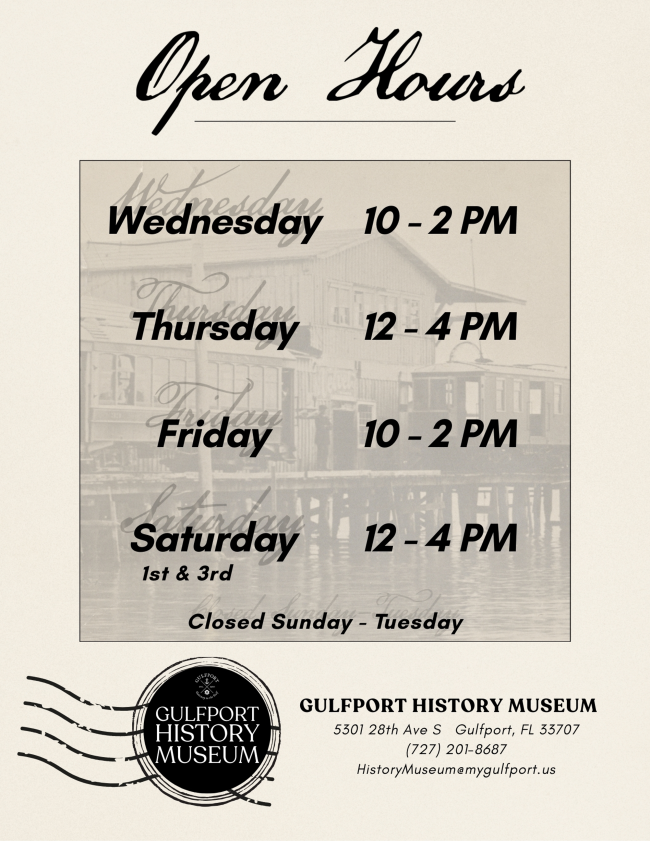
| Gulfport History Museum Operating Hours- Monday & Tuesday: Closed
- Wednesday: 10 a.m. – 2 p.m.
- Thursday: 12 – 4 p.m.
- Friday: 10 a.m. – 2 p.m.
- Saturday: Noon – 4 p.m. (1st and 3rd Saturdays)
- Sunday: Closed
727-201-8687 | historymuseum@mygulfport.us |
|
|
| Gulfport provides once-a-week collection of household recyclables. Curbside service is provided to all single-family and duplex homes, apartment/condo complexes, mobile home parks and smaller businesses. Items collected are plastic containers and jugs, steel cans, aluminum cans, mixed paper, cardboard and newspaper. A drop-off center is located at the Neighborhood Center, 1617 49th Street South, for glass containers (all colors), mixed paper, and cardboard. It is open 24 hours / 7 days a week. For more information, visit https://mygulfport.us/public-works-department/. |
|
|
| The Gulfport Public Works Department located at the 49th Street Neighborhood Center (1617 49th St. S.) is an official collection site for rechargeable batteries! For more information, please call 727-893-1089 or visit https://mygulfport.us/public-works-department/. |
|
|
| The City of Gulfport Private Waterline and Sewer Lateral Replacement Assistance Program offers financial reimbursement after the replacement of a deteriorated residential waterline or sewer lateral. City Utilities residential water or sewer customers are eligible for a rebate of 50% up to $3,500.00 after the purchase, installation, and inspection of failing waterlines or sewer lateral between the home connection and the city connection. |
|
|
| The City of Gulfport Senior Center’s Telephone Reassurance Program is a free service for Gulfport Residents 50 years of age or older. Volunteers provide daily phone calls to registered members and provide comfort, security, and peace of mind to members and families. Registration is simple and free. If you or someone you know could benefit from this service during this difficult time, please call (727) 893-2237 and register today. |
|
|
| GEMS door-to-door transportation has provided independence & freedom to elderly and disabled residents of Gulfport for over 40 years. Any Gulfport residents 65 & older or residents with a disability can take advantage of GEMS door to door service for a yearly membership of $70 plus $2 per one-way trip. For more information, call 893-2242. |
|
|
| | Let’s Keep Gulfport Beautiful and Our Streets Clean! Keeping grass clippings out of the street helps protect our bay, prevent flooding, and keep roads safe. Bag, compost, or blow clippings back onto your lawn to recycle nutrients naturally. Every small action helps keep Gulfport clean, green, and beautiful. Thank you for doing your part to care for our community! |
|
|
|
|
| | City of Gulfport | 2401 53rd street south | Gulfport, FL 33707 US |
|
|
|
|
|
|



































Be the first to comment!