Visit Logged
  • Select Region
    • All Regions
    • VA to NC Line
    • North Carolina
    • South Carolina
    • Georgia
    • Eastern Florida
    • Western Florida
    • Florida Keys
    • Okeechobee Waterway
    • Northern Gulf
    • Bahamas
    • New York
    • Ohio
    • Pennsylvania
    • Washington
    • Puerto Rico
    • Minnesota
    • Maryland
    • Tennessee
    • NW Waters
    Order by:
    • Looking Forward to an Extraordinary 2026, Edenton, NC [Albemarle Sound, NC]


      Edenton, NC - the prettiest town in the South!

      A longtime CRUISERS NET SPONSOR, historic Edenton always has an exciting calendar of events and places to visit! Edenton is at the mouth of the Chowan River on the northwest shore of Albemarle Sound.​

      Looking Forward to an Extraordinary 2026

      Click Here To View the North Carolina Cruisers Net Marina Directory Listing For Edenton Harbor City Docks

      Click Here To Open A Chart View Window Zoomed To the Location of Edenton Harbor City Docks

      Be the first to comment!

    • The Case for the Compass – Passagemaker


      Be the first to comment!

    • Cruisers’ Net Weekly Newsletter – January 2, 2026

      Cruisers’ Net Newsletter for this week has just been emailed via Constant Contact.
       
      If you want to view the newsletter but are not signed up to receive them automatically, you can view it at https://conta.cc/4qDUPpi or see it below.
       
      To automatically receive our emailed Fri Weekly Newsletter and Wed Fuel Report, click:


      Newsletter icons created by Freepik – Flaticon

      Be the first to comment!

    • Two Marinas Certified as Georgia Clean Marina Program – GADNR


      CRD Header May 2019 -2
      CRD Latest News
      Hoisting flag

      Two Georgia Marinas Earn Georgia Clean Marina Certification

      Two marinas along Georgia’s coast have been newly certified under the Georgia Clean Marina Program, recognizing their commitment to protecting coastal waters and implementing environmentally responsible business practices.

      Safe Harbor Savannah Yacht Center in Savannah and The Ford Field and River Club Marina in Richmond Hill were certified Tuesday, Dec. 16, 2025, for adopting Clean Marina Best Management Practices (BMPs), which are designed to reduce or eliminate waterway pollution from everyday marina operations.

      The Georgia Clean Marina Program is a voluntary certification program allowing coastal Georgia marinas the opportunity to demonstrate their environmental stewardship through implementation of Clean Marina Best Management Practices (BMPs). Certified marinas are eligible to fly the Georgia Clean Marina flag and use the logo in their advertising and promotional materials, signaling to the boating community their commitment to protecting coastal waterways.

      Marinas are assessed in several areas such as fueling operations, boat washing policies and emergency preparedness to demonstrate the policies they have in place to go above and beyond in ensuring their operations are not negatively impacting their coastal environment. They must meet minimum requirements addressing all areas of marina operation to become certified. Certified marinas can use this designation to attract clientele that value the steps clean marinas have taken to be better stewards of our coast.


      These certifications mark the third cohort of facilities to earn designation since the Georgia Clean Marina Program was relaunched in 2023. The program is part of a national initiative and is administered through a collaborative partnership between the Georgia Department of Natural Resources’ Coastal Resources Division (CRD), University of Georgia Marine Extension and Georgia Sea Grant, and the Georgia Marine Business Association (GAMBA).

      “The continued growth of the Georgia Clean Marina Program shows how effective this partnership has been,” said Kelly Hill, CRD green growth specialist. “By working together, we’re helping marinas implement practical solutions that protect water quality while supporting a strong coastal economy.”

      Marinas play a vital role in Georgia’s coastal communities by supporting recreational boating, marine tourism, and local jobs. Most facilities are located in or near sensitive marshlands and estuarine waters, making environmental stewardship a critical component of marina operations.

      “These certifications demonstrate the marine industry’s commitment to balancing business operations with environmental responsibility,” said Lucy Bowie, GAMBA secretary. “Each new cohort strengthens the program and sets a positive example for marinas across the coast.”

      Bryan Fluech, associate director of extension for University of Georgia Marine Extension and Georgia Sea Grant, emphasized the long-term impact of the program.

      “The Georgia Clean Marina Program is a successful model of collaboration,” he said. “Each newly certified marina represents real progress toward conserving Georgia’s coastal resources for future generations.”

      Marinas interested in becoming certified may apply each fall and work closely with program partners throughout the year to meet program benchmarks. For more information, visit GeorgiaCleanMarina.org.

      -30-


      Learn more about CRD on our YouTube Channel

      YouTube

      Support marine habitats by upgrading your license plate!

      tag


      .

      Be the first to comment!

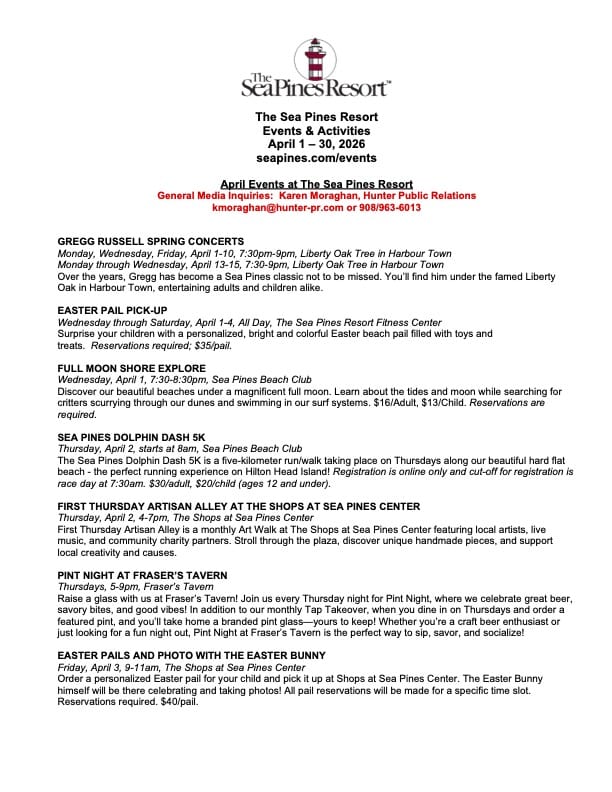
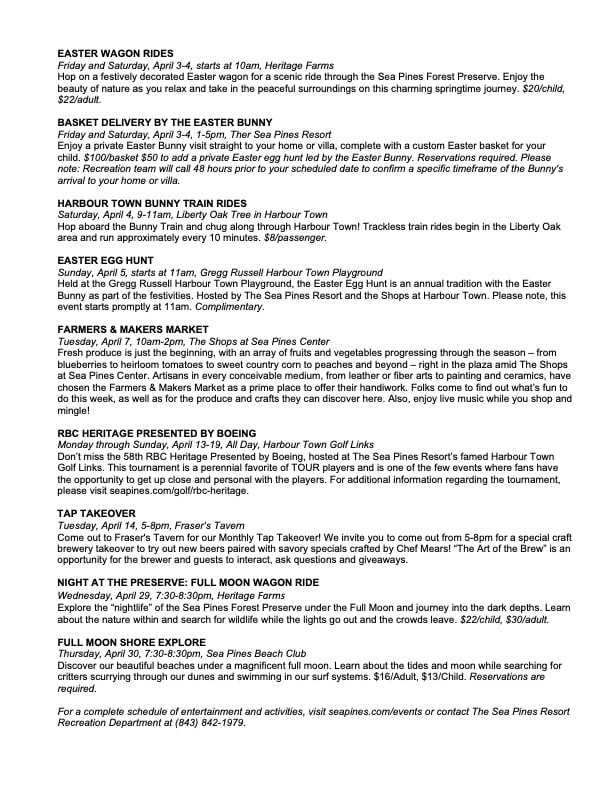
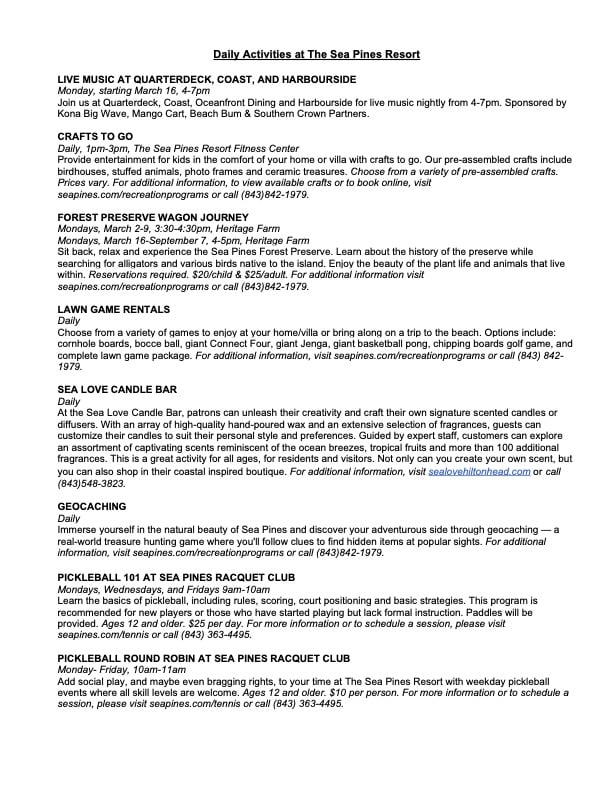
    • The Sea Pines Resort – February 2026 Events Calendar, Harbour Town Yacht Basin, SC AICW MM 565


      Harbour Town at Hilton Head, with its familiar red-and-white-striped lighthouse, is a fine resort marina with an enormous number of amenities.

      Harbour Town Yacht Basin, A CRUISERS NET SPONSOR, is ready for your reservation with newly renovated docks, upgraded electrical service and onSpot WiFi, also a CRUISERS NET SPONSOR. And, as always, numerous activities at the Sea Pines Resort are offered for your enjoyment, as you will see in the Event Schedule below. Hilton Head Island is absolutely marvelous any time of year.

      Be the first to comment!

    • Needed Rain Tonight And Saturday – SCDNR

      South Carolina Department of Natural Resources color logo and white text of agency name and State Climatology Office

      Weather Alert  –  January 2, 2026

      Needed Rain Tonight And Saturday

      Good morning and welcome to 2026. I hope y’all had a grand New Year’s celebration with your friends and family. I know some of y’all did because driving home from my girlfriend’s house during the first minutes of the year, it sounded like Colonel Sumter’s men were driving the British out of Columbia’s Rosewood neighborhood.

      This morning, a storm centered over the southern Plains is moving our way, bringing us some needed rain over the next 36 hours. The rain will reach the northwest later this evening and spread over the state through Saturday morning. While the entire state will see some rain, the southern part will get more than the northern part.

      The rainfall forecast for now through 7 a.m. Sunday from the National Weather Service.

      Here’s the National Weather Service’s forecast for rainfall across South Carolina
      through early Sunday. Most of the state will see a half-inch to an inch of rain.
      Locally heavier rain will fall over the southern part of the state,
      where amounts can exceed one inch in spots.

      Image Source: WeatherBELL

      Meanwhile, a cold front to our north and west will shift southward and send chilly air into the northern part of the state. That will keep the Upstate, Catawba region, and upper Pee Dee in the upper 40s and low 50s, while the Lowcountry sees highs in the 60s.

      The warm air over the southern part of the state will be conducive to thunderstorms rumbling through during the afternoon and early evening. A part of the Lowcountry will be at risk for seeing an isolated severe storm.

      This is the latest Day 2 Severe Weather Outlook graphic from the Storm Prediction Center, covering Saturday and Saturday night.

      The level 1 of 5 (marginal) risk area on the Storm Prediction Center’s outlook for Saturday is the area of concern for severe storms; the concern is for isolated damaging wind and an isolated tornado.

      This storm system will move out Saturday evening, with dry and seasonably cool air pushing in behind it. Sunday may start with lingering low clouds and fog, but it’s likely to be sunny across the state by the afternoon with highs in the mid to upper 50s from north to south.

      Monday also looks dry, with high pressure centered over New York controlling our weather. Highs will range from the mid-50s north to the lower 60s south.

      That area of high pressure will slide eastward on Tuesday, and southerly to southwesterly winds around the departing high will give us a warmup. Temperatures will run well above normal again on Tuesday through at least Thursday. We’ll see highs in the 60s on Tuesday, upper 60s and lower 70s on Wednesday, then most of the state will reach the 70s on Thursday. Tuesday and Wednesday should feature plenty of sun, but clouds will stream in on Thursday ahead of our next cold front.

      Computer models show varying ideas about the front coming our way late next week. It could move in on Friday and become stationary through next weekend, or it could stall to our northwest and not move through until Sunday. So, there is a lot of uncertainty about what the weather will be like during that time. Once that front finally pushes through, we’re likely to see a period of colder-than-average weather.


      This week’s Drought Monitor indicates an expansion of drought conditions since last week. 

      The latest U. S. Drought Monitor shows about 40 percent of the state in a drought and most other areas abnormally dry.

      Rain coming through Saturday will help, but won’t get rid of the drought entirely. Another dry spell Sunday through at least Thursday will not help matters. The setup for next Friday and next weekend has a chance to bring us substantial rainfall, but don’t get your hopes up because most computer models do not show us seeing a soaking.


      Frank Strait
      Severe Weather Liaison
      S.C. State Climate Office

      facebook
      instagram
      rss feed
      twitter
      youtube

      Be the first to comment!

    • Beaufort Docks Under New Management Starting Jan. 1 – Coastal Review

      Be the first to comment!

    • Pileups, Power Outages, Closed Interstates… Meanwhile in the Keys – Key Lime Sailing Club


      Key Lime Sailing Club in Key Largo, 305-451-3438, www.keylimesailingclub.com

      Key Lime Sailing Club, A CRUISERS NET SPONSOR, always has very special offers for their visitors! Key Lime Sailing Club is a unique slice of KEYS ENJOYMENT…give it a try and let us hear about your experience.

      Flip Flops Beat Snow Boots

      Leave the cold behind and settle into a Keys winter filled with sunshine, bare feet, and time well spent at Key Lime Sailing Club and Cottages. Sail (for qualified sailors), or enjoy kayaking, paddle boarding, swimming, snorkeling, cycling, and fishing whenever the mood strikes.

      Spot dolphins and manatees along the way, explore nearby sandbars, take sunset cruises, or wander through local marinas, tiki bars, seafood shacks, and waterfront restaurants.

      Spend a day visiting state parks, coral reefs, historic sites, art galleries, and charming island towns throughout the Florida Keys, then come back to your cottage and slow everything down. This is the kind of winter getaway you will remember.

      Reply to this email with your dates or any questions, or select a cottage and request to book here.

      Ready to Sail This Winter?

      Slots are still open for this winter’s 8-day, 7-night coastal sailing passage from Key Largo to Key West, and it is built to turn “I know the basics” into real confidence on the water.

      This is not a sightseeing trip. You are part of the crew from day one. Under experienced guidance, you rotate through real responsibility, including stepping up as Captain for the Day. You will plan routes, stand watch, make weather calls, handle the boat under sail, anchor, dock, and lead the way between classic Florida Keys stops in warm water and easygoing conditions.

      By the end of the passage, you will have real offshore miles, stronger sail handling, better trim and reefing skills, and a true feel for navigation, weather, and cruising life. You can also complete ASA 104 along the way, with all required on-water skills covered. This trip is for sailors who want more than a resort vacation, beginners who are ready to jump in, and anyone curious about life under sail.

      Winter start dates are flexible, but cabins are limited and tend to go fast. If you want your next season on the water to feel different from the last, this is where it starts.

      View the full itinerary, dates, and certification details here.

      Vote for Your Favorite Key Lime Moments

      Less than 24 hours left. The voting period for our photo contest is almost over.

      Cast your vote now and help crown the winner of our Key Lime Sailing Club and Cottages photo contest! Our guests captured unforgettable moments during their stay, and you can help them win by visiting our Facebook page, viewing all the qualified entries, and clicking “Like” on your favorites.

      You can like as many photos as you want and invite your friends to join the fun too. The photo with the most Facebook Likes by January 1, 2026 at 12:00 am EST will win a FREE three-night stay at Key Lime Sailing Club and Cottages, with winners of both the Photo Contest and Video Contest being announced on January 2, 2026 via Facebook and our email newsletter.

      Thank you to all our amazing guests for sharing your beautiful memories in Key Largo. We are honored to be part of them and wish everyone the best of luck!

      Key Lime Sailing Club and Cottages | 305-451-3438 | 99306 Overseas Highway, Key Largo Florida | www.keylimesailingclub.com
      Facebook  Twitter  Instagram  
      Key Lime Sailing Club and Cottages | 99306 Overseas Highway Key Largo, FL 33037 US
      Constant Contact Data Notice
       

      Be the first to comment!

    • Fun Times: Weekend Forecast Calls for a ‘Tehuantepecker’ – Peter Swanson

      Cruisers Net publishes Loose Cannon articles with Captain Swanson’s permission in hopes that mariners with salt water in their veins will subscribe. $7 a month or $56 for the year, and you may cancel at any time.


      Forwarded this email? Subscribe here for more

      When all else fails, try journalism.


      Fun Times: Weekend Forecast Calls for a ‘Tehuantepecker’

      Keeping ‘One Foot on the Beach’ in a Mexican Gale


      READ IN APP


      Windy app for Saturday, January 31 predicts the effects of high winds funneling through the Chivela Pass through the Sierra Madre. That purplish color signifies winds of up to 50 knots.

      Baby, its cold outside here on the East Coast. This is the story about how the same weather phenomenon that makes us shiver creates a signature gale off the Mexican coast. This is the story of my stormy transit of the Gulf of Tehuantapec in a 37-foot trawler.


      Don’t get me wrong. I take comfort in the presence of law enforcement on the water. I just happen to believe it best to avoid contact with the authorities whenever possible and keep a low profile. This is especially true if I happen to be at the helm of a boat in Latin American waters, where the enforcers are military and the U.S. Constitution holds no sway.

      The trawler yacht I was captaining had crossed into Mexican waters from Guatemala just a few hours earlier. Now, to starboard, a 100-foot Mexican navy patrol boat was cutting through the inky blue Pacific on an intercept course. And the last thing I wanted was to be boarded, searched and questioned.

      When the naval vessel had approached to within a half-mile, a voice on the VHF began calling us in Spanish: “Yacht with the green hull, yacht with the green hull. This is the Mexican navy on channel 16.”

        
      Chef Charles steers the boat as conditions begin to worsen. The boat’s owner had actually specified a single flybridge steering set-up. The boatbuilder installed this temporary deckhouse helm station for the delivery from Florida to Hawaii.

      Here we go, I thought. “Mexican navy, Mexican navy. This is the yacht with the green hull. Ho’Okele. Ho’Okele. We’re an Estados Unidos yacht en route to Ensenada. Our last port was Barillas in Jiquilisco Bay in El Salvador.”

      “USA yacht. What is your name?”

      “Ho’Okele. A difficult word,” I confessed. “Ho’Okele.

      “What is your port of origin?”

      “Florida. Florida, Estados Unidos.”

      “Bien, USA yacht. There is a storm now. Not here, but up ahead. Forty-five-knot winds and 10-foot seas. You ought to be very careful.”

      “Is this storm of the Tehuantepec type?” I asked, though I knew the answer. We were purposely heading into the Gulf of Tehuantepec in time for one of its signature gales.

      Share

      “Yes, yes, a Tehuano,” he said, and proceeded to read an English-language marine forecast, which he pronounced using phonetic Spanish. His performance was endearing and I regretted any negative thoughts I may have directed at the Mexican navy a few minutes before.

      “I understand that during a Tehuantepec storm it is less dangerous near the beach,” I said.

      “Yes, stay near the beach, a half-mile or less.”

      “Thank you for your help, Mexican navy.”

      “We will be here if you need us, captain. Just call. Adios.”

      By now you are probably wondering why my crew and I are taking a 37-foot trawler into some famously foul weather. The story begins in Gainesville, Florida., the home of Great Harbour Trawlers. The builder of Ho’Okele, a Great Harbour N37, needed to get hull No. 3 to Hawaii for the owner, a medical supply company executive with a passion for offshore fishing.

      The owner chose the N37 for its outstanding initial stability, then ordered it built with some funky modifications. He wanted a sportfish-style canvas flybridge for the helm and asked that the usual deckhouse steering station be omitted.

      Following his specifications, the N37’s cavernous aft storage locker was modified to create a hold for his catch, to be iced down with an industrial icemaker. The fact that this full-displacement trawler is an 8-knot boat didn’t matter a whit, since Hawaii’s fishing grounds lay just a few miles off the beach. Heilbron said he wanted to use the boat to tap into the lucrative Asian sushi market.

        
      Once we arrived at Cabo San Lucas we had the luxury of a photo session, running in front of the iconic Cabo arch. Note the funky owner-specified canvas flybridge enclosure. The Tehuantepec run would not have been possible without the temporary inside helm station.

      In a moment of inspired audacity, the owner and Great Harbour president Ken Fickett decided that the boat would be delivered to Hawaii on her own bottom. This unusual decision was due, in part, to conditions in late 2002, when these events occurred. A longshoreman’s strike at West Coast ports had run up shipping costs to the point that it wouldn’t cost too much more just to drive it the nearly 7,000 miles from Florida to Honolulu. Remember, diesel back then was less than $1.50 a gallon.

      Share

      Money was a factor, but both the owner and the factory saw this Hail Mary delivery as an opportunity for bragging rights. A year earlier, Nordhavn had set the standard for adventure by sending one of its 40-footers on a successful journey around the world. Great Harbour wanted its turn at what I later dubbed “heroic marketing.”

      My job was to get the boat from Florida to Ensenada, Mexico, where Heilbron and two other crewmen—handpicked by the factory—would take Ho’Okele the remaining 2,300 miles across the Pacific.

      During the five weeks before the Tehuantepec passage, I had taken the boat from Key West to Isla Mujeres in Mexico, through the Panama Canal to Costa Rica and on to the port at Jiquilisco Bay in El Salvador. With me was a longtime crewmate from Massachusetts, a seagoing chef named Charles deVarennes—Chef Charles for short.

      Let’s Just Go

      Chef Charles and I were holed up with Ho’Okele at Marina Barillas in El Salvador over the New Year’s holiday. We were watching the weather to gauge when best to embark on a 475-mile run to a little resort town in the Oaxaca region called Santa Cruz. It didn’t look good. January sees Tehuantepec storms, or Tehuanos, on 19 of its 31 days. Anyone seeking to take a yacht from one coast to the other during winter must transit these waters.

      The meteorological chain of events that causes Tehuanos is straightforward. In winter, cold high-pressure systems march southward from Texas over the Gulf of Mexico, creating pressure gradients that generate winds through three mountain passes—one in Mexico that leads to the Gulf of Tehuantepec, one in Costa Rica that empties into the Gulf of Papagayo and one in Panama. These passes through the cordilleras act like funnels, accelerating the winds. Counterintuitively, Tehuanos and their southern cousins produce waves coming out from land, not crashing against it.

      Reading the guides and several magazine articles and talking to West Coast cruisers had left me with the impression that Tehuantepec storms were difficult to anticipate. This is total nonsense. Bear in mind, this is from an era before Windy, the weather app.

      But even then, the U.S. Navy’s weather prediction center, known by the unpronounceable acronym FNMOC, clearly showed that a gale would be brewing in the Gulf of Tehuantepec days before the event. It was plain to see in the wave height and direction section of its website, which Chef Charles and I were examining at Marina Barillas. FNMOC’s wave map clearly showed a patch of 10-foot seas coming off the Mexican coast at the Gulf of Tehuantepec.

      Nowadays, the Windy app would be a go-to source as it renders the Navy data in a clear and useful fashion.

      Earlier in the voyage, Chef Charles and I had crossed the Gulf of Papagayo during just such a “Papagayo” storm, with sustained 35-knot winds. We rocked, rolled and pounded in the short chop, but reached the eastern side of Papagayo to find calm waters near shore—none the worse for it.

        
      This is the scene as we approached the Gulf of Tehuantec. You can see the Sierra Madre through the haze.

      Eric Kunz, a product development manager at electronics manufacturer Furuno, had warned me about “Tehuantepeckers” when I explained Ho’Okele’s route to him. So had Great Harbour naval architect Lou Codega, who once had witnessed Tehuano bedlam from the deck of a ship. It was Kunz who gave me the classic advice about “keeping one foot on the beach.”

      Charlie, I said, let’s just go. Get it over with. We could sit at Marina Barillas for weeks and never get a weather window. Ho’Okele had performed well during the Papagayo, and drawing under three feet, she was an ideal vessel for shoal water work. No matter how bad it gets, I said, it will all be over 24 hours after it starts. Vamonos.

      Plotter Problems

      Our conversation with the Mexican navy occurred at around 8:30 a.m. Jan. 3. By midafternoon and with Santa Cruz still 30 hours away, Ho’Okele came under attack, as winds whipped up to 35 knots. As predicted, however, seas close to the beach were only one to two feet, but that did not mean we would have a dry ride. Increasing to more than 40 knots, the wind grabbed the tips of these waves and hurled water against us.

      Even though Ho’Okele’s owner wanted the single steering station on the flybridge, Great Harbour installed a temporary helm and console in the deckhouse for the purposes of the delivery, or we never would have braved the storm. Snug inside, we could see nothing to starboard; that side looked as if we were going through a car wash. At the windshield, the view was just as poor. We could only see out the port side and aft glass.

      Entering the storm in daylight gave me the chance to work out a system for keeping a consistent half-mile out that could be applied once the sun had set. The chartplotter’s cartography was faulty for this section of Mexico, we soon learned, as the plotter displayed Ho’Okele’s position more than a quarter-mile inland.

      Radar would be the answer. I got the boat on course using the radar and put a cursor waypoint on the plotter so the autopilot would have something to steer to. Then it would be just a matter of monitoring our progress and adjusting our course with new cursor waypoints as the shore curved.

      All this sounds pretty straightforward, and in daylight it was. Night would be different—no moon, nothing to see but brine and blackness. One of the Spanish words for darkness has no single-word English equivalent. The word is tinieblas, which translates as utter darkness or pitch black, black in an almost Biblical sense.

      Tinieblas—we might as well have been a submarine. So besides keeping our right foot on the beach, Ho’Okele’s radar would be our only way to avoid collision with other stray vessels or big debris, a process of regularly varying range and gain.

      Our only emergency happened around midnight. I was looking down into the chart plotter and saw a number changing—seven, six, five, four, three. Holy moley! It was the depth sounder readout! I took control of the boat away from the autopilot and turned us 90 degrees to port to head offshore. The depth rose almost immediately to five feet, but took what seemed like forever to get past 10.

      We had almost run into a sand berm alongside the mouth of a big lagoon. The plotter showed this obstacle more than a mile ahead, but, of course, we had established that the chart was wrong. In retrospect, going aground probably would have been okay because of the manageable sea state and offshore winds. With twin Lugger engines turning big screws, we would have had little trouble backing and twisting into deeper water. But with 40- to 45-knot winds and utter darkness, it was a scary thought at the time.

      We went out about a mile to skirt the sandbars and found ourselves bouncing in square four- to five-foot seas, which utterly discombobulated the autopilot, so I hand-steered until we were able to crab toward shore and renew our half-mile interval. I let Chef Charles play the radar-sounder video game for a couple of hours while I took a nap.

      At 4 a.m. I took over again, wearing a sweatshirt against the cold. By the radar, I thought, we were skirting the shore a little too closely, but I had a heck of a time getting it to the correct interval and steering by waypoint at the same time. After a two-hour nap, I was out of practice.

      At 6 o’clock, Chef Charles took over for the dawn watch and never thought to wake me for a most marvelous sight. I later read that the Tehuano’s jet winds bring cold water to the surface and, with it, the dissolved nutrients that form the base of the marine food chain. The sea surface temperature can drop more than 20 degrees in a single day of Tehuano winds and, when that happens, the fish are biting.

      Through the spray and salt-encrusted glass—the boat was covered in salt—Chef Charles saw native people in groups of two or three on the beach with great big kites. They launched the kites off the beach with fishing gear attached, flying them far out over the gulf, then dropped the whole rig into the water.

      We were exhausted, but we had done it. We deserved to get an ear pierced, or maybe a Tehuantepecker tattoo, whatever that would be.

      Recently, someone on Facebook asked about a January transit of the Gulf of Tehuantepec. He had a sailboat that drew six feet.

      I don’t care how well his canvas enclosure was made, the wind on the landward side of the vessel would have pushed water through the zippers like a pressure washer. Because of his draft, he would be transiting in a zone of tall, square seas. No go.

      This is a passage for shoal draft, a warm pilot house and good electronics.

      Ocean Navigator Interview


      LOOSE CANNON covers hard news, technical issues and nautical history. Every so often he tries to be funny. Subscribe for free to support the work. If you’ve been reading for a while—and you like it—consider upgrading to paid.


      ·
       
      Jan 23


      The Stuart Boat Show earlier this month was mostly dedicated to the sales of center-consoles with a smattering of pontoon boats and a couple trawler yachts, so as you might expect it wasn’t a cruising crowd. But what attendees might have lacked as mariners, they compensated fo…


      Read full story
       

      You’re currently a free subscriber to LOOSE CANNON. For the full experience, upgrade your subscription.

      Upgrade to paid

       
      Like
       
      Comment
       
      Restack


      Be the first to comment!

    • Elizabeth City: Lights of the Albemarle Lighted Lantern Parade – TONIGHT


      Elizabeth City sits at the southern terminus of the Dismal Swamp Canal and has the well-earned reputation of being a transient-friendly town with free dockage for 72 hours.

      Be the first to comment!


    Social Media Auto Publish Powered By : XYZScripts.com