


CRUISERS NET
Cruisers Helping Cruisers
Comprehensive cruising resource for the Intracoastal Waterways
from Norfolk to the Northern Gulf and Bahamas.
from Norfolk to the Northern Gulf and Bahamas.
FREE to use due to the generosity of our sponsors - please patronize them
East Coast Major Storm Update – Fred Pickhardt
Fred Pickhardt’s Substack is free today. But if you enjoyed this post, you can tell Fred Pickhardt’s Substack that their writing is valuable by pledging a future subscription. You won’t be charged unless they enable payments.
 Forwarded this email? Subscribe here for more
East Coast Major Storm Update
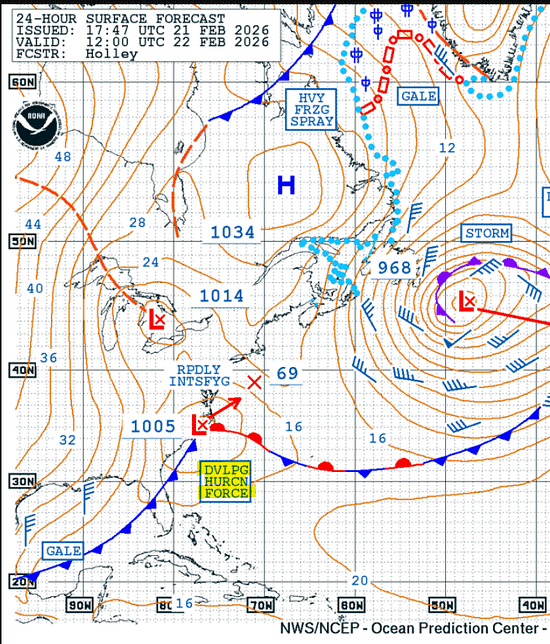
A major winter storm is forecast to impact the Mid-Atlantic and Northeast from Sunday, February 22, through Monday, February 23, 2026.



A powerful nor’easter is expected to produce widespread snowfall of 1 to 2 feet (12–24 inches) and blizzard conditions along coastal areas, resulting in nearly impossible travel and potential for numerous power outages.
Key Weather Hazards
- Blizzard Conditions: Millions of residents from coastal Delaware through southeastern New England are under blizzard warnings. High winds combined with heavy snow will cause whiteout conditions and near-zero visibility.
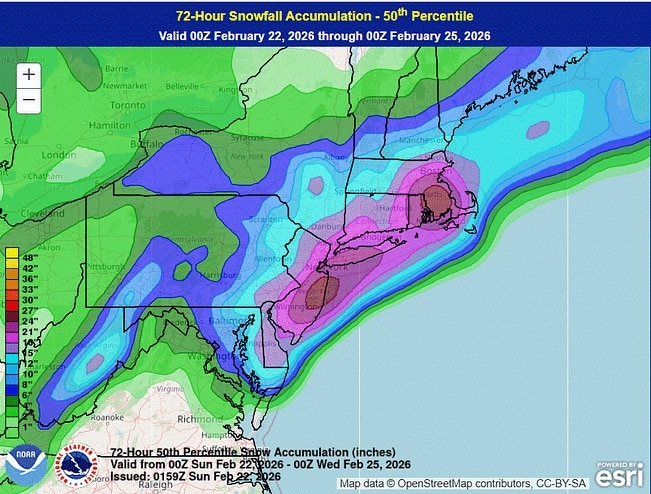
- Extreme Winds: Wind gusts are expected to range from 40 to 70 mph from coastal New Jersey to southeast New England.
- Power Outages: The combination of strong winds and the weight of heavy, wet snow is likely to cause scattered to numerous power outages.
- Coastal Flooding: Moderate to major coastal flooding and high surf are forecast, with inundation of roads and property most likely from Delaware to Cape Cod.
Travel and Safety Impacts
Travel will become treacherous to life-threatening starting Sunday afternoon. Officials have urged residents in major metropolitan areas, including New York City, to stay off the roads. Significant disruptions to travel and infrastructure are likely, including widespread flight cancellations and school closures on Monday.
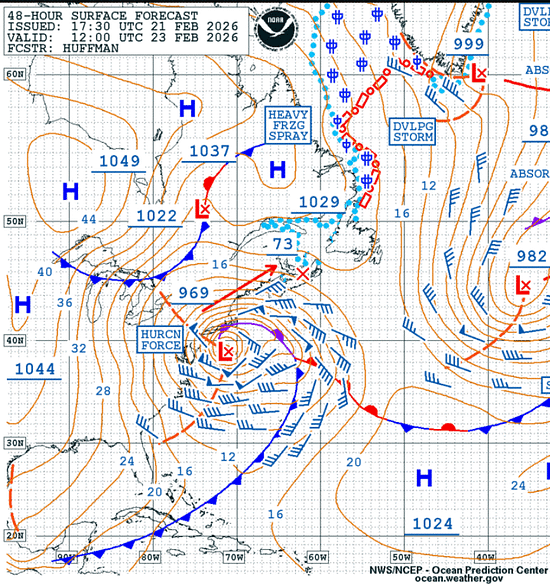
Offshore Waters
Storm to Hurricane force winds and seas building up to 9-11 meters within 180-360 nm south of the center during the next 36-48 hours.
NOAA US Coastal Waters Forecasts
NOAA Weather Prediction Center
You’re currently a free subscriber to Fred Pickhardt’s Substack. For the full experience, upgrade your subscription.
© 2026 Fred Pickhardt
548 Market Street PMB 72296, San Francisco, CA 94104
Unsubscribe

Be the first to comment!
- Blizzard Conditions: Millions of residents from coastal Delaware through southeastern New England are under blizzard warnings. High winds combined with heavy snow will cause whiteout conditions and near-zero visibility.
March Cruising Weather in the Gulf & Caribbean – Fred Pickhardt
Fred Pickhardt’s Substack is free today. But if you enjoyed this post, you can tell Fred Pickhardt’s Substack that their writing is valuable by pledging a future subscription. You won’t be charged unless they enable payments.
Forwarded this email? Subscribe here for moreMarch is one of the most popular months for cruising the Gulf of Mexico and the Caribbean—and for good reason. It sits right at the sweet spot between winter cold fronts and the start of the wetter summer pattern. For cruisers, that means comfortable temperatures, manageable seas, and very low risk of tropical weather…

Continue reading this post for free in the Substack app
Like
Comment
Restack
© 2026 Fred Pickhardt
548 Market Street PMB 72296, San Francisco, CA 94104Be the first to comment!
Hurricane Force Wind Warning: West Atlantic – Fred Pickhardt
Fred Pickhardt’s Substack is free today. But if you enjoyed this post, you can tell Fred Pickhardt’s Substack that their writing is valuable by pledging a future subscription. You won’t be charged unless they enable payments.
Forwarded this email? Subscribe here for more
A 1000 mb low at 36N 72W is moving NE at 25 knots with winds up to 45 knots and 5-meter seas. Within the next 30 hours the storm center will intensify significantly, with central pressure dropping to 966 mb. Winds will reach 55 to 70 knots with seas building 8 to 13 meters (approx. 26 to 43 feet) within 180 nm south of the low center.

You’re currently a free subscriber to Fred Pickhardt’s Substack.
Be the first to comment!
Severe Weather Risk For Southeast Update – Fred Pickhardt
Fred Pickhardt’s Substack is free today. But if you enjoyed this post, you can tell Fred Pickhardt’s Substack that their writing is valuable by pledging a future subscription. You won’t be charged unless they enable payments.
Forwarded this email? Subscribe here for more
There is a risk for severe weather across the Southeast through Sunday due to severe thunderstorms with potentially damaging gusty winds and a few possible tornadoes, particularly across northern Florida and Georgia, including the adjacent coastal waters.

There is a 5 to 15% risk for wind gusts in thunderstorms to exceed 50 knots producing Hazardous sea conditions over the coastal waters of parts of Florida and Georgia.
You’re currently a free subscriber to Fred Pickhardt’s Substack. For the full experience, upgrade your subscription.
© 2026 Fred Pickhardt
548 Market Street PMB 72296, San Francisco, CA 94104
Unsubscribe

Be the first to comment!
Storm Update: Marine Severe Weather Risk – Fred Pickhardt
Fred Pickhardt’s Substack is free today. But if you enjoyed this post, you can tell Fred Pickhardt’s Substack that their writing is valuable by pledging a future subscription. You won’t be charged unless they enable payments.
Forwarded this email? Subscribe here for more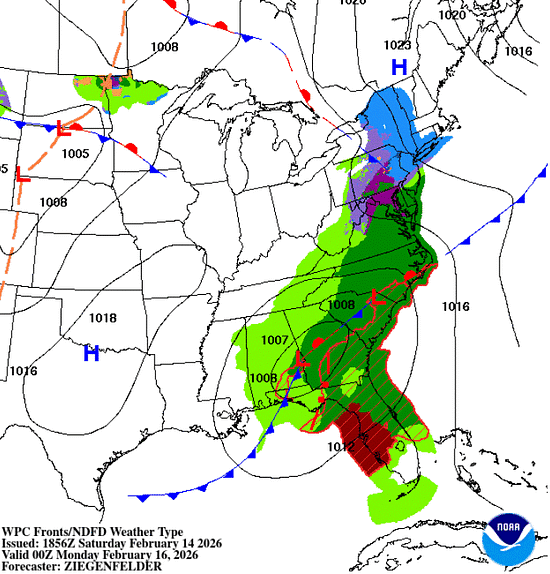
A strong storm system is making its way across the South and East, bringing a threat of severe weather and localized flooding through Monday morning. For Saturday and Sunday, February 14-15th, the Storm Prediction Center indicates a 5-15% risk of severe thunderstorms capable of producing wind gusts of 50 knots or higher for the adjacent marine areas of the Gulf and portions of the coastal waters of Georgia and northern Florida.


Be the first to comment!
Severe Weather Threat to West-Central Gulf Coastal Waters – Fred Pickhardt
Fred Pickhardt’s Substack is free today. But if you enjoyed this post, you can tell Fred Pickhardt’s Substack that their writing is valuable by pledging a future subscription. You won’t be charged unless they enable payments.
Forwarded this email? Subscribe here for moreSevere weather is expected to impact the Southern U.S. from Saturday, February 14 (Valentine’s Day) into early Sunday morning. A potent storm system moving from the Southern Plains toward the Mississippi Valley will trigger multiple hazards across the region.

There will be at least a 15% probability of damaging thunderstorm winds or wind gusts of 50 knots or higher in the coastal waters of northeastern Texas to the coast of central Louisiana.

Be the first to comment!
Major East Coast Storm Update: Powerful Winter Storm Likely – Fred Pickhardt
Fred Pickhardt’s Substack is free today. But if you enjoyed this post, you can tell Fred Pickhardt’s Substack that their writing is valuable by pledging a future subscription. You won’t be charged unless they enable payments.
Forwarded this email? Subscribe here for more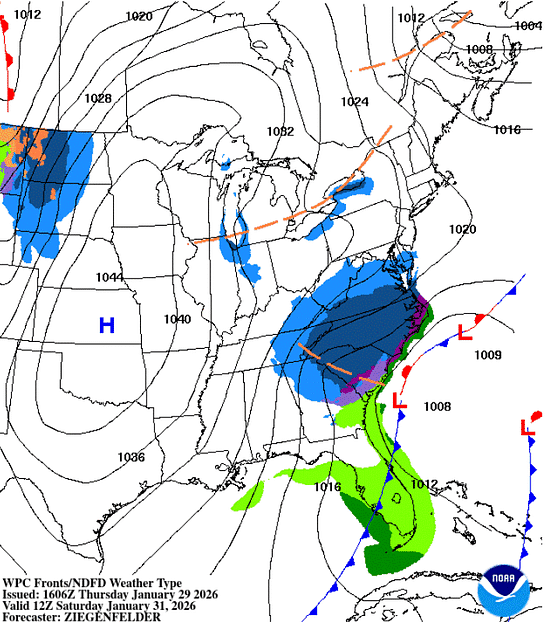
A powerful winter storm, forecast to intensify into a “bomb cyclone,” is expected to create dangerous marine conditions along the US East Coast and Western Atlantic from Saturday through Monday…
Continue reading this post for free in the Substack app
© 2026 Fred Pickhardt
548 Market Street PMB 72296, San Francisco, CA 94104
UnsubscribeBe the first to comment!
Weather Alert (Jan 29): Snowstorm This Weekend – SCDNR

Weather Alert – January 29, 2026
Snowstorm This Weekend
Key Points:
- A snowstorm is likely to affect South Carolina Friday night through Saturday night. A Winter Storm Watch is in effect for the entire state.
- Many areas may see light rain at the onset, and parts of the Coastal Plain may see up to a few hours of sleet and freezing rain. However, the risk for power outages will be low because significant ice buildup is unlikely, and the snow will be dry and fluffy.
- Snow will start Friday evening in the Upstate and spread over the state through the night, reaching I-20 by around midnight and the Lowcountry around daybreak.
- There remains uncertainty about how much snow will fall. However, the Catawba Region, the Pee Dee, and perhaps the Grand Strand will likely see the heaviest snowfall.
- Snow will taper off from west to east on Sunday, ending by daybreak in the Upstate and by midday along the Grand Strand.
- Winds will increase during the storm with peak gusts of 35-40 mph along the coast and around 30 mph elsewhere on Sunday. The wind will cause blowing and drifting snow where we see a substantial accumulation. The winds will also drive wind chills down to the single digits and teens over most of the state on Saturday through Sunday.
- Roads will become slippery for a few days where substantial snow falls because it will remain cold behind the storm, resulting in slow daytime melting and nighttime refreezing. The extent and duration of potential travel problems are uncertain; it will depend on how much snow falls.
It’s gonna snow this weekend, y’all, with impacts from the storm lingering into early next week. The only questions are how much, and who gets the heaviest.
In the meantime:
- A moisture-starved front in the area through tonight brings us some high clouds, but no rain or snow. Probably would have been snow with a better supply of moisture.
- Clouds will increase on Friday into Friday night ahead of the approaching storm. Highs on Friday will range from the low 40s in the Upstate to the upper 50s in the far south.
Uncertainty remains in the forecast, but there is more confidence than before. We can provide you with an accumulation forecast now; here’s what the National Weather Service (NWS) is calling for:

The current questions are about where the heaviest snow falls and how much we all see. The heaviest snow may fall over tomato-and-vinegar country instead of here, though it’s most likely that some of the heavy snow will affect the northern part of the state. The greatest uncertainty for snow amounts is over the Grand Strand and lower Pee Dee region; the ceiling is pretty high there, but the most likely scenario is relatively low. I just did a quick check before sending this out; it looks like the NWS is in the process of increasing the forecast snow for the Pee Dee region, so don’t be surprised to see the forecast for that area being bumped up.
Storms like these sometimes cause oddities, such as a large difference in snowfall over a relatively short distance, due to small bands of heavy snow that often form. Don’t be surprised if what falls in your backyard varies a lot from what a buddy of yours 15 miles away sees.
The primary impact will be slippery travel, since it’s going to be mainly dry, fluffy snow (parts of the coastal Plain might see a brief period of freezing rain that would make elevated roads slick like a muddy pig). Snow-covered roads will be a problem Saturday through Monday morning, and it’s going to remain cold behind this storm, so the roads could remain slick for a while. How hard it will become to get around and how long the roads remain bad will depend on how much snow falls. If you’re in an area that could see over three inches, start planning to avoid travel from Saturday through at least Monday. Areas to the south are likely to see lower impacts, but travel will be hazardous at least through Saturday and Sunday morning.
Bundle up if you go out to play in the snow or if you must be out for work or an emergency; this is among the coldest snow events we’ve seen. The frigid winds will bring a bite, so layer up! Do check your pipes if you didn’t before the last storm to ensure that they’re properly insulated, because it will be at least as cold behind this storm as it was after the last one.
What else can you do now? Check out SCEMD’s SC Winter Weather Guide and ready.gov for tips, and go from there.
Frank Strait
Severe Weather Liaison
S.C. State Climate Office


South Carolina Department of Natural Resources
260 D. Epting Lane
West Columbia, SC, 29172Stay Connected with SCDNR: 




SUBSCRIBER SERVICES:
Manage Subscriptions | Unsubscribe | HelpBe the first to comment!
New Climate Reports Show ‘Unprecedented Run of Global Heat’ – Inside Climate News (ICN)
Be the first to comment!
Weather Alert (Jan 28): Snow Likely This Weekend – SCDNR
Weather Alert – January 28, 2026
Snow Likely This Weekend
Key Points:
- Confidence is increasing for most or all of South Carolina to see a snowstorm this weekend.
- Mainly snow will fall, but many areas may see light rain at the onset, and parts of the Coastal Plain may see up to a few hours of sleet and freezing rain. However, the risk for power outages will be low because significant ice buildup is unlikely, and the snow will be dry and fluffy.
- Snow amounts are in question, and it’s still too early to provide specifics. However, it’s likely that the Catawba Region, the Pee Dee, and the Grand Strand will see the heaviest snowfall and have the best chance of three inches or more.
- The potential exists for slippery travel starting Friday night with snow falling through Saturday night. Roads may remain slippery for a few days where substantial snow falls because it will remain cold behind the storm, resulting in slow daytime melting and nighttime refreezing. The extent and duration of potential travel problems are uncertain.
- Winds will increase during the storm with peak gusts of 35-40 mph along the Coastal Plain and around 30 mph elsewhere on Sunday. The wind will cause blowing and drifting snow where we see a substantial accumulation. The winds will also drive wind chills down to the teens over most of the state on Saturday through Sunday and to the single digits Sunday night.
Another winter storm now looks likely for most or all of the state Saturday into Sunday. There is good computer model agreement that the storm will bring mainly snow, but they disagree on the amounts. Some show a major event with parts of the state seeing over six inches, while others show a peak of only a few inches.
In the meantime:
- We’ll remain dry ahead of the storm, but a moisture-starved cold front will move through tonight into Thursday. Highs on Thursday will range from the low 40s north to near 50 south.
- Clouds will increase on Friday ahead of the approaching storm. Highs on Friday will range from the low 40s in the Upstate to the upper 50s in the far south.
Uncertainties remain because of the complexity of the weather pattern over North America. The primary weather feature is moving southward from Hudson Bay today. It will cross the Great Lakes on Friday and reach the Tennessee Valley on Saturday. It will then move through the Carolinas and depart to the northeast on Saturday night into Sunday. Pacific disturbances now south of Alaska and west of Baja California may join with the storm and add moisture. However, the computer models could be off on the timing of those Pacific disturbances, and they may end up not becoming involved. More available moisture would lead to more snowfall.

This annotated infrared satellite image shows the complexity of our current weather pattern that leads to the uncertainties with this weekend’s potential winter storm:
- The track of the primary feature moving south from Hudson Bay is in question, and slight differences in its track could make a big difference in how severe the storm is for South Carolina.
- We may see weather features currently over the Pacific pulled into the weekend storm, and this would result in more moisture available and a more energetic storm.
- Other weather features not directly involved in the storm may still influence its behavior.
Image Source: University of Wisconsin RealEarth
However, the range of scenarios points to at least a little snow falling over some or all of South Carolina as early as Friday night. Some scenarios would lead to less moisture available, and some would result in the storm not really getting its act together until it’s moving away from us. Others show the storm intensifying by the time it gets here, bringing a major snowstorm that affects most of the state. The truth is somewhere in between, but the model trend over the last day has been toward more snow.
You can expect different impacts from this storm than from this past weekend’s, since it’s likely to bring snow rather than thick ice. Also, the snow will be dry and fluffy because it will be so cold, and it won’t adhere well to trees or power lines, so the risk for power outages will be low. Slick roads will be a problem, and it’s going to remain cold behind this storm, so the roads could remain slick for a while. How hard it will become to get around and how long the roads remain bad will depend on how much snow falls. It’s too early to give specific accumulation numbers (that’s coming tomorrow), but the area east of I-77 and north of U.S. 378 has the best chance of heavy snow. If you’re in that area, start planning to avoid travel Saturday through at least Monday. The rest of the state is likely to see lower impacts, but travel will be hazardous at least on Saturday and Sunday.
What else do you do now? Check out SCEMD’s SC Winter Weather Guide and ready.gov for tips, and go from there.

Frank Strait
Severe Weather Liaison
S.C. State Climate OfficeSouth Carolina Department of Natural Resources
260 D. Epting Lane
West Columbia, SC, 29172Stay Connected with SCDNR: SUBSCRIBER SERVICES:
Manage Subscriptions | Unsubscribe | HelpBe the first to comment!
Mardi Gras Fun in St. Marys & Kingsland, St Marys, Georgia, off AICW MM 712
During Mardi Gras or anytime be sure to stay at St Marys Intracoastal Gateway Marina, a CRUISERS NET SPONSOR!
2026 Mardi Gras Fun in St. Marys & Kingsland
KINGSLAND: FEBRUARY 6-7 ~~~ ST. MARYS FEBRUARY 15 & 17
KINGSLAND: FEBRUARY 6 & 7, 2026
ST. MARYS: FEBRUARY 15 & 17, 2026
Let the Good Times Roll in St. Marys and Kingsland with a free concert with a nationally recognized artist (Collin Raye played in 2025), pirates, a family day, and a nighttime illuminated parade and concert.
When you think of Mardi Gras, your mind might drift to the spirited streets of New Orleans, but there’s another area where the spirit of Mardi Gras comes alive in a uniquely Southern way—Camden County, Georgia. Less than an hour north of Jacksonville, Florida, situated along the scenic southeastern coast, Camden County is home to two charming cities, Kingsland and St. Marys, that are both pulling out all the stops to deliver a memorable Mardi Gras experience. Here, you’ll find lively parades and toe-tapping concerts alongside family-friendly festivities and dazzling evening events, so consider this your invitation to join in on the celebration.
Kingsland Kicks Off the Festivities February 6 & 7, 2026
The Mardi Gras magic commences in Kingsland, just fifteen minutes from downtown St. Marys, with the K-BAY Mardi Gras Festival. On Friday, the festival kicks off with live music from 6-10 PM setting the tone for a weekend filled with rhythm and revelry. Saturday then ramps up the excitement with a full day of activities beginning at 9 AM, including the Mardi Gras Parade at 10 AM, where the streets are filled with camaraderie and cheer. Post-parade, the festival grounds come alive with creative vendors, unique crafts, fantastic festival food, and free concerts. The evening culminates with a performance by a chart-topping music legend at 6 PM promising a night of unforgettable entertainment. For Kingsland parade applications, vendor inquiries, or more information, visit the K-BAY Festival website here or call 912-729-6000.
SUNDAY, FEBRUARY 15, 2026
St. Marys Takes Center Stage for Family-Friendly Fun with the St. Marys Mardi Gras Jubilee at the St. Marys Waterfront Park on Sunday, February 15, 2026.
The St. Marys Mardi Gras Jubilee, held from 1-4 PM at the St. Marys Waterfront Park (201 St. Marys Street, St. Marys, Georgia 31558; 912-882-4000), is designed to delight visitors of all ages. Kids will be in heaven with a Kids Court featuring a Lucky Ducks game, football toss, Mardi Gras mask making station, Connect Four, Wheel of Fortune, Plinko, and face painting. The St. Marys Pirates Buccaneer Fun Zone will host Chuck-a-Duck, “Reel” fishing, and Ring Around the Sword games and kids can learn how to talk like a pirate and get to walk the plank. Other activities include miniature golf putting greens and bounce houses and an interactive golf experience.
It will be a carnival-like atmosphere where laughter and joy are guaranteed. Meanwhile, parents can relax and enjoy a lively DJ who will keep the energy elevated throughout the afternoon. What is a Mardi Gras Jubilee without king cake? Indulge in this traditional treat alongside a variety of delicious meal and dessert food trucks. The waterfront setting creates a gorgeous backdrop to the festivities, making it the perfect spot to unwind and soak in the Mardi Gras spirit.
TUESDAY, FEBRUARY 17, 2026
Fat Tuesday Fest in downtown St. Marys.
Fast forward to Fat Tuesday where, as the sun sets, the celebration continues with Fat Tuesday Fest – an Illuminated Parade & Party in the Park on Tuesday, February 17th. The evening kicks off at 6:30 PM with an illuminated parade that will light up the streets of St. Marys. The parade will start at Church Street and end at the waterfront park. Following the parade, the party moves to the park for a 7:30 – 9PM concert. This is your night to glow, sparkle, and be flashy! For St. Marys parade applications, to vote for your favorite decorations, or more information, go to www.visitstmarys.com or call 912-882-4000.
A Citywide Celebration of Mardi Gras Magic
The Mardi Gras spirit isn’t confined to the events. In fact, it’s alive all-around town! St. Marys is hosting a citywide Mardi Gras window and porch decorating contest, encouraging residents and businesses to showcase their creativity and festive flair. Take a stroll through the charming streets and admire colorful displays that add to the celebratory atmosphere. Use the QR displayed in the window to vote for your favorite. More to come on this later!
Plan Your Mardi Gras Getaway to Camden County
Camden County, Georgia, is the ideal destination for a Mardi Gras celebration that combines tradition, family fun, and Southern hospitality. Whether you’re dancing to live music in Kingsland, reveling in waterfront festivities in St. Marys, or simply soaking in the jubilant decorations around town, you’ll find that this corner of Georgia knows how to throw a party.
Start planning your Mardi Gras getaway today and be sure to stay current on local events, accommodations, attractions by checking out www.visitstmarys.com Bring some beads so you’ll be ready to experience an authentic Camden County Mardi Gras. As the French say, Laissez les bons temps rouler—let the good times roll!

Mardi Gras Celebrations in St. Marys!
Mardi Gras Fun in St. Marys & Kingsland
Be the first to comment!
Weekend Winter Storm Update – SCDNR
Weather Alert – January 21, 2026
Weekend Winter Storm Update
Key Points:
- A Winter Storm Watch is now in effect for much of northern South Carolina, including the Upstate, Catawba Region and Chesterfield County.

A map showing the counties under a Winter Storm Watch, highlighted in blue
- Confidence continues to increase that at least a part of South Carolina will be affected by a major, long-duration winter storm this weekend.
- However, the storm’s forecast track has shifted northward, lessening potential impacts for areas along and south of I-20. Timing has changed as well, with the storm starting in the afternoon or evening on Saturday and lasting into early Monday.
- The storm’s details, such as precipitation type, remain uncertain. Shifting computer model output will likely lead to more forecast changes.
- Most likely scenario, not heavily favored due to uncertainty:
- Snow, if any, and sleet in the Upstate starting on Saturday, will eventually turn to freezing rain. There may be a sleet accumulation into Saturday night, and a damaging ice buildup is possible on Sunday. Travel will be hazardous through at least Monday morning. Should there be a significant sleet accumulation, it would be slow to melt behind the storm as it remains cold.
- Across the CSRA, the Midlands, and northern Pee Dee, freezing rain may dominate north of I-20, with a chance of damaging ice accumulation and slippery travel Saturday night into Sunday. Areas along and south of I-20 see freezing rain for a time, then rain as temperatures warm above freezing on Sunday.
- Areas further south and east may see freezing rain for a time Saturday night, then rain Sunday. Elevated road surfaces could become icy for a time.
- The Lowcountry and Grand Strand primarily see rain, though a period of freezing rain is possible at the onset, especially inland. Some models show it warming up enough on Sunday for thunderstorms.
- Worst-case scenarios include:
- A severe ice storm is possible where freezing rain is dominant; the best chance appears to be in the Upstate, the Catawba Region, and the northern CSRA and Midlands.
- Continued northward shifts in the storm track would shift the potential for sleet accumulations out of South Carolina, but a damaging ice storm would still occur in the Upstate. Less of the state would be at risk for a damaging ice buildup.
- A more southerly track of the storm would bring heavy snow and sleet back into South Carolina, with a damaging ice storm further south, as previously thought. This idea is looking increasingly unlikely. However, the warmer, further north computer models may not be handling this weekend’s cold-air damming, and temperatures may remain below freezing near I-20 longer than the models indicate, resulting in a significant ice buildup in that area.
Good afternoon. A northward shift in the computer model guidance on the track of a winter storm for much of the nation changes the potential impacts here in South Carolina.
The forecast for now through Friday night remains unchanged:
- We remain dry through most of tonight.
- The next cold front will move in on Thursday, bringing light rain to the Upstate, possibly starting by daybreak in some areas.
- Light rain is possible over much of the state Thursday night into Friday evening as this cold front slowly sinks southward.
- Arctic air will filter into South Carolina behind this front starting Friday evening.
Our next storm, currently approaching California, will reach us on Saturday. It has become unlikely that any significant snow will fall in the state (a little at the onset maybe), but sleet and freezing rain are likely to affect much of the state. The computer models continue to show a range of possibilities, but the trend has been our friend, showing less of the state experiencing significant impacts.
It would be best to start your preparations soon if you’re in an area that still may be hit by a damaging ice storm and slippery travel. How do you deal with it? SCEMD’s SC Winter Weather Guide is a good starting point, and you can get more tips on winter storm preparedness at ready.gov. Pay close attention to the generator safety and kerosene and propane heater safety tips; carbon monoxide is quite the villain.
The picture should get increasingly clearer over the next couple of days as we get closer to the event. Another update is coming on Thursday!

Frank Strait
Severe Weather Liaison
S.C. State Climate OfficeSouth Carolina Department of Natural Resources
260 D. Epting Lane
West Columbia, SC, 29172Stay Connected with SCDNR: SUBSCRIBER SERVICES:
Manage Subscriptions | Unsubscribe | HelpThis email was sent to curtis.hoff@cruisersnet.net using GovDelivery Communications Cloud on behalf of: South Carolina DNR ·1000 Assembly Street · Columbia, SC 29201 Be the first to comment!
Potential Winter Storm Sunday – SCDNR
Weather Alert – January 15, 2026
Potential Winter Storm Sunday
Key Points:
- Fresh cold air will trickle into South Carolina Saturday night, then a storm system will arrive early Sunday to bring precipitation. There’s a chance it’s cold enough for snow, at least at the end of the precipitation or on the northwestern part of the area that sees precipitation.
- The latest computer model trends as of late Thursday evening are toward a mostly rain event, but it’s a close call and we’re not out of the woods yet. Models sometimes flip-flop, even within a couple of days of an event.
I said y’all would probably be hearing from me again sooner rather than later, and here we go (now that Verizon has its act together and I can use 2-factor authentication to access the system that composes these … been trying to send y’all of these since Wednesday morning). I wanted to get something out now that I finally can, so enjoy this waiting for you when you wake up or something to read during the downtime of your graveyard shift.
We’re at risk of seeing a winter storm on Sunday, though nothing is set in stone yet due to uncertainties.
First, let me set the table for the potential Sunday snow dinner:
- Winds are diminishing tonight, but aside from a bitterly cold morning, Friday won’t be as harsh as Thursday was.
- Another cold front will move through late Friday night into Saturday morning, causing a period of light rain in the Upstate. It may be cold enough for snow north of Highway 11, but you’d have to be on a high spot for a chance at an accumulation.
- Reinforcing cold moves in behind the front for Sunday, and the front will turn stationary along our coast late Saturday night.

This Weather Prediction Center weather map for Saturday evening shows a cold front moving through South Carolina and precipitation breaking out along the Gulf Coast.
Here are the uncertainties for Sunday’s storm:
- We know a storm will track along the front, moving along the Gulf Coast and then along our coast late Saturday night through Sunday. However, the storm could track farther inland or farther offshore, which will affect where the heaviest precipitation falls.
- The storm’s intensity is uncertain; a stronger storm would lead to more widespread and heavier precipitation.
- We’re not sure how well the cold air will penetrate South Carolina; it may not be cold enough for snow in areas where significant precipitation falls.
- Even if it snows, the storm will mostly occur during the daytime, which makes it harder for the snow to stick.
To illustrate the point, here’s output from one of the computer models, the GEFS (Global Ensemble Forecast System). It’s an ensemble model based on our GFS model. The GFS is one of the ensemble members, and the other members are the same model run with 30 slightly altered inputs, for a total of 31 variations. That simulates potential input errors. It also allows us to see the range of possibilities with an upcoming weather event and to gauge how well the model is performing.

Total snowfall to forecast hour ending at 7 a.m. Monday from the GEFS using weather observations from 7 p.m. Thursday as the model’s starting point.
Image Source: WeatherBELL
The late-breaking information is that the overnight model runs available as of 11:30 p.m. Thursday (my bedtime!) show more moisture available but less cold air, resulting in not much snow in the Palmetto State on Sunday. We’re not out of the woods yet, but this trend favors snow haters. We’ll have the rest of the overnight models available when we wake up Friday morning, and the next round of models will start trickling in by late morning.
You can see that there is a wide range of possibilities, ranging from little or no snow in the state to a part of the state receiving a significant snowstorm. Also, this is just one model. There are also models from Canada, Europe, the United Kingdom, Japan, Korea, and others to consider, plus a few newfangled artificial intelligence-based models. Meteorologists spend a ton of time looking at computer model output!
As we get closer to the event, we’ll be able to start nailing down more details. The picture usually steadily improves once we’re within 72 hours of the event, as we are now.
But we can say that the risk is there. Also, chilly days behind the storm, should it come to pass, could mean it takes a couple of days for the snow to melt. So, you’ll want to think about getting ready. That does not imply a stampede toward the bread and milk aisles of your favorite grocery store (though if you need bread or milk, buy it; even if it doesn’t snow, it seems milk sandwiches are haute cuisine according to YouTube). Start by reviewing SCEMD’s SC Winter Weather Guide, see which preps fit your situation best, and go from there.
Frank Strait
Severe Weather Liaison
S.C. State Climate OfficeSouth Carolina Department of Natural Resources
260 D. Epting Lane
West Columbia, SC, 29172Stay Connected with SCDNR: SUBSCRIBER SERVICES:
Manage Subscriptions | Unsubscribe | HelpThis email was sent to curtis.hoff@cruisersnet.net using GovDelivery Communications Cloud on behalf of: South Carolina DNR ·1000 Assembly Street · Columbia, SC 29201 Be the first to comment!
Thunderstorms Saturday, Then Colder – SCDNR
Weather Alert – January 9, 2026
Thunderstorms Saturday, Then Colder
For a change, there is a little weather excitement to outline today. A cold front now over the Mississippi and Ohio Valleys is moving our way, bringing rain and thunderstorms, mainly to the Upstate. The front will usher in colder air starting Sunday into Monday.
An area of rain and thunderstorms will reach the Upstate this afternoon, primarily affecting the I-85 Corridor and points to the northwest. The rain could become heavy enough to cause isolated flooding in the far northwest, despite the ongoing drought in the area.

The risk for isolated flooding continues through most of Saturday before the rain and thunderstorms shift southeastward.

Thanks to the unseasonably warm air mass in place ahead of the front, we’ll also have a low-end, level 1 of 5 risk of severe thunderstorms in the Upstate and vicinity.

The stronger storms moving through Saturday might cause locally damaging winds, and there is a risk of an isolated tornado or two.
In addition, it looks like winds will pick up early Saturday and remain gusty through the day, especially over the northern half of the state, with peak gusts around 35 mph. Motorists and pickleballers beware! Look for a wind shift late Saturday behind the front, and it remains breezy through Sunday.
While the severe storm threat drops to near zero as the front reaches the I-20 Corridor during the evening, that area and points south will see a scattering of showers as the front moves through Saturday night.
Colder air will move in behind the front Saturday night into Sunday. We will return to the reality of midwinter by Monday as temperatures running around 20° above average through Saturday shift to 4-8° below average on Monday.
High pressure keeps us tranquil and seasonable for Tuesday, then another cold front moves in on Wednesday. It is at this point that our forecast becomes complicated. We’ll enter a weather pattern that permits a winter storm to occur in South Carolina late next week. It will be the ol’ western North America upper ridge, eastern North America upper trough; the negative NAO, positive PNA combo that geeky snow lovers rave about.
One model (the GFS, the one whose output you take with the biggest grain of salt) has suddenly jumped on the idea that a storm blows up on our coast Thursday as fresh cold air blasts in, and the model throws down snow over nearly the whole state. Sus, as the young folks say these days. Other models show not much happening other than a solid blast of cold arriving Wednesday night and maybe a few showers.
However, the cold could still be entrenched when the next storm in line arrives around next Sunday. No promises, snow lovers, but I think our odds are better next weekend than later next week.
New Year, New (Old?) Weather Alert
I need to pass along a quick programming note. A couple of years ago, we decided to shift from issuing this regularly on Fridays only during hurricane season to year-round. The side effects of doing this made it more like a blog and less like an alert product, and it also forced us to ‘alert’ for several Fridays in a row when nothing truly alert-worthy was happening. So, we’ve decided to revert to the original schedule, where I only create these alerts each week during hurricane season and then send them on an as-needed basis during the rest of the year. So, today’s issuance will be the last regular Friday report until May 29, the Friday before hurricane season begins.
That said, there’s a good chance you’ll hear from me next week, since it looks like we’ll have at least one winter storm opportunity in the middle of the month. It may be warm now, but winter’s not over!
Frank Strait
Severe Weather Liaison
S.C. State Climate OfficeSouth Carolina Department of Natural Resources
260 D. Epting Lane
West Columbia, SC, 29172Stay Connected with SCDNR: SUBSCRIBER SERVICES:
Manage Subscriptions | Unsubscribe | HelpThis email was sent to curtis.hoff@cruisersnet.net using GovDelivery Communications Cloud on behalf of: South Carolina DNR ·1000 Assembly Street · Columbia, SC 29201 Be the first to comment!
Two Marinas Certified as Georgia Clean Marina Program – GADNR


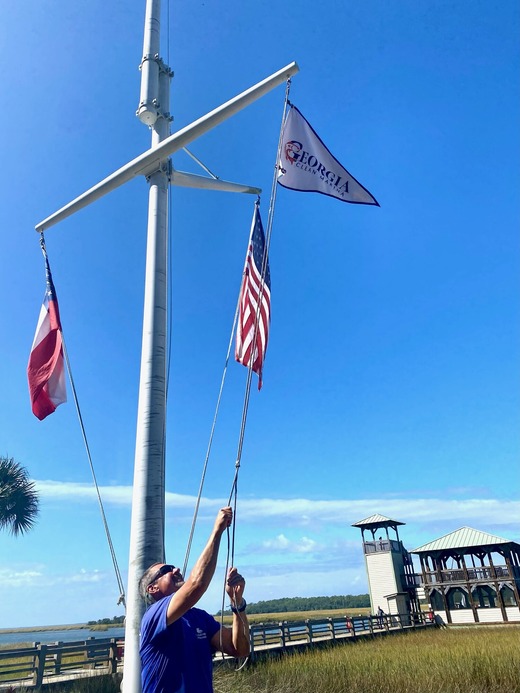
Two Georgia Marinas Earn Georgia Clean Marina Certification
Two marinas along Georgia’s coast have been newly certified under the Georgia Clean Marina Program, recognizing their commitment to protecting coastal waters and implementing environmentally responsible business practices.
Safe Harbor Savannah Yacht Center in Savannah and The Ford Field and River Club Marina in Richmond Hill were certified Tuesday, Dec. 16, 2025, for adopting Clean Marina Best Management Practices (BMPs), which are designed to reduce or eliminate waterway pollution from everyday marina operations.
The Georgia Clean Marina Program is a voluntary certification program allowing coastal Georgia marinas the opportunity to demonstrate their environmental stewardship through implementation of Clean Marina Best Management Practices (BMPs). Certified marinas are eligible to fly the Georgia Clean Marina flag and use the logo in their advertising and promotional materials, signaling to the boating community their commitment to protecting coastal waterways.
Marinas are assessed in several areas such as fueling operations, boat washing policies and emergency preparedness to demonstrate the policies they have in place to go above and beyond in ensuring their operations are not negatively impacting their coastal environment. They must meet minimum requirements addressing all areas of marina operation to become certified. Certified marinas can use this designation to attract clientele that value the steps clean marinas have taken to be better stewards of our coast.
These certifications mark the third cohort of facilities to earn designation since the Georgia Clean Marina Program was relaunched in 2023. The program is part of a national initiative and is administered through a collaborative partnership between the Georgia Department of Natural Resources’ Coastal Resources Division (CRD), University of Georgia Marine Extension and Georgia Sea Grant, and the Georgia Marine Business Association (GAMBA).
“The continued growth of the Georgia Clean Marina Program shows how effective this partnership has been,” said Kelly Hill, CRD green growth specialist. “By working together, we’re helping marinas implement practical solutions that protect water quality while supporting a strong coastal economy.”
Marinas play a vital role in Georgia’s coastal communities by supporting recreational boating, marine tourism, and local jobs. Most facilities are located in or near sensitive marshlands and estuarine waters, making environmental stewardship a critical component of marina operations.
“These certifications demonstrate the marine industry’s commitment to balancing business operations with environmental responsibility,” said Lucy Bowie, GAMBA secretary. “Each new cohort strengthens the program and sets a positive example for marinas across the coast.”
Bryan Fluech, associate director of extension for University of Georgia Marine Extension and Georgia Sea Grant, emphasized the long-term impact of the program.
“The Georgia Clean Marina Program is a successful model of collaboration,” he said. “Each newly certified marina represents real progress toward conserving Georgia’s coastal resources for future generations.”
Marinas interested in becoming certified may apply each fall and work closely with program partners throughout the year to meet program benchmarks. For more information, visit GeorgiaCleanMarina.org.
-30-
Learn more about CRD on our YouTube Channel 
Support marine habitats by upgrading your license plate! 

STAY CONNECTED
with Coastal Resources Division


.
Be the first to comment!
Needed Rain Tonight And Saturday – SCDNR
Weather Alert – January 2, 2026
Needed Rain Tonight And Saturday
Good morning and welcome to 2026. I hope y’all had a grand New Year’s celebration with your friends and family. I know some of y’all did because driving home from my girlfriend’s house during the first minutes of the year, it sounded like Colonel Sumter’s men were driving the British out of Columbia’s Rosewood neighborhood.
This morning, a storm centered over the southern Plains is moving our way, bringing us some needed rain over the next 36 hours. The rain will reach the northwest later this evening and spread over the state through Saturday morning. While the entire state will see some rain, the southern part will get more than the northern part.

Here’s the National Weather Service’s forecast for rainfall across South Carolina
through early Sunday. Most of the state will see a half-inch to an inch of rain.
Locally heavier rain will fall over the southern part of the state,
where amounts can exceed one inch in spots.Image Source: WeatherBELL
Meanwhile, a cold front to our north and west will shift southward and send chilly air into the northern part of the state. That will keep the Upstate, Catawba region, and upper Pee Dee in the upper 40s and low 50s, while the Lowcountry sees highs in the 60s.
The warm air over the southern part of the state will be conducive to thunderstorms rumbling through during the afternoon and early evening. A part of the Lowcountry will be at risk for seeing an isolated severe storm.

The level 1 of 5 (marginal) risk area on the Storm Prediction Center’s outlook for Saturday is the area of concern for severe storms; the concern is for isolated damaging wind and an isolated tornado.
This storm system will move out Saturday evening, with dry and seasonably cool air pushing in behind it. Sunday may start with lingering low clouds and fog, but it’s likely to be sunny across the state by the afternoon with highs in the mid to upper 50s from north to south.
Monday also looks dry, with high pressure centered over New York controlling our weather. Highs will range from the mid-50s north to the lower 60s south.
That area of high pressure will slide eastward on Tuesday, and southerly to southwesterly winds around the departing high will give us a warmup. Temperatures will run well above normal again on Tuesday through at least Thursday. We’ll see highs in the 60s on Tuesday, upper 60s and lower 70s on Wednesday, then most of the state will reach the 70s on Thursday. Tuesday and Wednesday should feature plenty of sun, but clouds will stream in on Thursday ahead of our next cold front.
Computer models show varying ideas about the front coming our way late next week. It could move in on Friday and become stationary through next weekend, or it could stall to our northwest and not move through until Sunday. So, there is a lot of uncertainty about what the weather will be like during that time. Once that front finally pushes through, we’re likely to see a period of colder-than-average weather.
This week’s Drought Monitor indicates an expansion of drought conditions since last week.

Rain coming through Saturday will help, but won’t get rid of the drought entirely. Another dry spell Sunday through at least Thursday will not help matters. The setup for next Friday and next weekend has a chance to bring us substantial rainfall, but don’t get your hopes up because most computer models do not show us seeing a soaking.
Frank Strait
Severe Weather Liaison
S.C. State Climate OfficeSouth Carolina Department of Natural Resources
260 D. Epting Lane
West Columbia, SC, 29172Stay Connected with SCDNR: SUBSCRIBER SERVICES:
Manage Subscriptions | Unsubscribe | HelpBe the first to comment!
Dry For A While, A Warm Christmas – SCDNR
Weather Alert – December 19, 2025
Dry For A While, A Warm Christmas
Our weather is looking mainly tranquil through Christmas and beyond. It could be ten days before we see another good chance for rain, which is unfortunate because much of South Carolina remains in a drought despite the soaking that parts of the state saw last night.
For the rest of today, we remain sunny with winds lessening as high pressure builds in. Aside from the gusty winds, it will be a lovely afternoon with temperatures slightly warmer than average. Tonight looks clear and seasonably chilly with light winds.
High pressure overhead Saturday gives us a pleasant December day with sunshine; a chilly start, but highs will be in the mid to upper 50s north and lower 60s south. A clear and seasonably chilly night will follow.
A moisture-starved cold front will move through the state on Sunday, so moisture-starved that we’ll only see a few clouds. We’ll have a mainly sunny sky with highs in the lower 60s north and middle 60s south, a pretty day. Sunday night looks seasonably chilly again with a mostly clear sky.
Monday will bring us below-average temperatures as Canadian air pays us a brief visit. We’ll see a few clouds as Sunday’s front stalls nearby to the south, but a good deal of sun, too. Highs will range from near 50 in the north to the upper 50s south.
The front will retreat northward on Tuesday; it will pick up some moisture while sitting to our south, but not much. So, clouds will limit the sun, and there might be a stray shower or two around the Upstate. If the stray showers or lack thereof are a problem for you, it will be the perfect time to air your grievances!
That front will again become stationary to our north through Christmas Eve before retreating further northward. Meanwhile, an upper-level ridge will set up shop for a while over the southeastern states. This will put us in a warm and dry regime for Christmas and beyond. We’re likely to see sunshine with highs in the upper 60s to lower 70s on Christmas Eve, then mainly lower 70s for Christmas Day. It’s not likely to be the warmest Christmas on record, as record highs for the date are in the upper 70s and lower 80s, but it should be in the top ten warmest (out of over 100 Christmases for many places in the state, our records go back as far as the 1880s).

These NDFD plots show the National Weather Service’s forecast highs for
Christmas Eve and Christmas Day.Image Source: WeatherBELL
The computer models generally agree that we’ll remain warm and dry, with highs in the 70s, until around the 29th (give or take a day), when another cold front finally arrives.
Sorry, snow lovers, the weather pattern looks hostile to snow for the rest of the month and likely the first part of January.
Over the last week, drought has worsened over the Upstate and Catawba region but has improved somewhat in the south.

The rain we saw over much of the state Thursday and Thursday night helped, but it was not a factor in this week’s Drought Monitor, which is compiled on Tuesdays. However, the mostly dry, warm weather over the next week or so will worsen the drought again.
Frank Strait
Severe Weather Liaison
S.C. State Climate OfficeSouth Carolina Department of Natural Resources
260 D. Epting Lane
West Columbia, SC, 29172Stay Connected with SCDNR: SUBSCRIBER SERVICES:
Manage Subscriptions | Unsubscribe | HelpThis email was sent to curtis.hoff@cruisersnet.net using GovDelivery Communications Cloud on behalf of: South Carolina DNR ·1000 Assembly Street · Columbia, SC 29201 
Be the first to comment!
Antarctic Ice Melt – Fred Pickhardt
Fred Pickhardt’s Substack is free today. But if you enjoyed this post, you can tell Fred Pickhardt’s Substack that their writing is valuable by pledging a future subscription. You won’t be charged unless they enable payments.
Forwarded this email? Subscribe here for moreAntarctica is 98% ice covered and contains 90 percent of Earth’s total ice volume. Melting ice is limited mainly to West Antarctica which is offset by ice mass gains over the remainder of Antarctica.

The mass of the Antarctic ice sheet has changed over the last decades. Research based on observations from the Gravity Recovery and Climate Experiment (GRACE) satellites (2002-2025) and GRACE Follow-On (since 2018) indicates that between 2002 and 2025, Antarctica shed approximately 135 gigatons of ice per year, causing global sea level to rise by 0.4 millimeters per year. Since 2020, however, the Antarctic has seen little or no ice mass loss.

At this rate, an additional 28 mm (1.1 inches) of sea level rise can be anticipated by 2100. If the Antarctic ice melt would triple between now and 2100 we should expect an additional 42 mm (1.7 inches) of sea level rise due to Antarctic melt.
Forensic Marine Weather Expert
You’re currently a free subscriber to Fred Pickhardt’s Substack. For the full experience, upgrade your subscription.
© 2025 Fred Pickhardt
548 Market Street PMB 72296, San Francisco, CA 94104
UnsubscribeBe the first to comment!






Social Media Auto Publish Powered By : XYZScripts.com
Be the first to comment!