SCORE Fall Newsletter – SCDNR
|



 Roast season is here! Please remember to recycle your oyster shell and to roast responsibly.
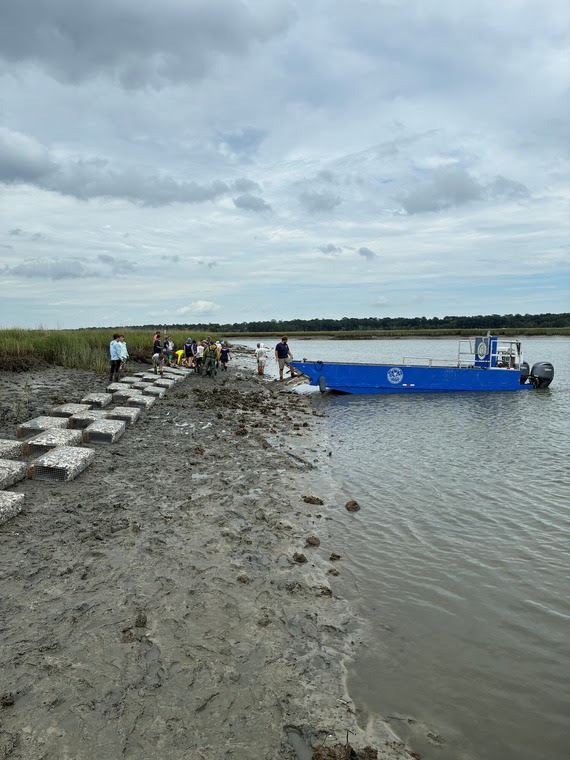 The SCORE team along with partners, Sustainability Institute and Conservancy of the Sea Islands, completed our Kiawah Bridge Project! We successfully deployed 800 manufactured wire reef units (MWRs) at four sites encompassing the bridge. The installation of these MWRs accounted for over 2,000 feet of living shorelines! These MWRs will provide the substrate needed for larval oysters to attach to, grow, and provide the amazing ecosystem services we get from having healthy living shorelines. These ecosystem services include but are not limited to habitat, erosion mitigation, and water filtration. It was tough work done well by all stakeholders involved!

 Be on the lookout for Shellby in a Christmas parade around town!
| Stay Connected with SCDNR: |


|
| SUBSCRIBER SERVICES: Manage Subscriptions | Unsubscribe | Help |


|
| Stay Connected with SCDNR: |
|
|
| SUBSCRIBER SERVICES: Manage Subscriptions | Unsubscribe | Help |
Fred Pickhardt’s Substack is free today. But if you enjoyed this post, you can tell Fred Pickhardt’s Substack that their writing is valuable by pledging a future subscription. You won’t be charged unless they enable payments.

| ||||||||||||
Elizabeth City sits at the southern terminus of the Dismal Swamp Canal and has the well-earned reputation of being a transient-friendly town with free dockage for 72 hours.

https://visitelizabethcity.com/
https://mailchi.mp/836724efb260/a-little-chill-a-lot-of-charm?e=96d535c547
Cruisers Net publishes Loose Cannon articles with Captain Swanson’s permission in hopes that mariners with

When all else fails, try journalism. Folksinger Hurt in ‘Grace Bailey’ Mast Catastrophe Asserts Seaman’s RightsKate McCann Files One of Three Lawsuits Against Schooner Owner
Kate McCann is a folksinger who plays banjo. She specializes in songs about the sea, and is studying ethnomusicology at a university in Newfoundland, that most maritime of Canadian provinces. When she was younger and living in Connecticut, she worked as “chanteyman” at Mystic Seaport and as a deckhand on sailing ships. The question now before a federal court in Maine is whether McCann was a “seaman” under the Jones Act when the top part of schooner Grace Bailey’s mast broke and fell on her during October 2023. Grace Bailey, wooden and built in 1882, was carrying passengers on a fall foliage tour of Penobscot Bay at the time of the accident. A witness said a spar landed on McCann’s lap. “Plaintiff Katherine McCann was on the subject voyage in service of the schooner and acting in the scope and course of her employment as a musician/crewmember of that schooner,” her lawyers wrote in a lawsuit against Grace Bailey owners. Earlier this month, two other federal suits were filed seeking compensation for injuries in the same accident, which injured a total of five people killed a local doctor. There were 25 passengers and seven crew on board, according to the Coast Guard. According to McCann writing in her Substack newsletter, she had to spend four nights in a Maine hospital. She also wrote about having been selected as a finalist in a statewide song contest. And she said she planned to attend the awards show six weeks later “even if it means I have to be wheeled onto the stage!”
The Grace Bailey defense team will likely argue that McCann and her co-musicians of the band Skylark may have been entertaining passengers for pay, but as contractors, not crew. As such, they will say, McCann did not meet the criteria to qualify for legal benefits afforded under the Jones Act. According to McCann’s suit, the fact that the top 25 percent of a 70-foot wooden mast broke off during moderate wind and seas was proof that Grace Bailey had been unseaworthy and that her owners were negligent for having failed to detect rot in the mast. McCann’s lawyers said she is “entitled to maintenance at a reasonable daily rate and cure until she reaches the point of maximum medical improvement…together with interest, costs and legal fees.” The Jones Act includes the ability for a successful plaintiff to slap a lien on the vessel itself, so McCann could end up owning Grace Bailey, at least theoretically. The ReportIn its November 21, 2024 investigation report, the U.S. Coast Guard issued nine safety recommendations calling for improved detection of internal wood decay, more rigorous mast inspections, updated testing methods, better crew training, preventive maintenance programs and more comprehensive recordkeeping. Investigators also urged unstepping wooden masts more frequently for inspection and greater cooperation with marine surveyors, sailing organizations and wood-science experts. Coast Guard headquarters accepted or partially accepted most recommendations but declined broad industry collaboration and additional crew-training guidance, opting instead for limited reviews and potential updates to existing inspection policies. For the wood-boat crowd, the report will read like porn, with its discussion of “non-destructive testing” and references to stress-wave scanning, resistance micro drilling and fungal identification. It also discussed the differences between sapwood and heartwood on a Douglas fir tree and the optimal growth rings per inch for mast use.
The investigators described how passengers began hearing weird noises above them, but couldn’t see any signs of a problem. Then this:
Other LawsuitsMaureen Colvin of Massachusetts was another person, suing Grace Bailey owners. Her lawyers described Colvin’s experience: Plaintiff was abruptly impacted from above by a sail and subsequently felt the weight of the mast. Plaintiff was propelled down approximately eight feet of stairs, resulting in a violent impact with the floor below. According to the lawsuit, Colvin was holder of a captain’s license, and so she put the first-aid component of its requirements to good use. She went back up on deck and then.
The third lawsuit, filed by Christopher and Diane Sarao, centers on his “serious injuries” and her “emotional distress and loss of consortium.” This lawsuit stands out because it tells the story of a prolonged breakdown in vessel maintenance, inspection, repair and oversight. It reaches beyond the current owner to the people and businesses involved in the schooner’s condition over many years. So were Tom Lokocz Adams and his company Maine Design, which performed a 2022 pre-purchase survey on the Grace Bailey. So were Raymond Williamson and Ann Williamson of Windjammer Cruises, which sold the boat to her current owners. So were Michael F. Rogers and his company Privateer Boatbuilding, which performed repair on Grace Bailey in 2014, and unspecified “2014 repair defendants.” The captain of the vessel, Samuel J. Sikkema, was also named as a defendant.
LOOSE CANNON covers hard news, technical issues and nautical history. Sometimes he tries to be funny. Subscribe for free to support the work. If you’ve been reading for a while—and you like it—consider upgrading to paid. | ||||||||||||||||||||||||||||||||||||||||||||||
Fred Pickhardt’s Substack is free today. But if you enjoyed this post, you can tell Fred Pickhardt’s Substack that their writing is valuable by pledging a future subscription. You won’t be charged unless they enable payments.
Mariners and boaters should excercise caution this weekend in the northern and western Gulf. A cold front is forecast to enter the northwest Gulf Friday afternoon or evening, and reach from southwest Florida to the central Bay of Campeche by late Saturday. Fresh to strong winds and moderate to rough seas will follow the front, with near gale to gale force winds likely over the west- central Gulf by Saturday morning, and over the SW Gulf by late Saturday.
Saturday Afternoon Forecast
Forensic Marine Weather Expert NOAA US Coastal Waters Forecasts
You’re currently a free subscriber to Fred Pickhardt’s Substack. For the full experience, upgrade your subscription.
© 2026 Fred Pickhardt |
Cruisers’ Net Newsletter for this week has just been emailed via Constant Contact.
If you want to view the newsletter but are not signed up to receive them automatically, you can view it at https://conta.cc/4hybKrC or see it below.
To automatically receive our emailed Fri Weekly Newsletter and Wed Fuel Report, click:
Fred Pickhardt’s Substack is free today. But if you enjoyed this post, you can tell Fred Pickhardt’s Substack that their writing is valuable by pledging a future subscription. You won’t be charged unless they enable payments.
Hurricane Isaias is strengthening in the Gulf of Mexico and posing a severe threat to the northern U.S. Gulf Coast with a likely landfall late Friday or early Saturday.
Current Storm Status
OutlookDuring the next 24 hours, Hurricane Isaias will peak near 95 knot max winds with significant waveheights building to 10 meters (about 33 feet). As the center approaches the Gulf Coast, increasing wind shear could weaken the max winds, however, the extent of weakening is uncertain.
FloodingOnshore winds will drive destructive waves and catastrophic coastal flooding. If the peak surge coincides with high tide, expect water heights to reach:
RainfallHeavy rain will dump 3 to 7 inches across the central U.S. Gulf Coast, with localized totals up to 15 inches across the Florida Panhandle and Big Bend. This will trigger significant river, flash, and urban flooding.
Forensic Marine Weather Expert NOAA National Hurricane Center NOAA US Coastal Waters Forecasts You’re currently a free subscriber to Fred Pickhardt’s Substack. For the full experience, upgrade your subscription. |
|
Elizabeth City sits at the southern terminus of the Dismal Swamp Canal and has the well-earned reputation of being a transient-friendly town with free dockage for 72 hours.
https://visitelizabethcity.com/
https://mailchi.mp/6fec3b0724ad/your-weekend-plans-ghosts-vikings-a-little-magic?e=96d535c547
Cruisers Net publishes Loose Cannon articles with Captain Swanson’s permission in hopes that mariners with
When all else fails, try journalism. That Time Vonnegut Did ‘the Ditch’ in a Kennedy BoatFamed Author Crewed on an Annual ‘Marlin’ Delivery to Palm Beach
Even before I read someone else saying it, I long ago came to believe that author Kurt Vonnegut Jr. was the late 20th century reincarnation of Mark Twain. Vonnegut’s 1969 novel Slaughterhouse Five was his masterpiece, his Twainyist work, his Huckleberry Finn equivalent. Slaughterhouse Five, by the way, has been banned in school libraries in the Florida county where I reside—a shining example of why no one is ever coming to Florida for the opera or the education.¹ Three years before Slaughterhouse Five began its 10,000-million-copy (and counting) sales run in 1969, Joe Kennedy’s skipper invited Vonnegut to crew for him on a delivery. Captain Frank Wirtanen was taking the Kennedy family boat from Hyannisport, Massachusetts, to the family’s winter colony at Palm Beach. Back then they didn’t called it the Intracoastal Waterway, instead it was the “Inland Waterway.” Vonnegut chronicled his adventure in a 3,000-word essay entitled “Brief Encounters on the Inland Waterway,” which was first published in Venture magazine in 1966 and later included in his 1974 collection, Wampeters, Foma & Granfalloons. Loose Cannon obtained a paperback copy of Wampeters online. ²
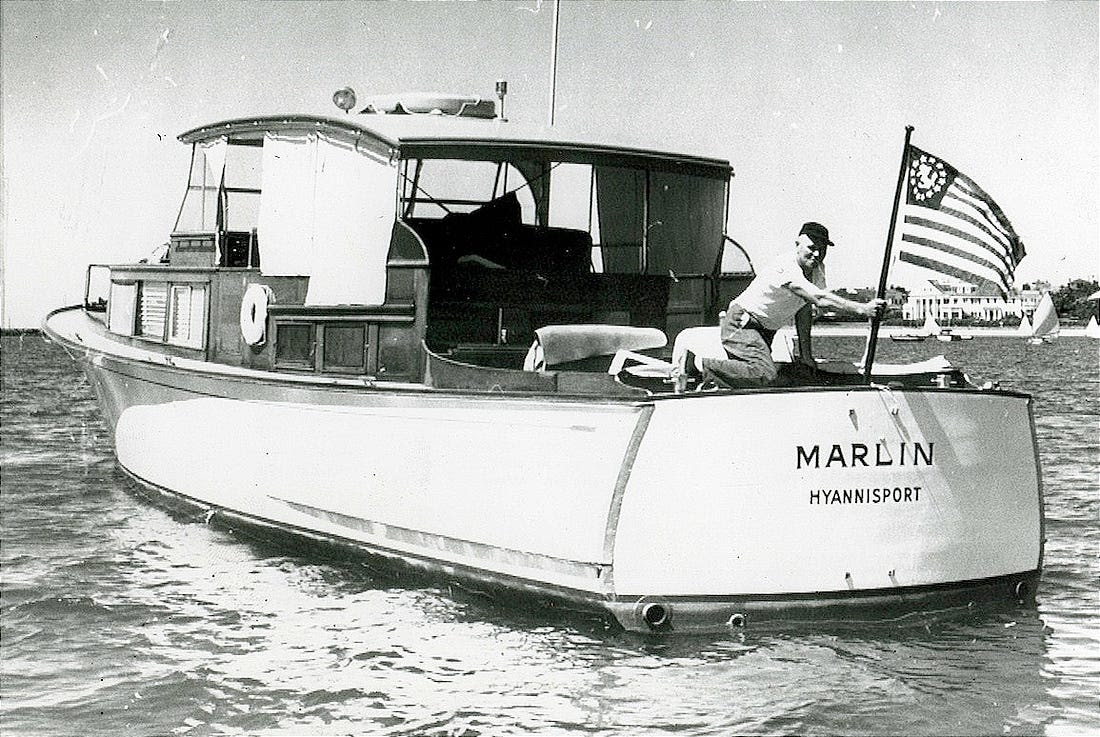
(Alas, there were no illustrations or photos of Vonnegut’s voyage to be found, unlike Loose Cannon’s recently republished “The Forgotten Voyage: Ansel Adams on the ICW.”) The name of the yacht is Marlin, and she was acquired by the Kennedys in 1952. According to Soundings magazine, she had recently been the property of the Yellow Cab Company of Massachusetts, which “put her at the disposal of the state’s governor. Prior to that, she had been commandeered by the Navy for coastal patrols during World War II. JFK was on board with his advisers in August 1961 when he was informed that the the East Germans had begun to build the Berlin Wall. Five years and one assassination later, here is how Vonnegut described her:
In the mid-1960s, the Golden Era of Middle-Class Boat Ownership had yet to take hold as the boating industry retooled to convert from custom-wood to fiberglass manufacturing. The ICW snowbird migration was nothing like it is today. Vonnegut described it thus:
That was the context of Vonnegut’s ride-along. Here’s how he described his deal with the captain:
Just like today, the captains and crews working for wealthy yacht owners constituted a their own subculture. Not millionaires themselves, yacht crew nonetheless lived and worked adjacent to their a lifestyle of luxury. Yet, because of the the many Kennedy children that it entertained, Vonnegut joked that the 35-year-old motoryacht looked like a “set from a Clifford Odets play about the Great Depression.” In the Chesapeake and Delaware Canal, they joined a migration of dozens of millionaires’ yachts heading south, ownerless. The captains and crews would regularly gather at restaurants and pubs, like Shaefer’s seafood restaurant, to swap stories. One of the captains was a rarity back then—a woman. She was single-handedly piloting a boat bigger than Marlin from New York to Key West. Vonnegut noted that she was a staunch Barry Goldwater supporter. You know, the conservative senator that Lyndon Johnson beat for the presidency. And speaking of women, Vonnegut recalled this exchange:
The author opined on Marlin’s fuel consumption, which he had meticulously tracked for the entire two-week trip. He reported that the twin V-8s had burned a total of 1,522 gallons, a rate Wirtanen described as “splendid.” What was actually splendid was the price—36 cents a gallon, for a grand total of about 550 bucks.
Because of images such as the above, Marlin was recognized and drew onlookers along the way, although Vonnegut mentions one obtuse Army Corps of Engineers officer who had never heard of Joe Kennedy of Hyannisport. The reception became more mixed as Marlin went deeper into the South.
The most touching moment came when Marlin pulled into a marina in Jacksonville, the nearest metropolis to where I sit typing. (Jacksonville calls itself the “Bold New City of the South,” a sentiment shared by absolutely no one.) As this next snippet suggests, symbols really do matter:
Here’s how Vonnegut ends his essay, an exchange at Palm Beach with one the yacht captains he had come to know, a Swede named Gunther:
LOOSE CANNON covers hard news, technical issues and nautical history. Every so often he tries to be funny. Subscribe for free to support the work. If you’ve been reading for a while—and you like it—consider upgrading to paid. |
Elizabeth City sits at the southern terminus of the Dismal Swamp Canal and has the well-earned reputation of being a transient-friendly town with free dockage for 72 hours.
https://visitelizabethcity.com/
https://mailchi.mp/9c70d8d84b9a/viking-pride-ghost-stories-fall-finds?e=96d535c547
Fred Pickhardt’s Substack is free today. But if you enjoyed this post, you can tell Fred Pickhardt’s Substack that their writing is valuable by pledging a future subscription. You won’t be charged unless they enable payments.






Be the first to comment!