


CRUISERS NET
Cruisers Helping Cruisers
Comprehensive cruising resource for the Intracoastal Waterways
from Norfolk to the Northern Gulf and Bahamas.
from Norfolk to the Northern Gulf and Bahamas.
FREE to use due to the generosity of our sponsors - please patronize them
Weather Alert – Atlantic Tropics Continue To Slumber – SCDNR

Weather Alert – August 7, 2026
Atlantic Tropics Continue To Slumber
The Atlantic tropics remain tranquil with no active tropical cyclones and none expected for at least another week.
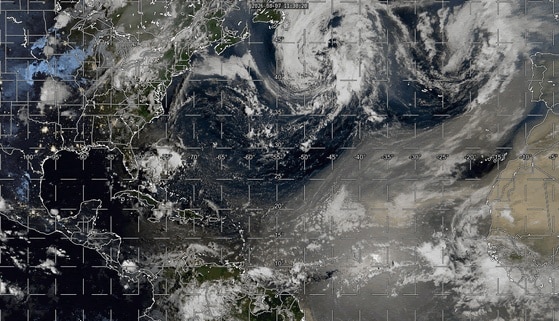
The above loop of visible satellite imagery above shows several features of interest across the North Atlantic and eastern U. S.:
- Tropical waves along 58° west near the Lesser Antilles, along 44° west over the central tropical Atlantic, and along 23° west over Cabo Verde.
- A massive cloud of Saharan dust covers much of the eastern and tropical North Atlantic; the dust cloud is dense near 20° north.
- A cluster of thunderstorms east of Florida and over parts of The Bahamas, moving northwestward.
- Strong vertical shear is evident over the Caribbean Sea; high wispy cirrus clouds are drifting eastward while the dots of lower clouds are being carried westward by the Trade Winds.
Hostile conditions remain in place over the Main Development Region; upper-level westerly winds are causing vertical shear over the Caribbean Sea and vicinity, while a dry and dusty air mass is in place over the tropical Atlantic. A few tropical waves are moving through the basin, but they have little chance to develop further.
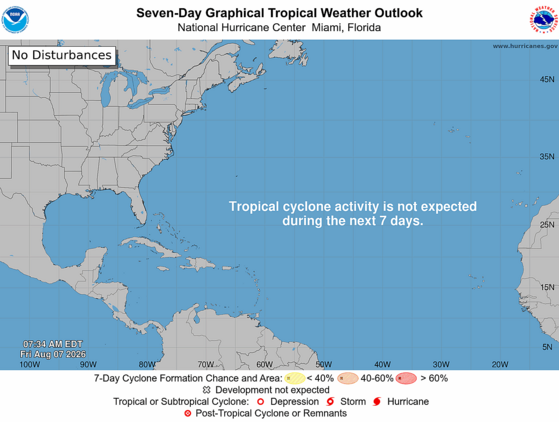
As we expected a week ago, a disturbance is east of Florida today and is moving toward our coastline. It’s generating a haphazard collection of thunderstorms. It likely will remain disorganized as it skirts our coastline tonight and Saturday before departing to the northeast. We’ll have to watch it for surprises, but further development is very unlikely. Our coastal areas are likely to see some downpours from it over the next day or so, doing more good than harm in the face of the area’s ongoing drought.
There are signs that the Atlantic might finally perk up in 10-15 days. The Madden-Julian Oscillation will become more favorable for Atlantic activity, and we’ll be in the typical ‘prime time’ for the Atlantic that starts in mid-August and ends in mid-October. So, now is a good time to ensure that your hurricane kits are ready for any action we might see in the coming weeks. If you need advice on what to put in your hurricane kit, hurricane.sc is the place to go for prep advice.
SC Weather Highlights For the Next Week:
Thursday brought a ‘just what the doctor ordered’ soaking to much of the state Thursday, especially the Midlands and Columbia metro. As usual for these setups, Whaley Street in Columbia flooded. As usual, a driver made the mistake of driving into those waters and quickly was introduced to the concept of engine hydrolock. I’m sure that driver will be fine after dropping thousands of dollars on repairs.
Seriously, y’all, don’t drive through flood waters. The water was deep enough that the car could have been carried downstream and that driver could have drowned, or first responders could have been put at risk during a rescue. When we say, “Turn around, don’t drown,” it’s not just a cute rhyme.
We have another setup this afternoon for slow-moving downpours that can result in isolated flash flooding, especially in prone areas. So, be careful if you encounter a flooded road and reroute around flood waters. Also, we likely see a severe storm with locally damaging wind in a few places.
Downpours along our coast with the disturbance moving in from the Atlantic later tonight and Saturday can also cause isolated flash flooding. We’ll also see a scattering of afternoon thunderstorms in the Upstate Saturday, with only isolated storms elsewhere.
In general, the trend over the next few days will be toward less widespread afternoon thunderstorm activity and hotter afternoons; we’ll return to typical midsummer weather. Our temperatures have run a little below average over the last few days, but will likely be a little above average next week. Through Saturday, our highs will be in the upper 80s and lower 90s, but we’ll see lower to middle 90s for highs for a while starting Tuesday.
It’s unlikely we see any more cold fronts this far south through next week, but most of the computer models show one reaching us the following week.
Frank Strait
Severe Weather Liaison
S.C. State Climate Office


South Carolina Department of Natural Resources
260 D. Epting Lane
West Columbia, SC, 29172Stay Connected with SCDNR: 




SUBSCRIBER SERVICES:
Manage Subscriptions | Unsubscribe | HelpBe the first to comment!
What’s Happening At the Sea Pines Resort (Aug 2026), Harbour Town Yacht Basin, SC AICW MM 565

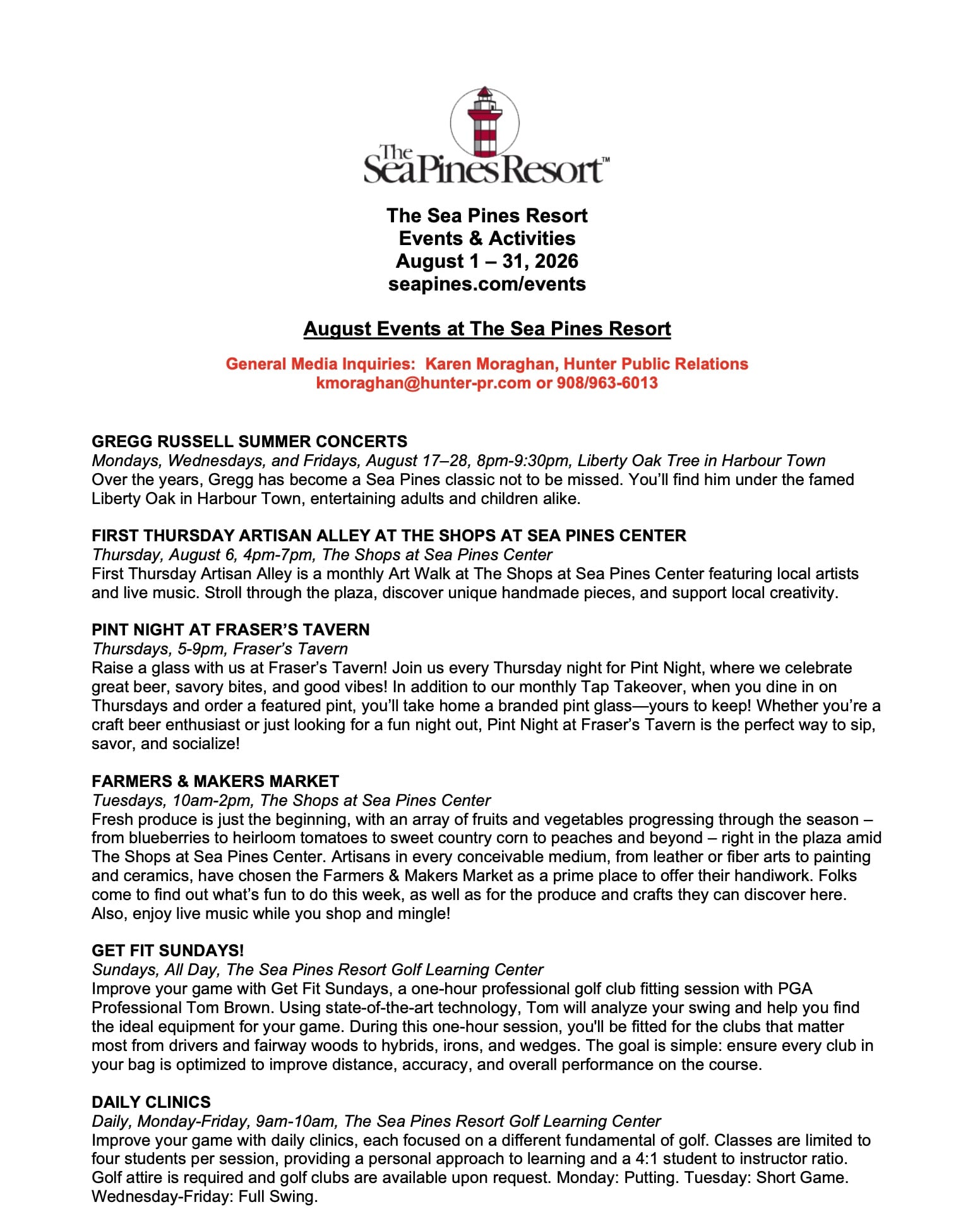
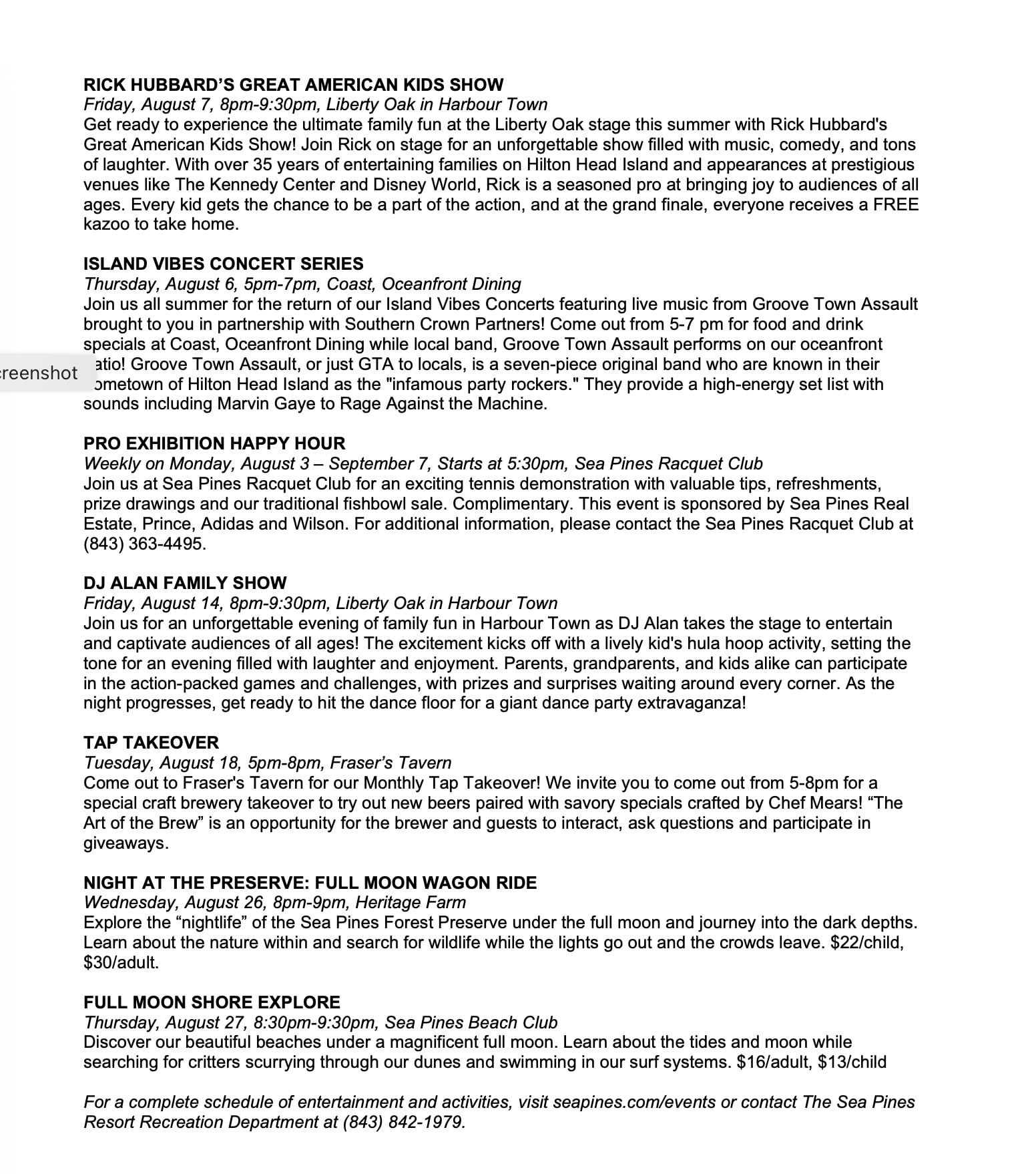
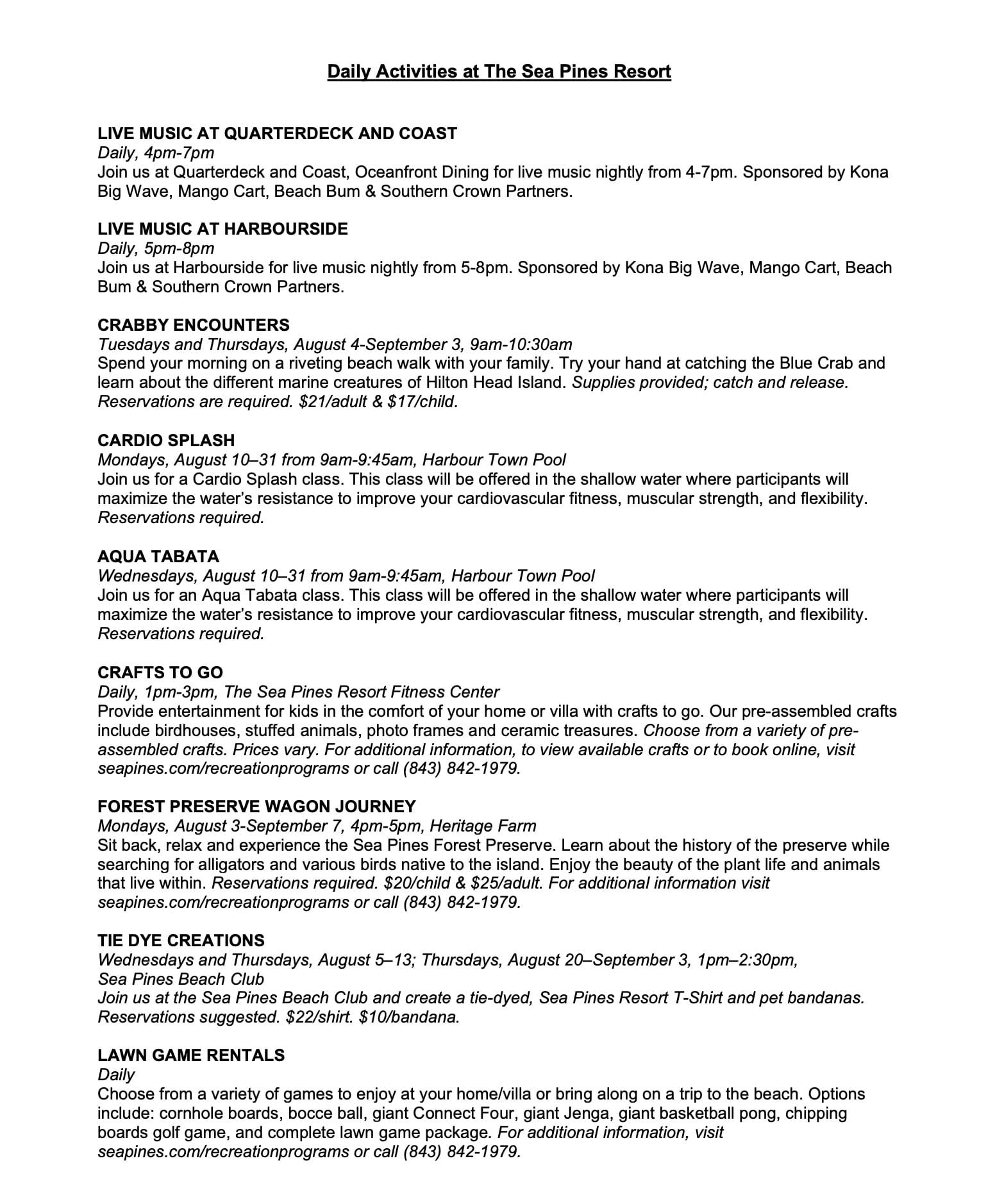
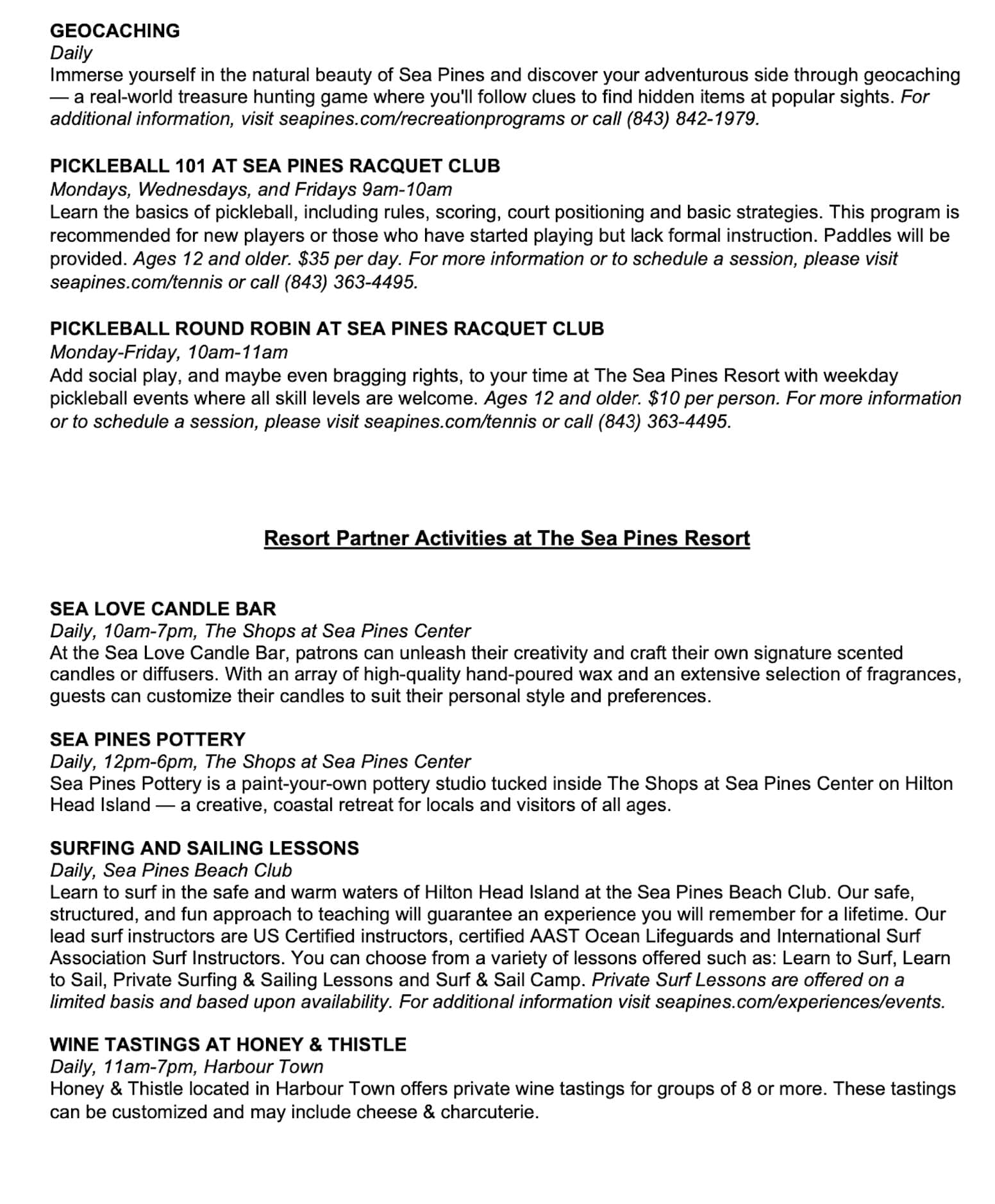
Harbour Town Yacht Basin, A CRUISERS NET SPONSOR, is ready for your reservation with newly renovated docks, upgraded electrical service and onSpot WiFi, also a CRUISERS NET SPONSOR. And, as always, numerous activities at the Sea Pines Resort are offered for your enjoyment, as you will see in the Event Schedule below. Hilton Head Island is absolutely marvelous any time of year.

https://cruisersnet.net/wp-content/uploads/2026/06/August-2026-Sea-Pines-Events.pdf
Kerry Maveus
kmaveus@hunter-pr.com | www.hunter-pr.com
mobile: 831-917-2878
P.O. Box 1049 | Pebble Beach, CA | 93953
Be the first to comment!
Weather Alert – Atlantic Quiet Again, Likely To Remain That Way – SCDNR
Atlantic Quiet Again, Likely To Remain That Way 
Weather Alert – July 31, 2026
Atlantic Quiet Again, Likely To Remain That Way
We have returned to a snooze-and-cruise weather pattern in the tropical Atlantic. We have no tropical cyclones present now, and it’s unlikely that we will see any form over the next week or so.
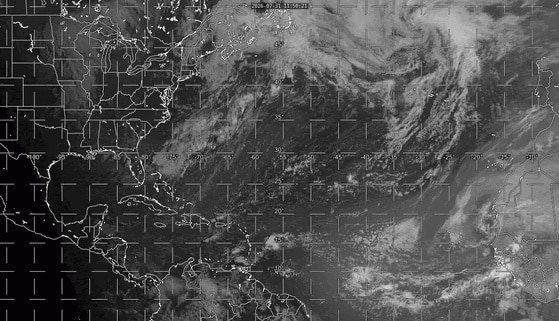
The above loop of visible satellite imagery above shows several features of interest across the North Atlantic and eastern U. S.:
- Tropical waves along 63° west near the Lesser Antilles and along 43° west over the central tropical Atlantic.
- A large low-pressure area centered between the African coastline and Cabo Verde, with Saharan dust swirling around it, but little in the way of clouds.
- A band of clouds with a stationary front off the East Coast and over Florida.
- A storm and trailing front over the nation’s midsection generating thunderstorm clouds.
Conditions remain hostile to development over the Atlantic’s Main Development Region (the area between 10° north and 20° north), with strong vertical shear aloft over most of the region, and most of the region under a dry, stable airmass. Tropical cyclones hate that, so it’s highly unlikely that the tropical waves moving through the region will develop further.
There is one other situation I must address today. I’m sure the model watchers in the audience have taken note of the GFS (the global model run by the National Weather Service) intermittently showing a tropical cyclone form next week over the western subtropical Atlantic (the area between the Tropic of Cancer and 35° north) and becoming a hurricane near our coast late next week and next weekend before curving back out to sea. There isn’t much support from other models, though some have a signal for a weaker storm behaving similarly. Also, the GFS is known for generating what I call ‘boguscanes’; storms that it predicts will form that don’t come to pass. So, it looks unlikely that we’ll have to deal with a storm next weekend, but it’s something we’ll have to monitor.
Stay prepped; hurricane.sc is the place to go for prep advice.
SC Weather Highlights For the Next Week:
- The brief stretch of pleasant midsummer weather ends after today; the humidity will increase Saturday. Highs will be in the lower to middle 90s on Saturday.
- Showers and thunderstorms will spread over the state Saturday afternoon and night as another cold front moves in.
- Sunday looks active with widespread showers and thunderstorms, especially during the afternoon. A locally severe storm with damaging wind is possible. Highs will mainly be in the 80s to around 90.
- Parts of the Upstate could see repeated downpours from the front over the weekend. Of course, all rain is welcome due to our drought, but there is a low-end risk for flash flooding across the Upstate, especially northwest of I-85.
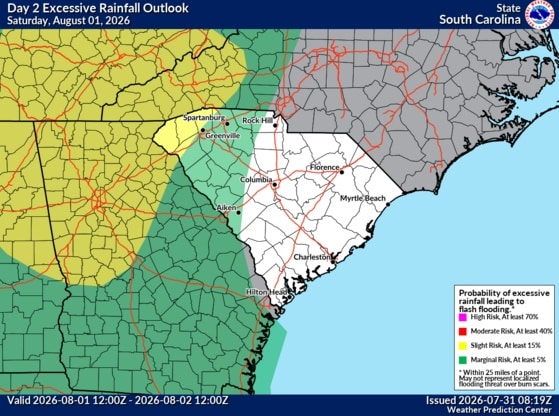
The Weather Prediction Center’s Day 2 Excessive Rainfall Outlook for South Carolina, covering Saturday and Saturday night, indicating the potential for isolated
flash flooding across the Upstate.- The front will turn stationary over us and then dissipate early next week. The result for us looks like typical summertime weather, highs mainly in the upper 80s to low 90s with scattered afternoon thunderstorms. What’s uncertain is the coverage of diurnal storms, which will depend on the strength of an upper-level trough over this part of the country. A deeper trough would mean more widespread storms and a risk for localized flash flooding for parts of the state. If showers and storms are more widespread, we end up cooler than forecast.
- Later next week, we’re likely to see fewer storms and increasing heat, with temperatures near to perhaps a little above average.
Frank Strait
Severe Weather Liaison
S.C. State Climate Office


South Carolina Department of Natural Resources
260 D. Epting Lane
West Columbia, SC, 29172Stay Connected with SCDNR: 




SUBSCRIBER SERVICES: Be the first to comment!
What’s Happening At the Sea Pines Resort (Sept 2026), Harbour Town Yacht Basin, SC AICW MM 565
Harbour Town Yacht Basin, A CRUISERS NET SPONSOR, is ready for your reservation with newly renovated docks, upgraded electrical service and onSpot WiFi, also a CRUISERS NET SPONSOR. And, as always, numerous activities at the Sea Pines Resort are offered for your enjoyment, as you will see in the Event Schedule below. Hilton Head Island is absolutely marvelous any time of year.
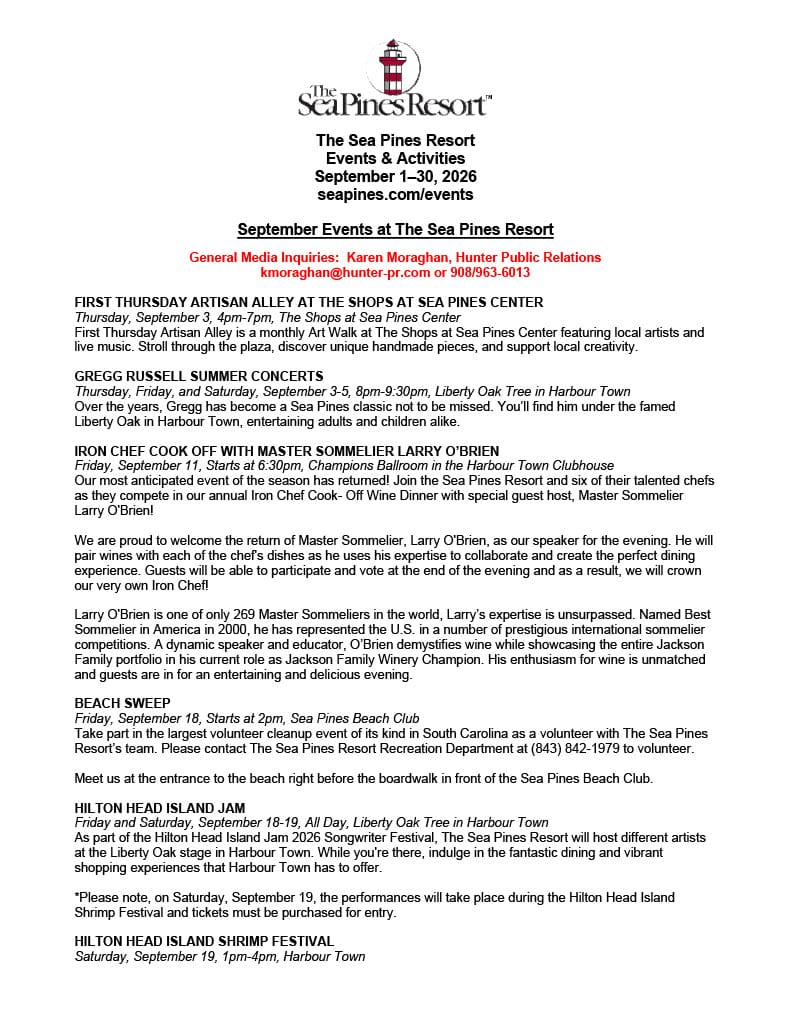
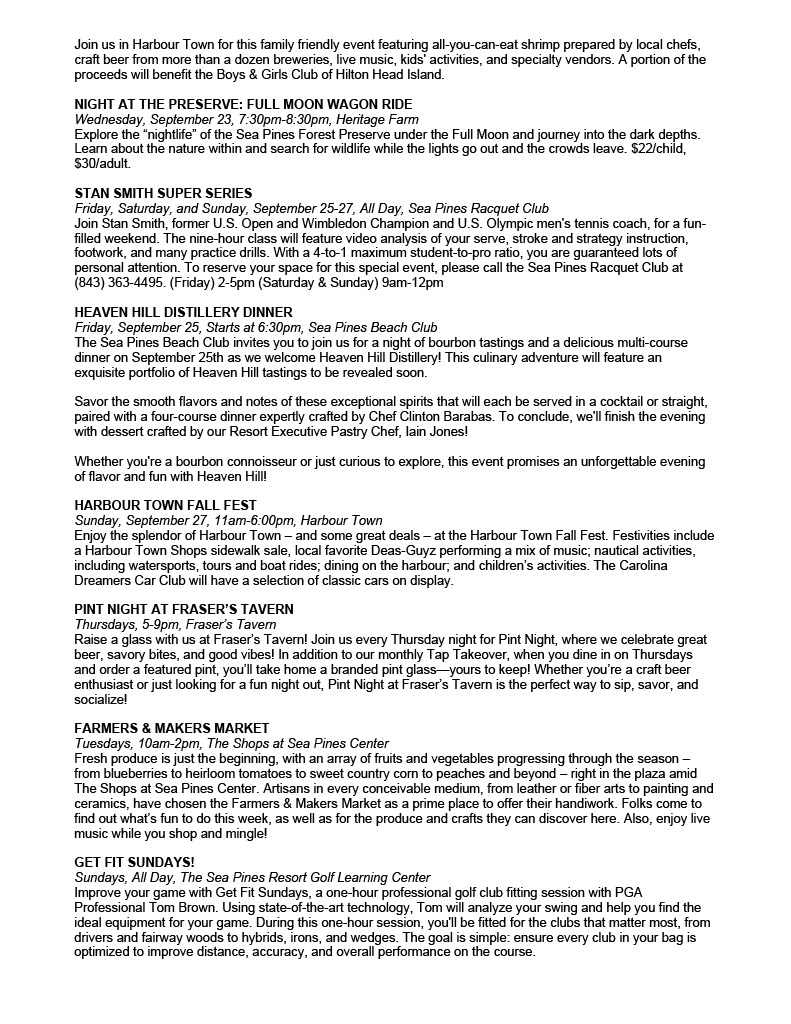
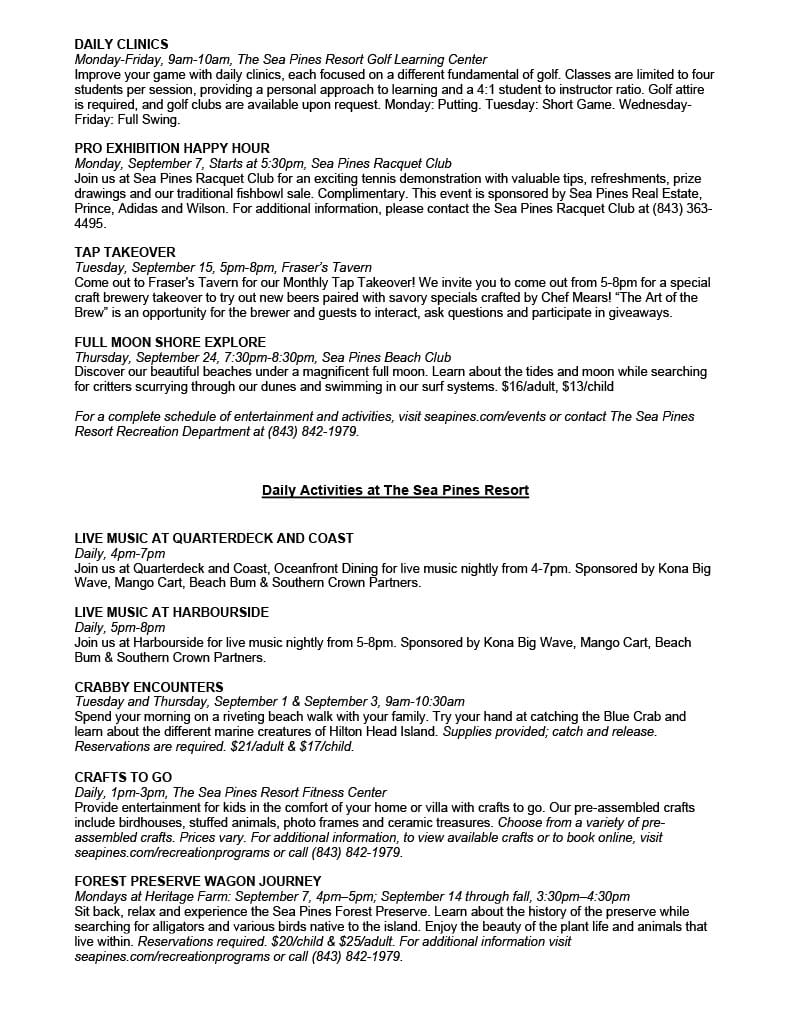
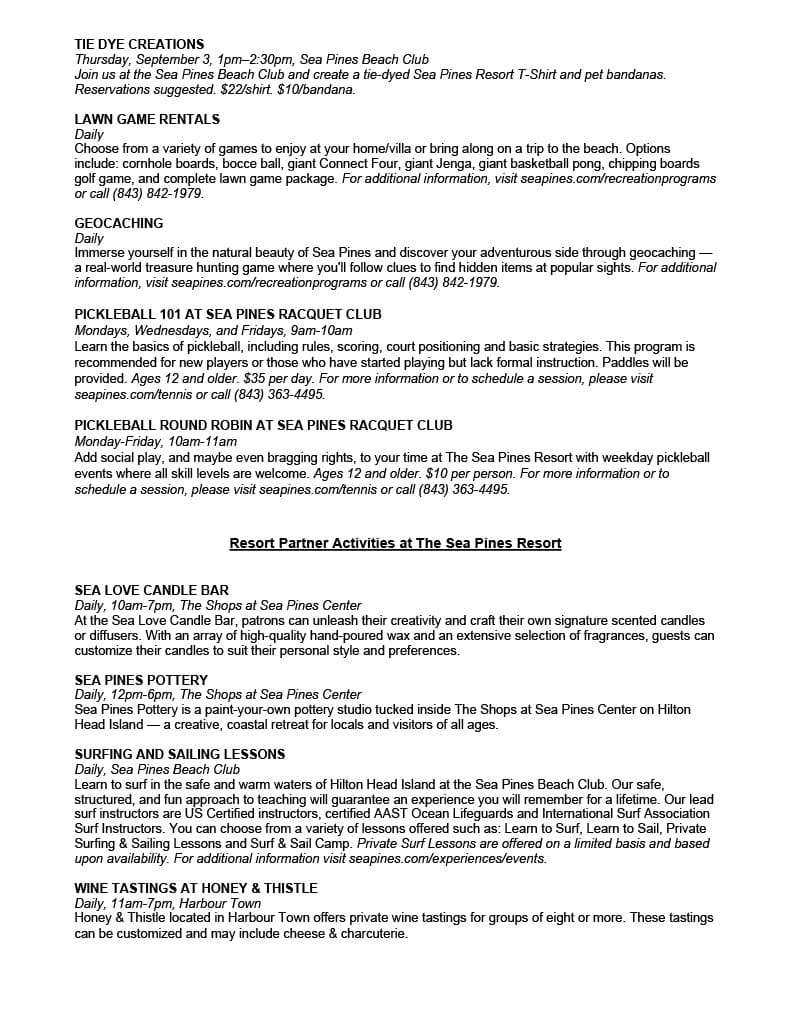
Kerry Maveus
kmaveus@hunter-pr.com | www.hunter-pr.com
mobile: 831-917-2878
P.O. Box 1049 | Pebble Beach, CA | 93953
Be the first to comment!
SCDNR Coastal Updates August

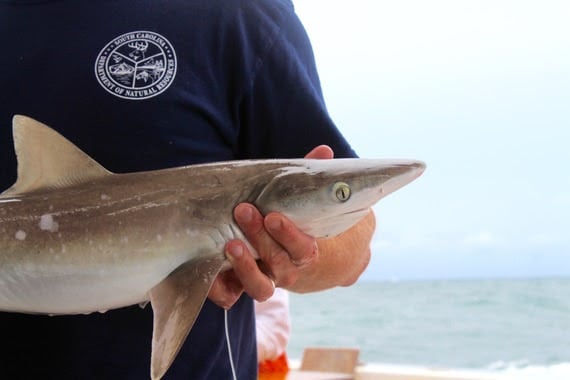
A SCDNR biologist holds an Atlantic sharpnose shark after measuring and tagging it as part of a routine longline survey. Tagged animals are released back into the ocean. (Photo: Erin Weeks/SCDNR)
Welcome to the South Carolina Department of Natural Resources Coastal Updates newsletter!
You are receiving this email because you attended one of our public programs or signed up for updates from our agency. In this monthly newsletter, you’ll find the latest outdoors news, volunteer opportunities, useful career information and more. We hope it will help you enjoy and protect our state’s beautiful coastline. What’s happening outdoors along the coast in August?
- It’s HOT out there–and not just on land. High temps stress fish too. Consider avoiding fishing for large, adult red drum until temperatures drop and spawning ends in October.
- Florida manatees migrate to South Carolina when the water is warm to enjoy our aquatic vegetation. Want to help these visitors on their journey in South Carolina? Report your manatee sightings to SCDNR biologists here.
 Women’s Inshore Saltwater Fishing Clinic (Georgetown, SC) | Thursday, July 30th, 8:30AM – 11:30AM | This clinic will teach you how to tie fishing knots, rig a rod and reel and cast. Women ages 12+ are welcome. You must RSVP here to attend.
Saltwater Fishing Clinic (Okatie, SC) | Saturday, August 1st, 8:30AM – 3:30PM | In partnership with the Port Royal Sound Foundation Maritime Center, we’re offering 2 fishing clinics as a component with the Inshore Slam Fishing Tournament. We will teach you how to tie knots, rig your rod, cast, what bait to use and what fish you can catch! You must RSVP here to attend.
Surf Fishing Clinic (Murrells Inlet, SC) | Thursday, August 6th, 7:30AM – 10:30AM | You will learn how to set up your tackle, tie fishing knots, choose the best rigs and bait and surf cast. Kids ages 6+ to adults are welcome. You must RSVP to attend.
Saltwater Pier Fishing Clinic (Hunting Island, SC) | Saturday, August 8th, 8AM – 11AM | You will learn how to tie fishing knots, rig a rod and reel and cast. Kids ages 6+ to adults are welcome. You must RSVP here to attend.
Flounder Fishing at the Pier (North Myrtle Beach, SC) | Saturday, August 8th, 8AM – 11AM | This flounder fishing pier clinic will teach you how to tie fishing knots, rig a rod and reel for flounder, cast, techniques and more! Kids ages 6+ to adults are welcome. You must RSVP here to attend.
Saltwater Pier Fishing Clinic (North Myrtle Beach, SC) | Wednesday, August 12th, 8:30AM – 11:10AM | This pier fishing clinic will teach you skills on how to tie fishing knots, rig a rod and reel and cast. Ages 6+ to adults are welcome. You must RSVP here to attend.
Advanced Surf Fishing (Myrtle Beach, SC) | Wednesday, August 12th, 6PM – 8PM | This class will teach skills on how to tie your own fish finder rig, advanced knots and more technical aspects to surf fishing. Kids ages 6+ to adults are welcome. You must RSVP here to attend.
SCORE MWR Fabrication (James Island, SC) | Wednesday, August 19th, 9AM – 12PM | Join SCORE and Casual Crabbing with Tia to build manufactured wire reefs (MWRs) that will be used as substrate for larval oysters! All volunteers must RSVP ahead of time in order to secure your spot as slots are limited.
Blue Crab Crabbing & Tagging Clinic (McClellanville, SC) | Wednesday, August 26th, 8AM – 11AM | Participants will learn recreational crabbing techniques, blue crab biology, new South Carolina blue crab regulations and conservation best practices. Participants will be helping collect data and tag blue crabs for ongoing research under SCDNR biologists’ supervision. All ages are welcome. You must RSVP to attend.
ACE Basin Fun Day (Edisto Island, SC) | Saturday, September 12th | Save the date! More information to follow.

We’re hiring!
Natural Resources Technician II | Colleton County, SC | This employee will be part of the ACE Basin NERR Stewardship program, and will assist with the management of McKenzie Field Station in Bennett’s Point, South Fenwick Island WMA and St. Helena Sound Heritage Preserve/WMA.
General Maintenance Technician III | Charleston County, SC | This employee will be responsible for completing tasks on the Upper Coastal Waterfowl Project.
Natural Resources Technician II | Berkeley County, SC | This employee will be responsible for assisting project staff in the operations and pond grow out of numerous species of fish at Bayless Hatchery and Dennis Wildlife Center.
Natural Resources Technician III | Berkeley County, SC | This employee will be responsible for assisting the hatchery manager with all pond harvest activities at Bayless Hatchery and Dennis Wildlife Center.
General Maintenance Technician II | Charleston County, SC | This employee will be responsible for monitoring, maintaining, controlling, and repairing electromechanical systems (e.g. HVAC, plumbing, electrical, generators, lighting, safety systems, and other associated building systems).
Vehicle/Equipment Repair Technician II (Hourly) | Charleston County, SC | This employee will work within SCDNR’s Vessel Operations Section at the Marine Resources Division.
Watercraft Captain I (Hourly) | Charleston County, SC | This employee will be responsible for piloting, navigating and operating SCDNR – MRD’s R/V Silver Crescent to support education and scientific research.
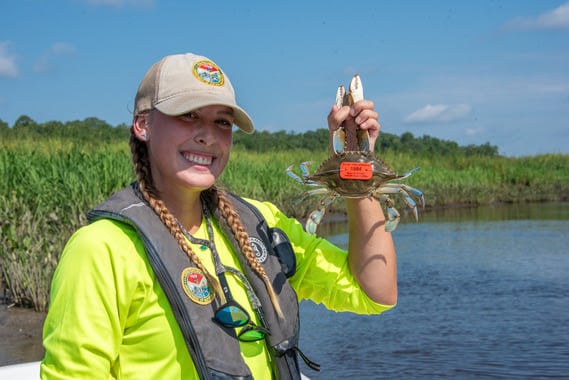
SCDNR crustacean biologist, Jordan, holds a tagged blue crab. (Photo: Erin Weeks/SCDNR)
Other Opportunities with Partners
Director of Preservation – Gullah Geechee Cultural Heritage Corridor | Remote within Gullah Geechee Corridor (NC, SC, GA, or FL) | This is an exceptional opportunity for a preservation professional who is passionate about cultural stewardship, community collaboration and ensuring that one of America’s most significant living cultures is preserved for future generations. The deadline to apply is August 7th.
Restoration Crew Member (Fall Cohort, 18 weeks) – The Sustainability Institute | North Charleston, SC | This cohort within the Environmental Conservation Corps will engage in habitat restoration activities in public parks, forests and waterways. The deadline to apply is August 10th.
C.A.R.E. Scholarship – Southeastern Association of Fish and Wildlife Agencies (SEAFWA) | The Conservation Access, Relevancy, and Engagement (C.A.R.E.) committee is actively seeking students to participate in the 80th Annual SEAFWA Conference October 26th -30th in Nashville, Tennessee. The deadline to apply is August 14th.
 Berkeley County boaters asked to watch for manatees as gentle giants return to local waterways | The Berkeley Observer
Belle W. Baruch Foundation and SCDNR announce new partnership | News 2
SCDNR and Wounded Nature-Working Veterans remove nine boats at Johns Island landing | ABC4 News
SCDNR encourages reports of non-native blue land crabs | News 2
August and September are peak spawning months for red drum in South Carolina!
August and September are peak spawning months for red drum in South Carolina, and successful spawning activity is critical to producing the next generation of red drum, like the fingerling seen below.
If you’d like to help the population rebound, give these adult (or bull) drum a break from fishing pressure during these months. They’ll still be around when temperatures dip and spawning ends in October – after they’ve had a chance to contribute to next year’s crop of young fish.
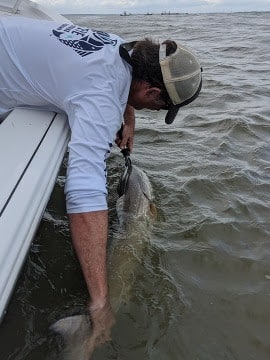
Photo: David Fladd
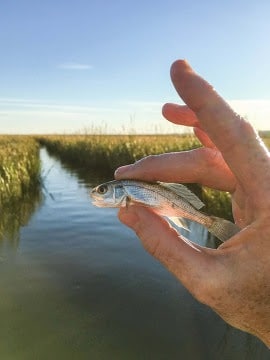
Photo: SCDNR
Stay Connected with SCDNR: 




SUBSCRIBER SERVICES: Be the first to comment!
Weather Alert – TD 2 No Threat to SC, Stormy Late Wednesday, SCDNR

Weather Alert – July 20, 2026
TD 2 No Threat
Over the weekend, the disturbance over the eastern Gulf became Tropical Depression Two. It remains a weak feature south of Panama City, Florida.
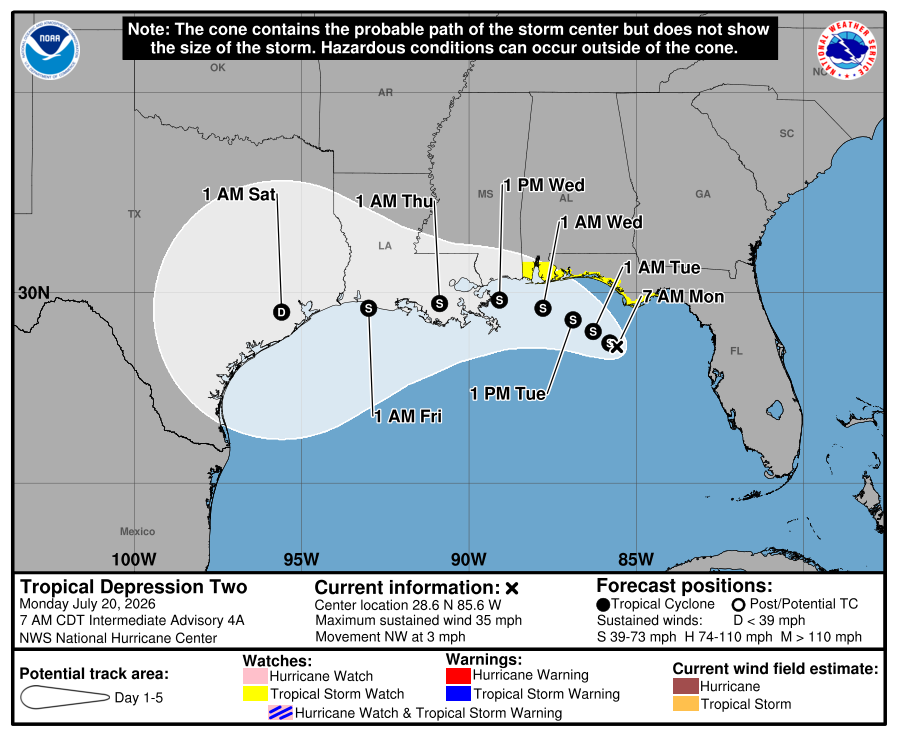
It now looks like it will head westward instead of our way. The National Hurricane Center calls for it to move into Louisiana Wednesday afternoon as a weak tropical storm. So, it won’t have any effect on us through the first part of the week. Some computer models show moisture from it being pulled toward us later this week by a cold front moving in. That would be nice; we need the rain.
It’s quiet over the rest of the Atlantic still. The tropical wave near Cabo Verde on Friday is now over the middle of the tropical Atlantic along 40° west, but there is little thunderstorm activity with it. Another wave moving off of Africa today will struggle against dry, stable air and vertical wind shear.
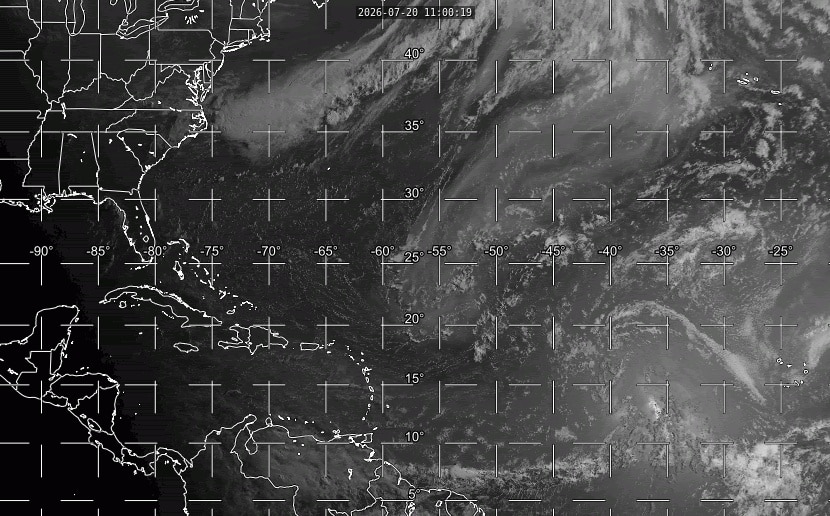
The above loop of visible satellite imagery above shows several features of interest across the North Atlantic and eastern U. S.:
- Tropical Depression Two over the northeastern Gulf.
- A tropical wave near 40° west in the tropical Atlantic
- A band of clouds over North Carolina, Virginia, Tennessee, Kentucky and the Atlantic associated with a stationary front.
- Smoke from Canadian wildfires is spilling southward over the middle of the Atlantic, all the way into the deep tropics.
Stay prepped; hurricane.sc is the place to go for prep advice.
Our Weather This Week:
The front we hoped would bring us active weather early this week has stalled farther north than expected. It’s close enough that the northern half of the state will see substantial coverage of afternoon thunderstorms through Tuesday, and a locally severe storm with damaging wind is possible. A stray storm can’t be ruled out further south, but they will be isolated. Temperatures will remain near to a few degrees above average.
We remain on track to see a more substantial cold front move through on Wednesday afternoon and evening. With that comes more widespread storms and the risk for locally severe storms, especially across the north. Damaging winds will be the primary concern.

It’s looking more likely that the front will stall over us later in the week now rather than push south. There’s a chance that the Upstate sees a nice day with low humidity on Friday, but don’t count on it. Otherwise, we’ll see limited sunshine with widespread showers and thunderstorms, mostly during the afternoon. If tropical moisture from TD Two becomes involved, torrential downpours and a flash-flooding risk would become a concern.
Frank Strait
Severe Weather Liaison
S.C. State Climate Office


South Carolina Department of Natural Resources
260 D. Epting Lane
West Columbia, SC, 29172Stay Connected with SCDNR: 




SUBSCRIBER SERVICES:
Manage Subscriptions | Unsubscribe | HelpBe the first to comment!
Weather Alert – Watching the Gulf, More Severe Thunderstorms Possible, SCDNR
Watching the Gulf, More Severe Thunderstorms Possible 
Weather Alert – July 17, 2026
Watching the Gulf
Finally, we again have some signs of life in the Atlantic tropics. There are two areas of interest out there today. One is close to home, and the other is way out there over the eastern Atlantic.
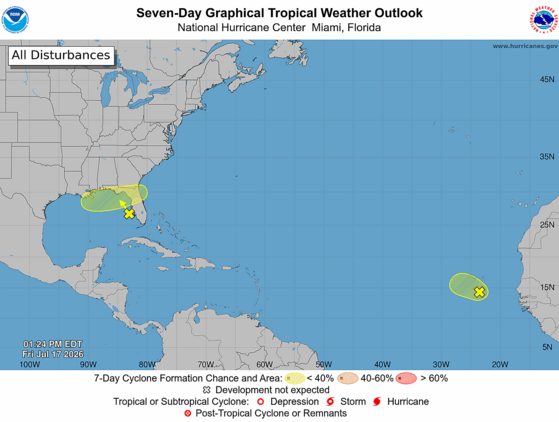
Here’s the National Hurricane Center’s (NHC’s) Seven Day Graphical Tropical Weather Outlook from Friday afternoon.
Our primary concern is a blob of thunderstorms that has erupted over the far western Gulf over the last 24 hours, associated with an upper-level low over the area. The area could (NHC gives it a 20 percent chance) evolve into a tropical cyclone as it wanders around the northeastern Gulf. Whether or not it becomes a tropical depression or storm, the most likely track will be over Florida and near the East Coast. The impacts will depend on the track and how strong of a feature it becomes, both of which are very uncertain right now. It could remain too far offshore to affect us, a disorganized plume of moisture that contributes to rain along our Coastal Plain early next week (ideal because we need the rain) or a tropical depression or weak tropical storm that brings our coastal areas heavy rain, gusty winds, a small storm surge along with a risk for isolated tornadoes. Another alternate scenario some of the computer models show is that it drifts westward instead and becomes more of a concern for the central Gulf Coast than for us. This feature will definitely have our attention over the weekend; if it will affect us, that will happen Monday night through Tuesday night.
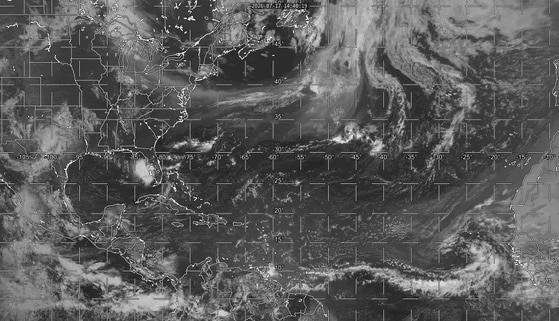
The loop of visible satellite imagery above shows several features of interest across the North Atlantic and eastern U. S.:
- Thunderstorms are clustering around a developing low-pressure area over the northeastern Gulf.
- Low pressure along a tropical wave is centered near Cabo Verde and moving northeastward.
- A tropical wave is near 45° west, drifting westward slowly.
- Bands of smoke from large wildfires west of Hudson Bay can be seen from Michigan and Ohio through the Mid-Atlantic region and over the Atlantic north and northeast of Bermuda.
The other area of concern is over the eastern Atlantic, where a weak low-pressure area has formed along a tropical wave that recently emerged from Africa. It looks decent on satellite imagery with a swirl of clouds and some associated thunderstorms. However, it’s moving northwestward toward dry and stable air. So, it’s a long shot (10 percent chance, according to NHC) to become a tropical depression or a weak tropical storm while causing squally weather in Cabo Verde this weekend. After that, it likely remains a weak feature as it moves toward the central North Atlantic. It looks, to borrow a phrase from my favorite author, mostly harmless.
There are no other features of interest over the Atlantic today. A tropical wave is near 45° west over the middle of the tropical Atlantic, but it is very weak and unlikely to raise any ruckus in the coming days as it drifts westward.
Since there’s a small chance we’ll have to deal with a tropical storm next week, you’ll want to use the weekend to make sure your hurricane kits are properly stocked. As always, hurricane.sc is the place to go for prep advice.
More Severe Thunderstorms Possible
Another weekend, another cold front: our late week heat will ease through Sunday as another cold front moves in. We’ll see sparse coverage of routine afternoon thunderstorms this afternoon and Saturday afternoon, though keep in mind that sometimes our summertime storms become severe with isolated damaging wind. The Upstate has the best chance to see a severe storm.
By Sunday, the approaching cold front will be over our tomato-and-vinegar-loving northern neighbors, which will increase afternoon thunderstorm coverage over the northern half of our state and increase the severe storm risk in that area. Locally damaging winds will be the primary concern with the storms.
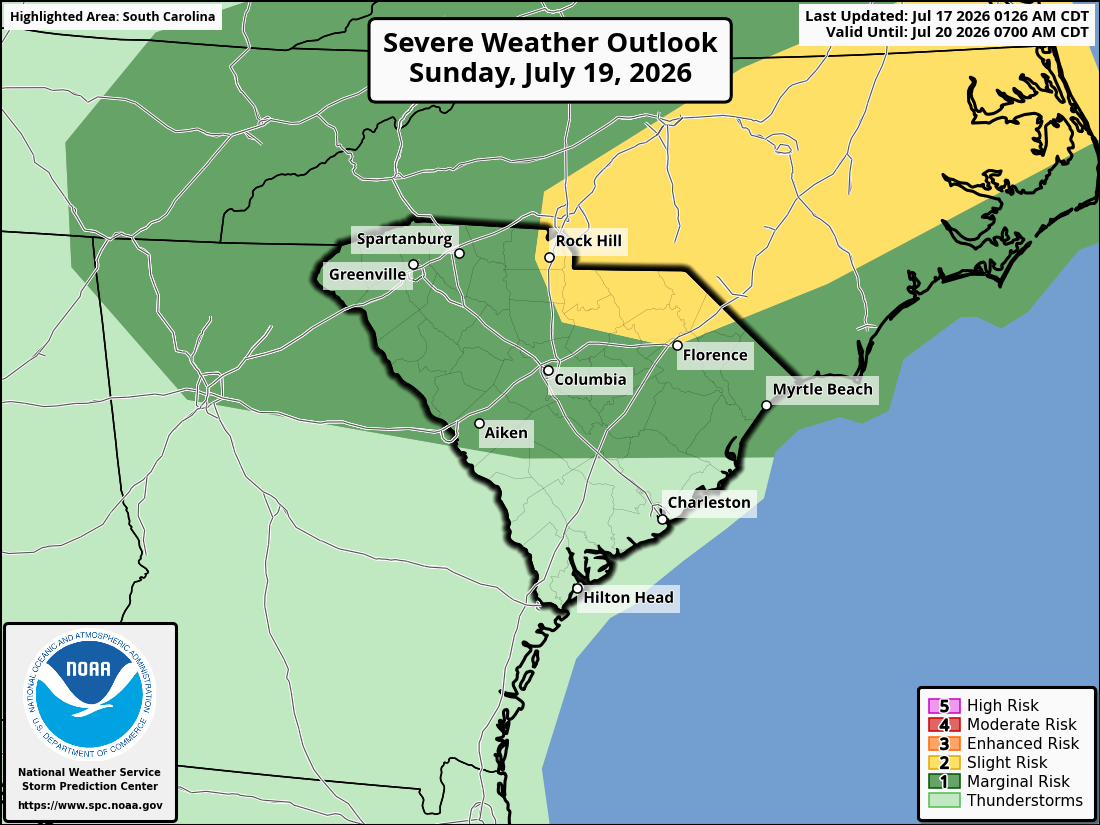
Here’s the Storm Prediction Center’s Day 3 Severe Weather Outlook for South Carolina, covering Sunday and Sunday night.
The front will become stationary and start to decay over us on Monday, so look for widespread showers and thunderstorms that could start to pop up before midday. Once again, a locally severe storm is possible. It will be the least hot day of the next few with highs only in the upper 80s and lower 90s.
Tuesday brings us less widespread thunderstorms and more heat; highs will be 90-95° across the state. However, the feature in the Gulf is the wild card for the day, as we’ll feel its impacts Monday night through Tuesday night if it tracks toward us. Our coastal areas are most likely to see it cooler and wetter; again, low-end wind, surge, rain and tornado risk is the worst-case scenario near our coast if the feature becomes a tropical cyclone.
On Wednesday, we have better-than-usual agreement among the computer models that another cold front will move in. The front is likely to bring showers and thunderstorms, and there is a chance of severe storms again if it moves through during the afternoon and evening.
We have a chance of unusually pleasant weather for at least part of the state later next week, as the weather pattern then will favor the cold front pushing much farther south than we typically see in July. Computer models tell us the front will stall to our south and east Thursday into Friday, allowing a drier air mass to move in with temperatures running near or slightly below average. 90° with low humidity is a pretty good deal for us in late July, so I’ll be rooting for that. However, climatology isn’t on our side, so don’t be surprised if the front stalls farther north and west than the models indicate, resulting in at least part of the state seeing scattered showers and thunderstorms. Of course, with most of the state still in a drought, more rain chances are a good deal, too.
On the satellite loop above, you’ll see areas of smoke from wildfires in Canada streaming by to our north. Some of it is sneaking into the Pee Dee; you may notice some haziness that way this afternoon. The smoke will mostly remain north of us through the weekend but it may shift southward toward us next week, especially later in the week.
Speaking of drought, if you have ever wondered how we define drought and its severity, I can tell you about an opportunity to learn more. The National Drought Mitigation Center (located at the University of Nebraska) will hold an online workshop to explain how the U.S. Drought Monitor works. If you’re interested, you can read more and sign up here: NDMC’s U. S. Drought Monitor 101 signup. The workshop will be held on August 13, from 3-4 p.m. Eastern Time.
Frank Strait
Severe Weather Liaison
S.C. State Climate Office


South Carolina Department of Natural Resources
260 D. Epting Lane
West Columbia, SC, 29172Stay Connected with SCDNR: 




SUBSCRIBER SERVICES:
Manage Subscriptions | Unsubscribe | HelpBe the first to comment!
What’s Happening At the Sea Pines Resort (July 2026), Harbour Town Yacht Basin, SC AICW MM 565
Harbour Town Yacht Basin, A CRUISERS NET SPONSOR, is ready for your reservation with newly renovated docks, upgraded electrical service and onSpot WiFi, also a CRUISERS NET SPONSOR. And, as always, numerous activities at the Sea Pines Resort are offered for your enjoyment, as you will see in the Event Schedule below. Hilton Head Island is absolutely marvelous any time of year.
Be the first to comment!
What’s Happening At the Sea Pines Resort (Aug 2026), Harbour Town Yacht Basin, SC AICW MM 565
Harbour Town Yacht Basin, A CRUISERS NET SPONSOR, is ready for your reservation with newly renovated docks, upgraded electrical service and onSpot WiFi, also a CRUISERS NET SPONSOR. And, as always, numerous activities at the Sea Pines Resort are offered for your enjoyment, as you will see in the Event Schedule below. Hilton Head Island is absolutely marvelous any time of year.
https://cruisersnet.net/wp-content/uploads/2026/06/August-2026-Sea-Pines-Events.pdf
Kerry Maveus
kmaveus@hunter-pr.com | www.hunter-pr.com
mobile: 831-917-2878
P.O. Box 1049 | Pebble Beach, CA | 93953
Be the first to comment!
Charleston SC250 Fireworks, TONIGHT, Charleston, SC

SALTY SOUTHEAST CRUISERS’ NET SPONSOR, Charleston Harbor Marina, would be a great place to dock your boat while you are visiting Charleston and to watch these fireworks. Charleston Harbor Marina sits on the Mount Pleasant side of Charleston Harbor, hard by Patriots Point between Horse Reach’s flashing buoys #34 and #36.
Good afternoon Charleston HSC,
Please find attached the MSIB 10-26 for the SC250 Fireworks Safety Zone. The event information is as follows:
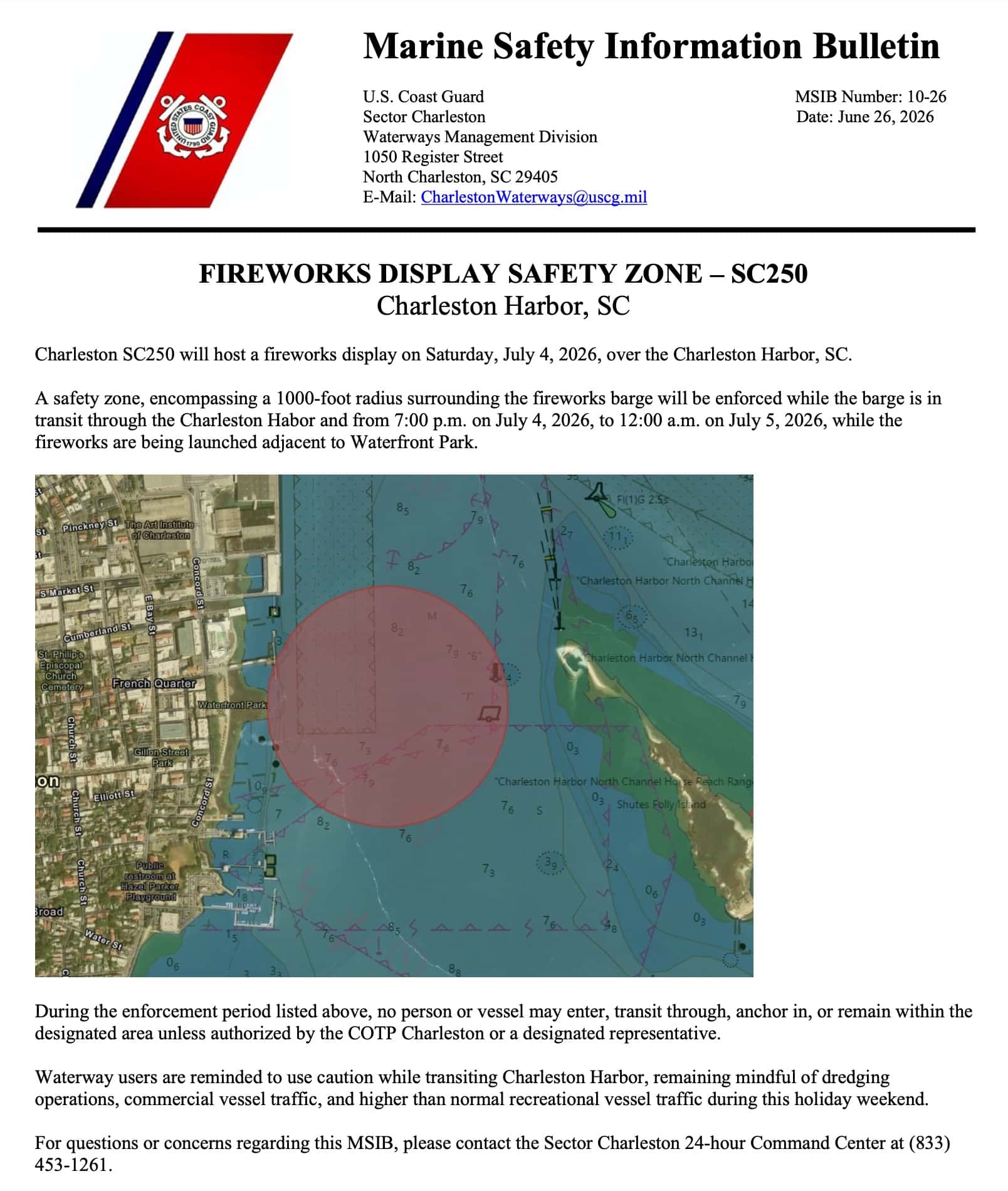
Charleston SC250 will host a fireworks display on Saturday, July 4, 2026, over the Charleston Harbor, SC. A safety zone, encompassing a 1000-foot radius surrounding the fireworks barge will be enforced while the barge is in transit through the Charleston Harbor and from 7:00 p.m. on July 4, 2026, to 12:00 a.m. on July 5, 2026, while the fireworks are being launched adjacent to Waterfront Park.
During the enforcement period listed above, no person or vessel may enter, transit through, anchor in, or remain within the designated area unless authorized by the COTP Charleston or a designated representative.
Waterway users are reminded to use caution while transiting Charleston Harbor, remaining mindful of dredging operations, commercial vessel traffic, and higher than normal recreational vessel traffic during this holiday weekend.
For questions or concerns regarding this MSIB, please contact the Sector Charleston 24-hour Command Center at (833) 453-1261.
Very respectfully,
LT Nicholas Jones
WWM Division Chief
USCG Sector Charleston
Nicholas.J.Jones@uscg.mil
O: 843-740-3184
C: 843-323-7761https://cruisersnet.net/wp-content/uploads/2026/06/MSIB-10-26_SC250-Fireworks_Safety-Zone_2026.pdf
Screenshot
Click Here To Open A Chart View Window, Zoomed To the Location of Charleston Harbor Marina
Be the first to comment!
North Charleston and Patriots Point Fireworks Events, TONIGHT, Charleston, SC
SALTY SOUTHEAST CRUISERS’ NET SPONSOR, Charleston Harbor Marina, would be a great place to dock your boat to watch the Patriots Point fireworks. Charleston Harbor Marina sits on the Mount Pleasant side of Charleston Harbor, hard by Patriots Point between Horse Reach’s flashing buoys #34 and #36.
Good afternoon Charleston HSC,
Please find attached MSIB 09-26 for the North Charleston and Patriots Point Fireworks Events. The event details are as follows:
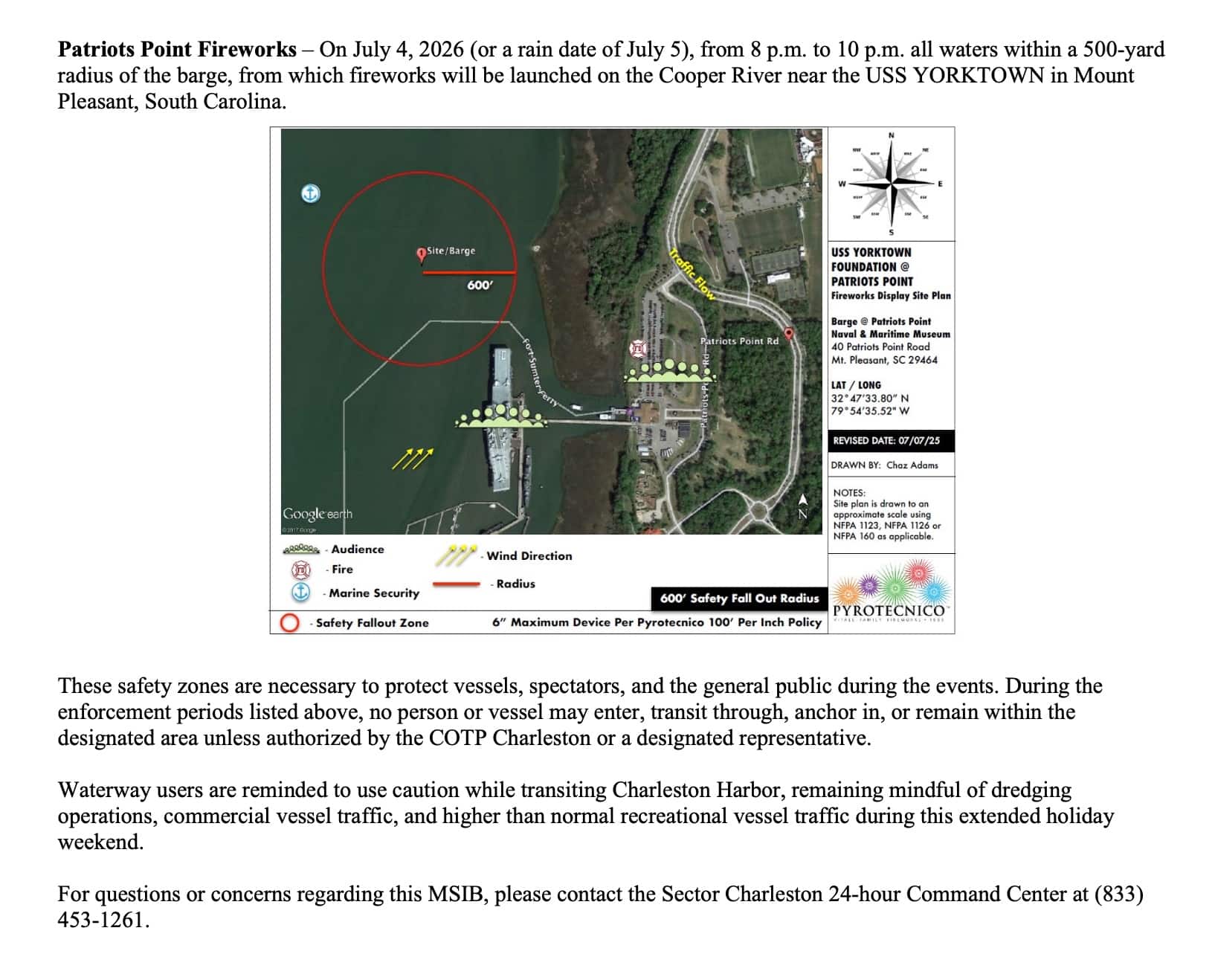
North Charleston Fireworks – On July 4, 2026 (or a rain date of July 5), from 9:00 p.m. to 9:30 p.m. all waters within a 100-yard radius of the barge, from which fireworks will be launched on the Cooper River near River Front Park in North Charleston, South Carolina.
Patriots Point Fireworks – On July 4, 2026 (or a rain date of July 5), from 8 p.m. to 10 p.m. all waters within a 500-yard radius of the barge, from which fireworks will be launched on the Cooper River near the USS YORKTOWN in Mount Pleasant, South Carolina.
These safety zones are necessary to protect vessels, spectators, and the general public during the events. During the enforcement periods listed above, no person or vessel may enter, transit through, anchor in, or remain within the designated area unless authorized by the COTP Charleston or a designated representative.
Waterway users are reminded to use caution while transiting Charleston Harbor, remaining mindful of dredging operations, commercial vessel traffic, and higher than normal recreational vessel traffic during this extended holiday weekend.
For questions or concerns regarding this MSIB, please contact the Sector Charleston 24-hour Command Center at (833) 453-1261.
Very respectfully,
LT Nicholas Jones
WWM Division Chief
USCG Sector Charleston
Nicholas.J.Jones@uscg.mil
O: 843-740-3184
C: 843-323-7761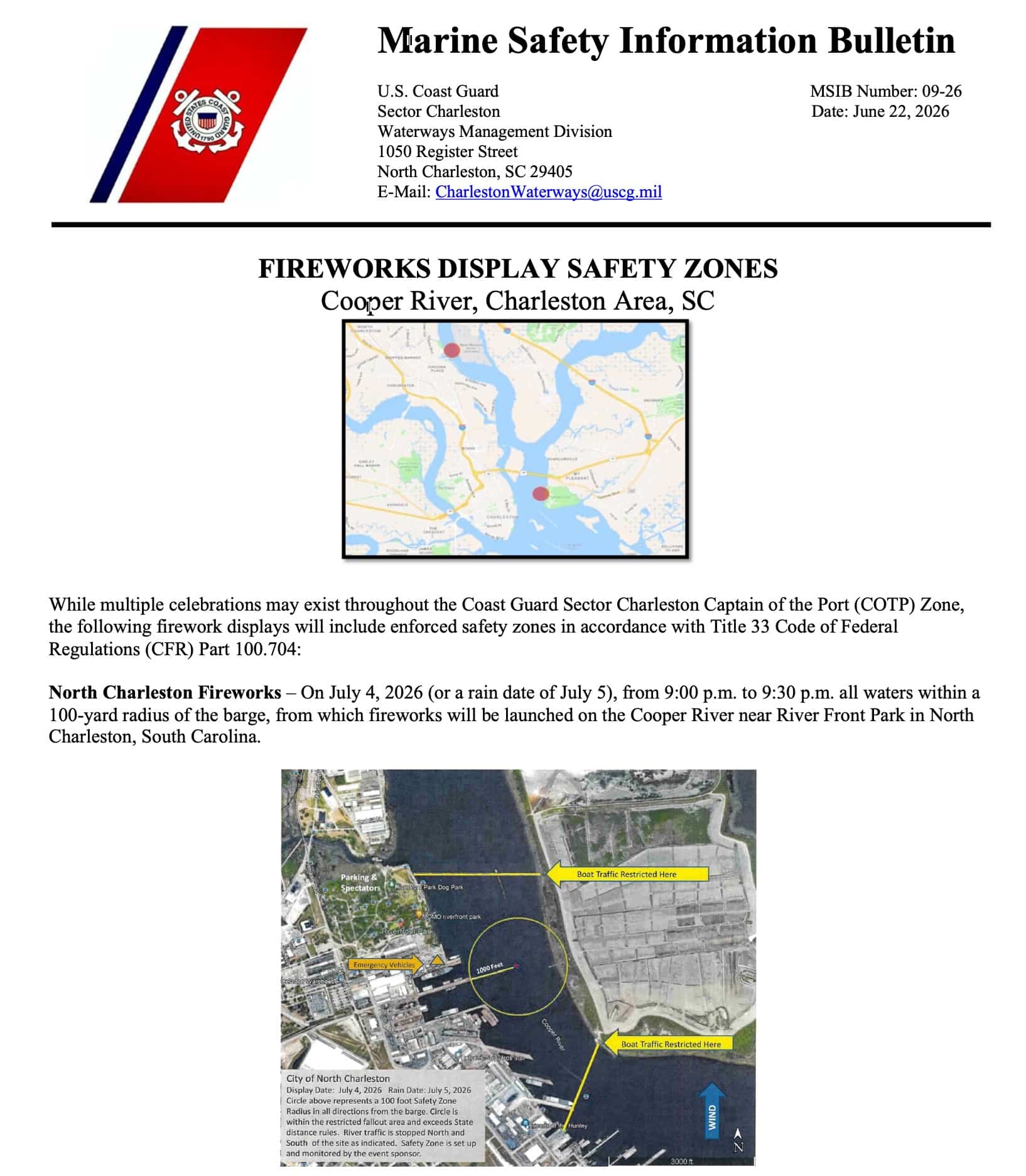
Screenshot
Click Here To Open A Chart View Window, Zoomed To the Location of Charleston Harbor Marina
Be the first to comment!
SKYWORX Drone Show. Charleston SC250, TONIGHT, Charleston, SC
SALTY SOUTHEAST CRUISERS’ NET SPONSOR, Charleston Harbor Marina, would be a great place to dock you boat to watch this Drone Show. Charleston Harbor Marina sits on the Mount Pleasant side of Charleston Harbor, hard by Patriots Point between Horse Reach’s flashing buoys #34 and #36.
Please find attached the Marine Safety Information Bulletin for the upcoming SKYWORX Drone Show. Charleston SC250 will host a drone show on June 26 and June 27, 2026. A safety zone, encompassing a 400’ by 700’ area around the drone show box will be enforced for the duration of the show, 7:00 p.m. to 10:00 p.m. on June 26th and from 9:00 p.m. to 9:45 p.m. on June 27th.
During the enforcement period listed above, no person or vessel may enter, transit through, anchor in, or remain within the designated area unless authorized by the COTP Charleston or a designated representative.
Waterway users are reminded to use caution while transiting Charleston Harbor, remaining mindful of dredging operations, commercial vessel traffic, and higher than normal recreational vessel traffic during this holiday weekend.
For questions or concerns regarding this MSIB, please contact the Sector Charleston 24-hour Command Center at (833) 453-1261.
Very respectfully,
LT Nicholas Jones
WWM Division Chief
USCG Sector Charleston
Nicholas.J.Jones@uscg.mil
O: 843-740-3184
C: 843-323-7761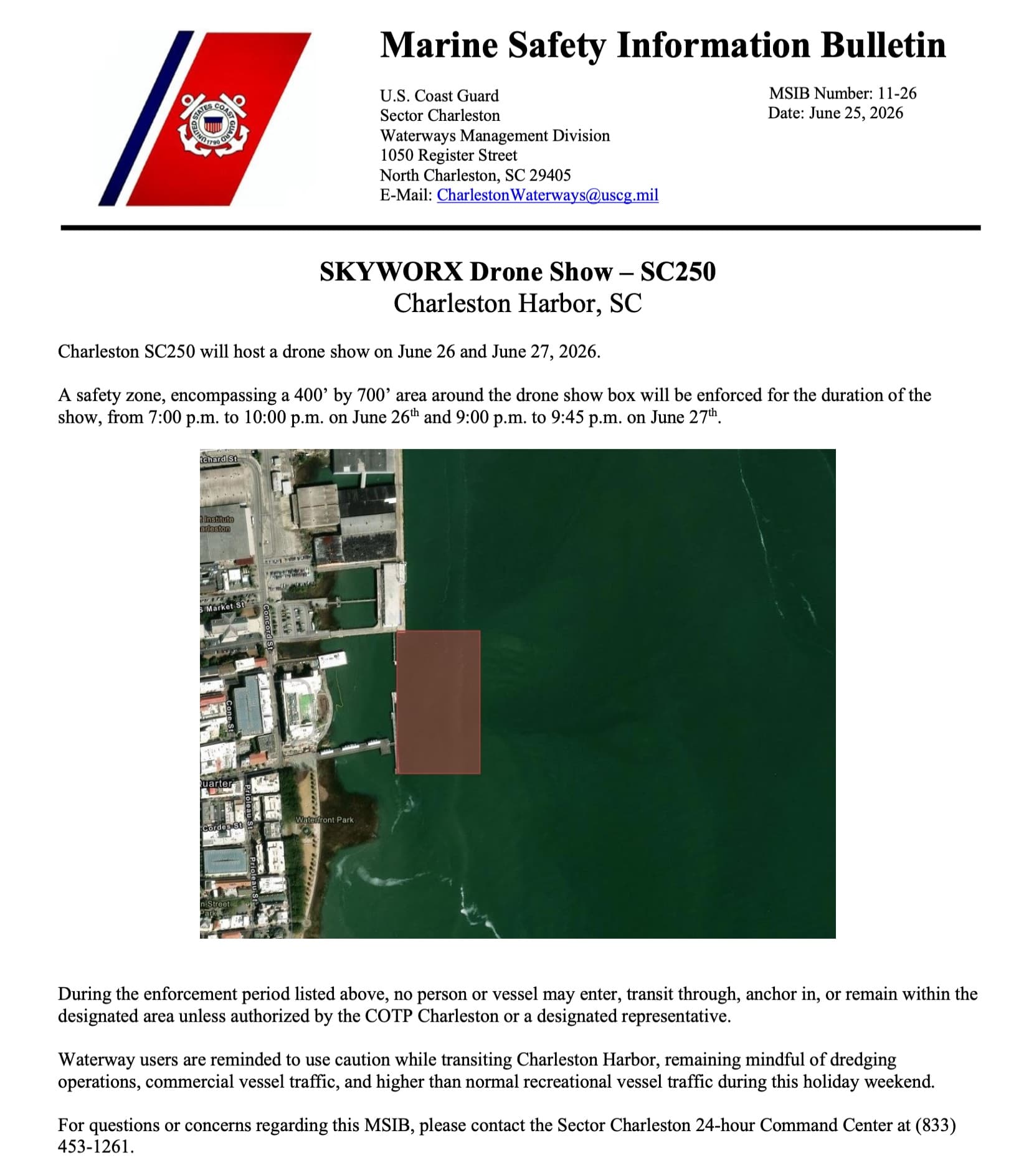
Click Here To Open A Chart View Window, Zoomed To the Location of Charleston Harbor Marina
Be the first to comment!
Charleston SC250 Fireworks, July 4, Charleston, SC
SALTY SOUTHEAST CRUISERS’ NET SPONSOR, Charleston Harbor Marina, would be a great place to dock your boat while you are visiting Charleston and to watch these fireworks. Charleston Harbor Marina sits on the Mount Pleasant side of Charleston Harbor, hard by Patriots Point between Horse Reach’s flashing buoys #34 and #36.
Good afternoon Charleston HSC,
Please find attached the MSIB 10-26 for the SC250 Fireworks Safety Zone. The event information is as follows:
Charleston SC250 will host a fireworks display on Saturday, July 4, 2026, over the Charleston Harbor, SC. A safety zone, encompassing a 1000-foot radius surrounding the fireworks barge will be enforced while the barge is in transit through the Charleston Harbor and from 7:00 p.m. on July 4, 2026, to 12:00 a.m. on July 5, 2026, while the fireworks are being launched adjacent to Waterfront Park.
During the enforcement period listed above, no person or vessel may enter, transit through, anchor in, or remain within the designated area unless authorized by the COTP Charleston or a designated representative.
Waterway users are reminded to use caution while transiting Charleston Harbor, remaining mindful of dredging operations, commercial vessel traffic, and higher than normal recreational vessel traffic during this holiday weekend.
For questions or concerns regarding this MSIB, please contact the Sector Charleston 24-hour Command Center at (833) 453-1261.
Very respectfully,
LT Nicholas Jones
WWM Division Chief
USCG Sector Charleston
Nicholas.J.Jones@uscg.mil
O: 843-740-3184
C: 843-323-7761https://cruisersnet.net/wp-content/uploads/2026/06/MSIB-10-26_SC250-Fireworks_Safety-Zone_2026.pdf
Screenshot
Click Here To Open A Chart View Window, Zoomed To the Location of Charleston Harbor Marina
Be the first to comment!
North Charleston and Patriots Point Fireworks Events, July 4, Charleston, SC
SALTY SOUTHEAST CRUISERS’ NET SPONSOR, Charleston Harbor Marina, would be a great place to dock your boat to watch the Patriots Point fireworks. Charleston Harbor Marina sits on the Mount Pleasant side of Charleston Harbor, hard by Patriots Point between Horse Reach’s flashing buoys #34 and #36.
Good afternoon Charleston HSC,
Please find attached MSIB 09-26 for the North Charleston and Patriots Point Fireworks Events. The event details are as follows:
North Charleston Fireworks – On July 4, 2026 (or a rain date of July 5), from 9:00 p.m. to 9:30 p.m. all waters within a 100-yard radius of the barge, from which fireworks will be launched on the Cooper River near River Front Park in North Charleston, South Carolina.
Patriots Point Fireworks – On July 4, 2026 (or a rain date of July 5), from 8 p.m. to 10 p.m. all waters within a 500-yard radius of the barge, from which fireworks will be launched on the Cooper River near the USS YORKTOWN in Mount Pleasant, South Carolina.
These safety zones are necessary to protect vessels, spectators, and the general public during the events. During the enforcement periods listed above, no person or vessel may enter, transit through, anchor in, or remain within the designated area unless authorized by the COTP Charleston or a designated representative.
Waterway users are reminded to use caution while transiting Charleston Harbor, remaining mindful of dredging operations, commercial vessel traffic, and higher than normal recreational vessel traffic during this extended holiday weekend.
For questions or concerns regarding this MSIB, please contact the Sector Charleston 24-hour Command Center at (833) 453-1261.
Very respectfully,
LT Nicholas Jones
WWM Division Chief
USCG Sector Charleston
Nicholas.J.Jones@uscg.mil
O: 843-740-3184
C: 843-323-7761
Screenshot
Click Here To Open A Chart View Window, Zoomed To the Location of Charleston Harbor Marina
Be the first to comment!
Weather Alert – Tropics Quiet, Get Ready To Roast, SCDNR

Weather Alert – June 26, 2026
Tropics Quiet
The Atlantic tropics remain quiet today and are likely to stay that way for a while, at least through Independence Day. A few tropical waves are present: one over the western Caribbean Sea near 80° west, another east of the Lesser Antilles, slanted between 45° and 50° west, and the third over the eastern tropical Atlantic near 28° west.
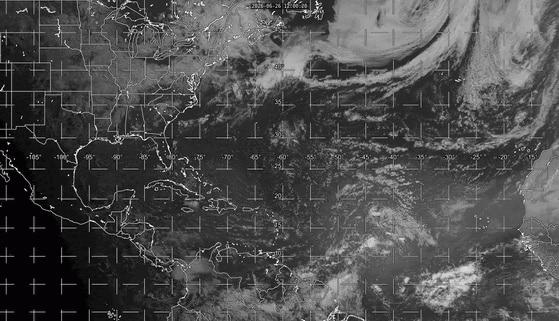
This loop of visible satellite images shows the weather features of interest
over the Atlantic Basin today.Image Source: University of Wisconsin RealEarth
None of these waves shows any promise for development; strong westerly winds aloft are causing vertical shear over the entire Atlantic Main Development Region (the area between 10° north and 20° north), and sinking air is present over the Atlantic as well, thanks to the Madden-Julian Oscillation.
So, it’s no surprise that no computer models indicate a significant chance for any developments in the deep tropics over the next two weeks. If we were to see a tropical cyclone form, it would come from spins developing along stationary fronts off the East Coast over the Gulf. The odds of this happening are low.
We’re always happy to see tranquility in the Atlantic tropics, and we hope it stays that way. However, it’s a long hurricane season, and we just got started. It’s important to be ready for the risk we face from hurricanes, and if you need readiness advice, SCEMD has you covered at hurricane.sc.
SC Weather Highlights for the next week or so:
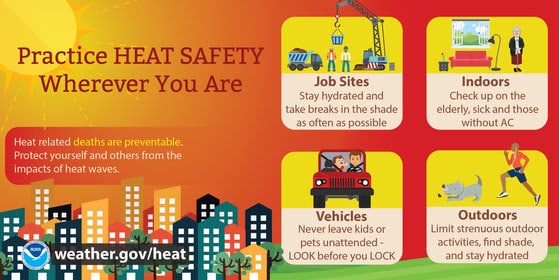
The big story for us, as well as our neighbors in this part of the country, will be the intense heat that we’re about to see. A strong upper-level ridge (a northward buckling of the jet stream) will form over this part of the country over the weekend and early next week; it will suppress thunderstorms and promote above-average temperatures until it breaks down about a week later.
Translation: It’s about to turn into Satan’s back porch ’round these here parts.
Today we’re under the influence of an upper-level disturbance that likely brings us widespread afternoon and evening showers and thunderstorms. The severe storm risk is low but not zero.
Temperatures tick upward on Saturday with sparse coverage of afternoon showers and thunderstorms. Highs will mainly be in the lower to middle 90s around the state.
Sunday looks even hotter, with 95-100° highs for most of the state, the Upstate looks slightly less hot; the heat index will peak at 105-110° across most of the state.
A weak cold front moves in Sunday night, becomes stationary, then fizzles out Monday into Monday night. That will generate a scattering of showers and thunderstorms. This results in a less-hot Monday, with highs mainly in the lower to middle 90s. Thunderstorm coverage will be lower on Tuesday; perhaps it’s slightly hotter as a result.
After that, the misery begins in earnest; the upper ridge will suppress thunderstorms and promote intense heat from Wednesday through at least Independence Day. Here’s the forecast highs for Thursday from the National Weather Service, which is as far out as their specific forecasts go:
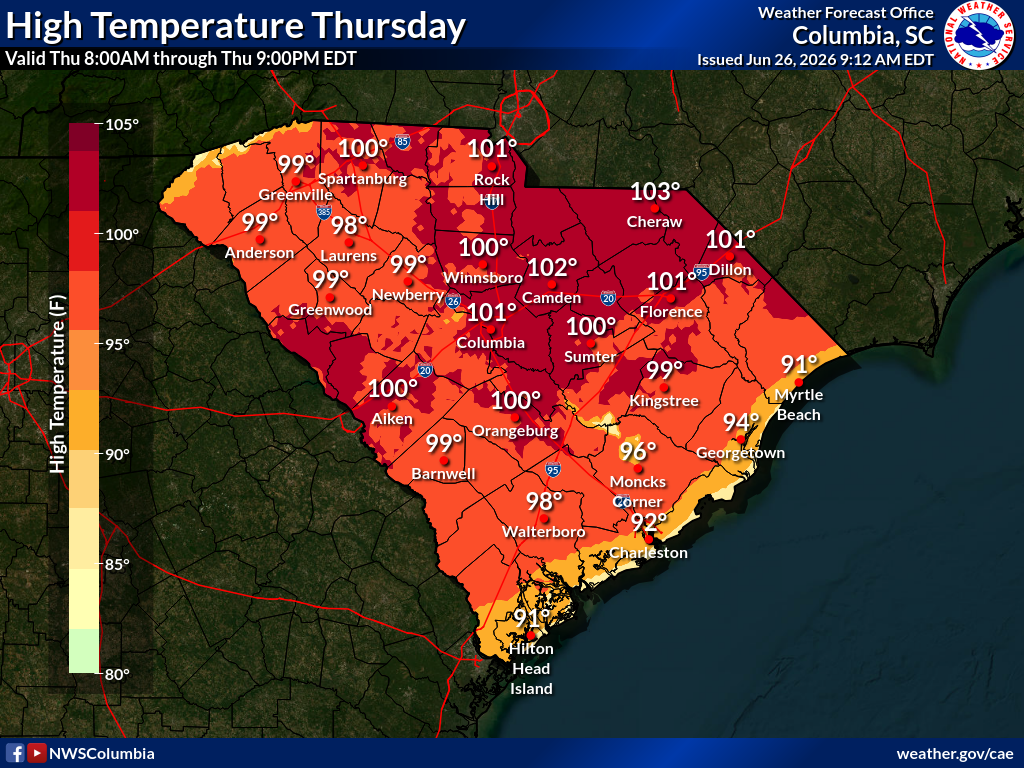
Friday and Independence Day could be even hotter. The computer models show the hot weather pattern will break down after that, but disagree on when. Some say we’ll cool down starting next Sunday, some keep us searing on the grill through around next Tuesday. Either way, we’re all going to be well done by the time the upcoming heat wave ends.
Frank Strait
Severe Weather Liaison
S.C. State Climate Office


South Carolina Department of Natural Resources
260 D. Epting Lane
West Columbia, SC, 29172Stay Connected with SCDNR: 




SUBSCRIBER SERVICES:
Manage Subscriptions | Unsubscribe | HelpBe the first to comment!






Social Media Auto Publish Powered By : XYZScripts.com
Be the first to comment!